

Skills shortages mean UK manufacturers cannot hire their way out of late projects. Pricing each week of delay shows where scarce engineering hours earn most.
Ask a director of engineering what one week of delay costs on their most important project. Almost nobody can give you a number. Yet November is when most manufacturers sign next year’s plan: launch dates, customer commitments, hiring budgets. Every one of those decisions is a bet on weeks that nobody has priced.
The bet is getting harder to cover. Make UK’s Executive Survey 2026 puts live manufacturing vacancies at 48,000, and Make UK research finds nearly three-quarters of manufacturers see a shortage of technical skills as the biggest barrier to recruitment. Hiring will not rescue a 2027 plan that assumes more engineers than you have. Deciding where their weeks go will. That is the test any manufacturing project management software should pass: can it put a price on a week of delay before the plan is signed, not just report the delay after it lands?
Not every week costs the same
A late week is not a fixed cost. On some projects, a week of slip costs nothing. The customer date has slack, or the next stage is not ready anyway. On others, the same week costs tens of thousands. A launch misses its season. A penalty clause starts to run. Revenue planned for March arrives in June.
The cost rarely rises in a straight line, either. It climbs in steps. Miss a trade show, a customer’s installation window or a model-year change, and one late week becomes a lost quarter.
Most portfolios treat both weeks alike. Projects are marked red, amber or green, and every red looks equally urgent. So the order of work is set by whoever pushes hardest at the Monday meeting. It is rarely set by what the week is worth.
The expensive weeks queue in one place
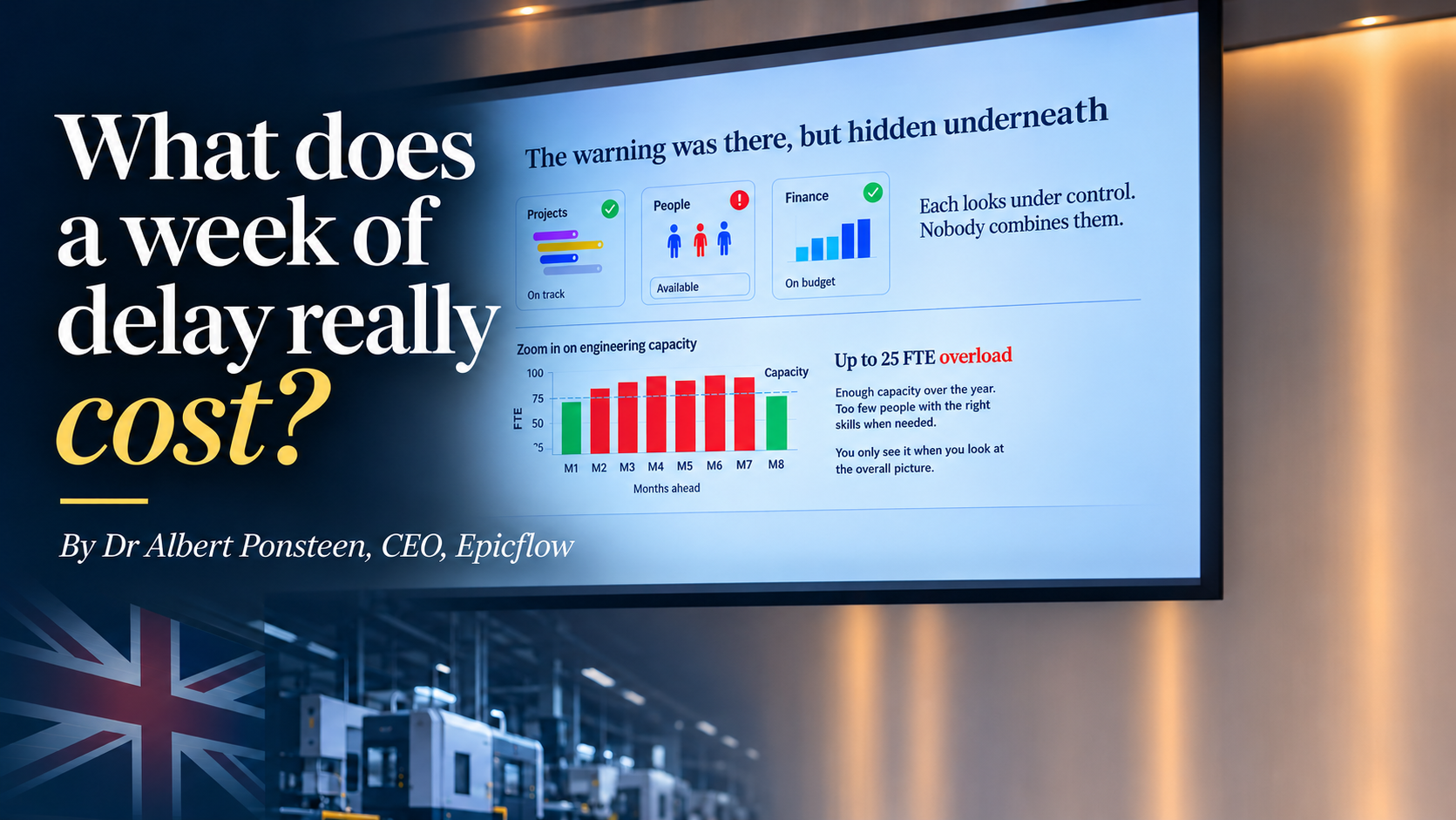
In most engineering-led manufacturers, the costly weeks gather in front of one team. It might be controls engineering, electronics design or test and validation. Every new product and every engineer-to-order job passes through it. When that team is overloaded, everything behind it waits. The waiting is where the money goes.
Extra effort elsewhere does not help. A faster mechanical design team only lengthens the queue at the bottleneck. A week saved upstream is worth nothing if the job then waits a fortnight for the same three specialists. The only weeks worth buying are the ones at the bottleneck.
This is why pricing the week matters more than tracking it. A plan built around the people you actually have shows when each project will really finish. Put a value on those dates, and you can see which week of waiting costs most, and which costs nothing.
Five steps to price the week before you sign 2027
- Name the team everything waits on. Look at last year’s late projects. Ask which specialists they were waiting for. It is usually the same few names.
- Forecast with the people you have. Build next year’s plan on the real availability of that team, not on the headcount the budget hopes for. The dates will move. That is the point.
- Put a price on each project’s week. Use figures finance already holds: margin per month on the market, penalty clauses, launch windows, payment milestones. A product that will earn £100,000 a month in margin loses around £23,000 for every week it ships late. A rough number beats no number.
- Give the bottleneck’s hours to the most expensive week. Let the cheap weeks wait. Write down why, so the decision survives the next escalation.
- Spend only where the week is expensive. Overtime, subcontractors and automation pay back at the bottleneck. Elsewhere they add cost and no output. Before any spend, ask three questions. Is anything waiting on this work? Does the wait cost real money? Can someone, or something, else do it well?
What it looks like in practice
Arnold AG, a German specialist in high-end metal products, builds elements for superyacht manufacturers. Its project managers each planned in their own way. Due dates were hard to promise, and nobody could say what an extra order would do to capacity.
Once every project sat in one plan built around real capacity, the bottlenecks became visible. So did capacity nobody knew the company had: room for extra projects at short notice. The result, for this Epicflow customer, was more output without extra labour cost.
The money follows the same logic at portfolio level. On a sample portfolio of late projects and overloaded teams, a $330,000 loss became nearly $1.3 million of profit. Nothing about the work changed. The decisions did.
Before you sign 2027
2027 will not bring the engineers your plan needs. It can bring better decisions about the ones you have. Find the weeks that cost money, see which team they queue for, and price them while the plan can still change, not after the penalty lands.
Start with one question at your next planning review: what does a week of delay cost on our most important project? If nobody can answer, fix that before 2027 is signed.
Author: Dr Albert Ponsteen, CEO, Epicflow