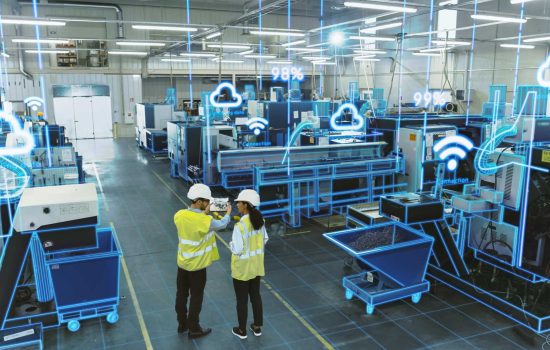


In the Conan Doyle story ‘Silver Blaze’, Sherlock Holmes famously refers to ‘the curious incident of the dog in the night-time’. The incident is ‘curious’ because of something that did not happen: a dog which did not bark. The promise of AI in industry is that it will produce a stream of curious incidents: machines which do not break down before the maintenance team inspects them, defective products which are prevented from being made, materials which avoid being dumped in the waste container. In theory, AI is the magic eye which discovers emerging problems and inefficiencies hidden in complex patterns of data, and alerts operators to fix them. John Mackey, Head of Automation Sales, WAGO UK & Ireland explains more.
But AI cannot work its magic in thin air: to be able to analyse repeating patterns, it needs a stable and measurable set of processes to produce training data. And when AI software recommends process improvements, the operator needs a way to implement them systematically and reliably in the physical world. Both requirements highlight the crucial role of automation equipment as the foundational layer underpinning the use of AI in industry.
Key takeaways
-
Why does industrial AI need automation?: AI needs consistent, reliable data to identify patterns, detect problems and recommend improvements. Automation provides controlled, repeatable processes that generate the high-quality data AI needs to work effectively.
-
How does automation improve the effectiveness of AI?: Automation reduces human error and process variation, making it easier for AI to identify inefficiencies. It also ensures that AI-recommended improvements can be implemented consistently and reliably.
-
What role do digital twins play in industrial AI?: Digital twins allow manufacturers to simulate real-world industrial processes in a virtual environment. This enables operators to test AI-driven improvements, assess risks and understand potential benefits before making changes on the factory floor.
-
Can manufacturers use AI with existing legacy equipment?: Yes. Multi-protocol PLCs and I/O systems can connect older equipment using protocols such as Modbus and Profibus with modern communication standards such as OPC UA, MQTT and Ethernet. This avoids the need for costly, large-scale equipment replacement.
-
How can manufacturers adopt AI cost-effectively?: By focusing on improving data collection and connectivity through multi-protocol automation equipment, manufacturers can integrate AI into existing operations. This protects investments in legacy equipment, minimises disruption and helps unlock improvements in productivity, efficiency and reliability.
The importance of repeatable, controllable processes
AI works by studying repeating patterns, and finding common elements and anomalies in them. For chatbots which can converse with human users, the stable environment is provided by text, on which large language models (LLMs) are trained. In an industrial context, it is automation equipment which produces the stable environment. Modern operational technology (OT), which allows operators to monitor, measure and control industrial processes in a systematic and repeatable way, provides the platform on which AI-derived improvement strategies should be based.
If left to human operators to control the temperature of a flow of molten cocoa in a chocolate factory or the pressure applied to a workpiece in a foundry, the process will have excessive random variation. An AI model will find it difficult to see any signal in the process data through the noise of the human influence. Even if AI could detect ways to reduce waste or increase throughput, a manual system would not be able to implement it consistently and systematically, severely blunting its impact.
Automation equipment ensures that processes are precisely controlled and exactly repeated, time after time after time. This allows the operator to generate a clean stream of data on which to train an AI model. It also means that when the AI recommends changes, they will be implemented consistently, allowing the operator to monitor their impact and to benefit in full from any improvements that AI can make to process efficiency, quality or speed.
Modern automation systems also have another helpful trick up their sleeve: by enabling the generation of a digital twin of a real-world industrial operation, they allow the operator to simulate the operation of AI systems in a safe software space. This means that the operator can virtually monitor the effect of implementing AI-driven changes, and assess the risks and benefits before committing to any expenditure or changing any processes on the factory floor.

Transporting process data with legacy equipment
Automation equipment, then, produces a comprehensive stream of repeatable data on which to train an AI model. But for this data to reach an IT data repository, it needs to be transported from end points such as sensors, actuators and valves through controllers and gateways to the IT network. But in the installed base of most legacy equipment, the end points will have been chosen primarily for their ability to perform a specific physical function, not for their compatibility with a modern communications protocol. This creates a potential data networking problem: how can an industrial company transfer operational data across an OT/IT system which supports different protocols, with some operating on older protocols such as Modbus or Profibus while others support OPC UA, MQTT, Ethernet or HTTP(S)?
There is no economic case for scrapping a whole generation of legacy equipment and replacing it with an all-new installation just to standardise on a uniform data-sharing platform. In fact, there is no need for such upheaval, since many suppliers of advanced industrial automation equipment build multi-protocol capability into their products. PLCs and I/Os which support open, standard protocols allow factory system designers to build a unified data pipeline from a heterogeneous mix of legacy and new automation equipment.
This allows operators to harvest consistent data from every part of an industrial process and feed it into an AI’s training dataset, while maintaining their investment in legacy equipment and avoiding the disruption entailed in the wholesale replacement of an entire automation system.
Gaining more value from existing assets
AI promises substantial improvements in productivity, efficiency and reliability in industrial operations, but its implementation can appear daunting when most equipment in use today was made for a world before AI agents such as ChatGPT existed. In fact, legacy equipment does not prevent factory operators from implementing AI: by focusing attention on gathering data through multi-protocol controllers and I/Os, engineers can put AI software to work at a minimal equipment cost and with little physical disruption.
For more articles like this, visit our Automation channel