

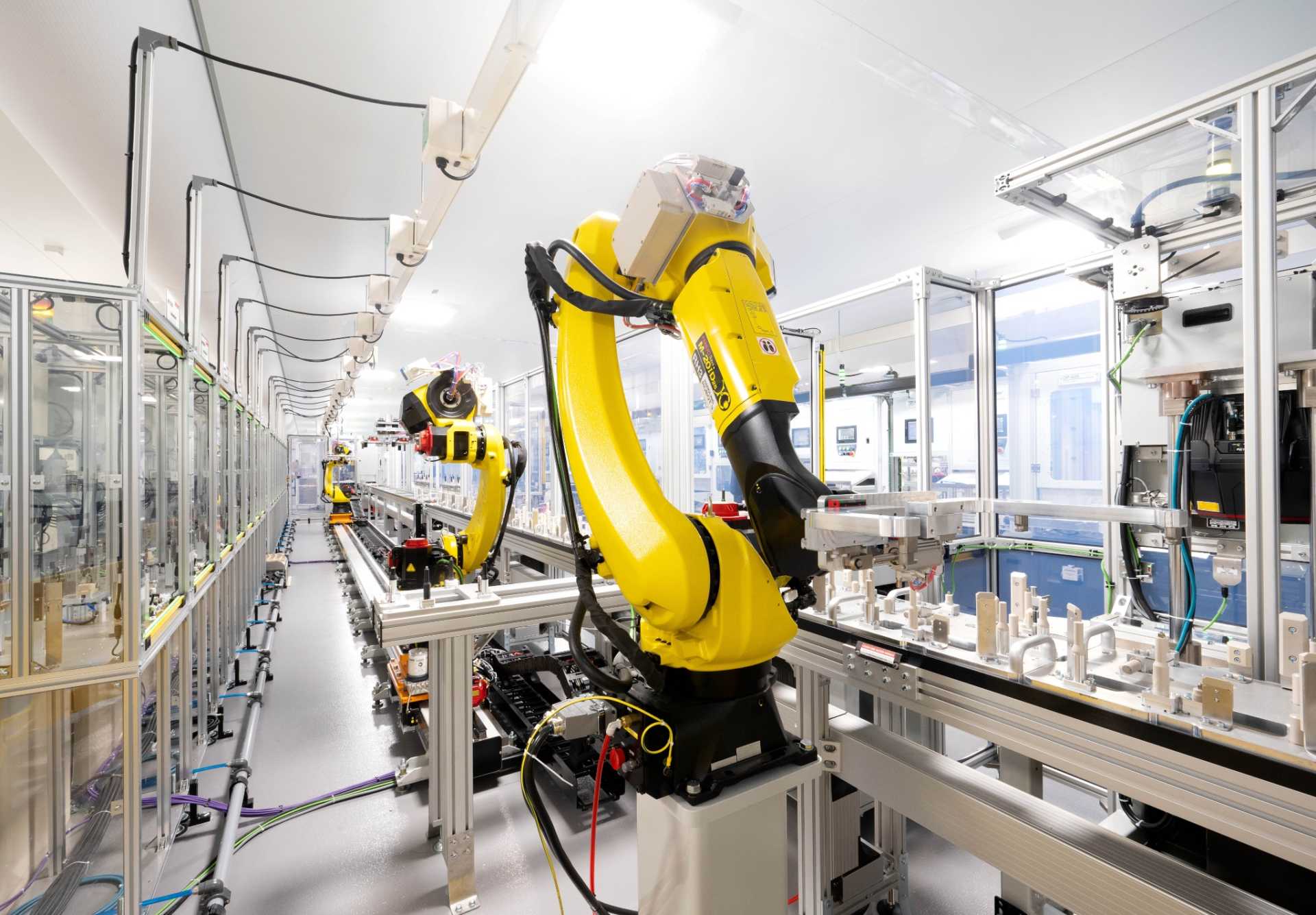
A £100m redevelopment by global automotive component business Astemo to its UK manufacturing plant is on track to finish next April as planned, and is already attracting interest from potential new customers.
The site – in Bolton, Lancashire – will house two new inverter production lines to support the next generation of electric vehicle (EV) powertrains. The upgrade is scheduled to create 125 new jobs and safeguard another 100. More than 20 roles have already been filled, with recruitment for the remainder underway.
This is great news for Astemo and the North West region. What we are building in Bolton will support future quoting opportunities and potential growth for Astemo.
Lee Owens, UK Managing Director, Astemo
News of the redevelopment work was first announced in July 2025 – exactly a year ago. Since then, several major project milestones have been hit. They include:
- Around 80% of site by footprint upgraded to accommodate new production lines and supporting infrastructure
- First inverter production line installed and commissioned on time
- Pre-production builds for contracted OEM customer achieved on time
The news coincided with a site visit from two senior leaders of the Astemo business, Mathieu Devillard, Executive Vice President, Head of Electrification Business, who is based in Japan, and Doug Bowling, Regional Head of Europe.
They were hosted in Bolton by Lee Owens, Astemo UK Managing Director, who said: “Twelve months on from the first announcement of this upgrade, start of production for our contracted OEM customer remains on target for April 2027. Furthermore, creation of what will be state-of-the-art production facilities, staffed by highly trained new personnel, continues to attract attention from the wider UK automotive industry. This is great news for Astemo and the North West region. What we are building in Bolton will support future quoting opportunities and potential growth for Astemo.”
Mathieu Devillard added: “It is amazing to see the progress which has been made since I last visited the Bolton site. Astemo globally manufactures advanced mobility, powertrain, and chassis systems across more than 100 sites. The Bolton investment marks the fourth country in which we manufacture innovative EV components, following Japan, the US and China.”
Andy Burnham, former Mayor of Manchester and now UK Prime Minister, has been a key supporter of the project since its inception. He previously met Mathieu during a regional trade mission to Japan, and has commented publicly on the impact the development will have on the local economy.
The two new Bolton production lines can manufacture more than a million inverters every year. Astemo UK’s next-generation inverters have been purpose-engineered to deliver excellent efficiency, while being both compact and lightweight for easy powertrain integration. By manufacturing the equipment in Europe, the product will comply with the green procurement policies of major regional OEMs and can contribute to an overall reduction in Scope 3 emissions throughout the supply chain.
It is amazing to see the progress which has been made since I last visited the Bolton site… The Bolton investment marks the fourth country in which we manufacture innovative EV components, following Japan, the US and China.
Mathieu Devillard, Executive Vice President, Head of Electrification Business, Astemo
The Bolton investment – which is valued at more than £100m in total – is backed by the UK government via the Automotive Transformation Fund (ATF), led by the Department for Business and Trade in partnership with the Advanced Propulsion Centre. Under the government’s DRIVE35 programme, the ATF will continue to unlock private investment in strategic zero-emission vehicle technologies in the UK.
Key suppliers for all renovation works, plus the creation of a new cleanroom on site, were from the UK’s north-west region. However, the project is global in nature, with resources from Astemo operations across Japan, China and mainland Europe used to support the design, manufacturing and programme management.
Astemo’s Bolton site first opened in 1997 and was previously extended in 2007. It has produced a varied portfolio of alternators, throttle bodies and pumps for the automotive industry. For more than 20 years the core business was air flow sensors and electronic control units (ECUs), while production of Advanced Driver Assistance Systems (ADAS) components began in 2020. Air flow sensors and ECU production has now ended to enable the site to focus on inverters.
Q&A with Mathieu Devillard and Lee Owens
What have been the key factors in the redevelopment and what milestones are still left to hit?
LO: We’ve had to go through the initial build with the customer OEM. We installed a full world-class clean room, which takes up around 60% of our facility on the manufacturing shop floor. For the volume required for the OEM, we need two production lines. One of these are for main assembly, and one is for a surface mount technology line, which is basically a PCB population line. Both of them are now installed, and we’re producing initial builds for the customer.
The next milestone is installing the second line. The PCB population line will be installed in September/October, and the second assembly line will be installed by December. That gives us enough opportunity to mature the line ready for the standard operating procedure (SOP), which will commence in April 2027.
Why was Bolton selected for this development?
LO: We’ve got a fantastic team here which provides the right foundation in terms of our knowledge and experience. The plant was established in 1997 and has gone through multiple iterations around components, from alternators to variable displacement pumps, through to electronic control units.
The footprint in Bolton also ties in well with the fact the OEM is based in Europe. The support from the global team gave us the opportunity to develop the plant and we’ve also had a visit from the OEM directors, and they were very complimentary and supportive of the business being in the Bolton plant.
MD: The decision was fairly easy, based on the fact that Astemo don’t currently have electronic plants in Europe. We have them in Japan, China and the US, so this is the fourth region where we will set up this capability. But Bolton has a great track record of quality control electronics and the customer was also very happy with that.
It’s easier to bet on a plant which has a strong track record. They’re not easy to build, so having that reassurance is very important when it comes to decision time. Once the power electronics business is set up we anticipate it will usher in new business. This development is obviously not a one-off; we wouldn’t invest in a plant, and set it up to manufacture power electronics just for a one-time programme. So the whole ball game now is to make sure this continues for years to come, and we trust the team to do that?
What skills will be required to fill the new jobs that are being created on-site?
LO: The roles, which are both direct and indirect, are quite diverse. The key focus for recruitment was initially around technical skills in automation, engineering and quality functions, where we have had some success with regards to recruiting.
As we go through the rest of the requirements, we will look at the various local recruitment opportunities in relation to when we need to bring people in and what we do in regards to development, training and support to get the right people on the ground in Bolton.
We’re also linked closely to universities, and we’re looking closely at what we do in regards to graduate support as well as apprenticeships, to make sure that we’ve not only got the right level of people being integrated into the business, but that also we have the required capabilities coming through behind them.
What resiliency has been built into the project against future disruption in the supply chain?
MD: This is a project that is already in development, is proven and we’re dealing with good volumes for the OEM, so we’re pretty safe in terms of resiliency right now. More broadly the market situation is rocky. It’s a very bumpy ride for everyone, so we need to make sure that we find the right counter measures going forward.
In the past we have experienced projects that were cancelled in the US, but for many reasons, this is not the same context. The European market is not the same as the US and this platform in particular is something where we have a proven track record of success, so we are confident.
What’s the biggest challenge of this redevelopment?
LO: From a UK side, what we say is we’re building a plant within a plant. Normally a project of this scale would be developed on a greenfield site. However, we had a brownfield site which we’ve had to put a greenfield site into. That means we’ve had to reshuffle, reorganise, retrain, restructure and re-strategise, so the complexity of the installation and integration has been our biggest challenge, and we’re just coming out of the other side of that.
DM: Programme development in the automotive industry is a long journey with ups and downs every day. What is certain is that the team is up for the challenge; they have the energy, stamina and the dynamism to take on any challenges that come our way.
Everything is done in a very coherent way. We are investing in people, the environment and we’re making sure the community is happy to welcome and support us which is very important. And we make sure we have the support from other global plants who have undergone similar launches in the past. Currently in Bolton we have some expatriated people from Japan and the US who have been working on very similar projects.
What’s it like having the backing of new Prime Minister Andy Burnham?
LO: We’ve both had the pleasure of meeting Andy Burnham and he’s been a very big advocate of the potential in Bolton originally, but now the execution. He was involved in the early phases and discussions and he was really pleased with the support for the project, not just from the UK, but also from the Japan investment side. That was one of our key drivers; building that relationship between Osaka and Manchester. He’s been very positive for the Bolton plant, not only in terms of getting the investment, but also having the opportunity to grow going forward.
For more articles like this, visit our Innovation channel