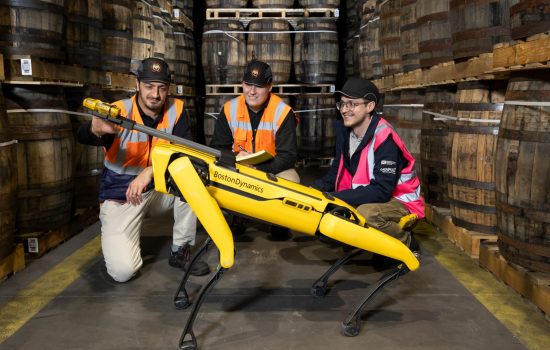


The Manufacturer recently covered a story about a robotics project taking place at the Bacardi-owned John Dewar & Sons maturation site near Glasgow. Supported by The National Manufacturing Institute Scotland (NMIS) and the Scotch Whisky Research Institute (SWRI), the project is deploying a robotic dog to detect expensive ethanol vapour leaks in whisky casks. We caught up with Angus Holmes, Whisky Category Director at Bacardi, to find out more.
Ethanol evaporation is a natural part of the whisky maturation process, which happens as the liquid sits in the barrel to age. This loss is known as the ‘angel’s share’ – which can be up to two per cent of the cask annually in cooler climates like Scotland – and requires careful monitoring to ensure as much liquid as possible is kept in the barrel, as well as ensuring safety.
Key takeaways
-
Automation is tackling the ‘angel’s share’ without compromising craft: John Dewar & Sons is using a robotic dog to detect ethanol vapour leaks in whisky warehouses, targeting exceptional losses rather than eliminating natural evaporation that’s essential to flavour development.
-
Scale makes manual inspection impractical: With thousands of casks stored across multiple warehouses, manually detecting leaks would require huge labour resources. Automation makes continuous, consistent monitoring feasible at Bacardi’s scale.
-
Robotics + sensors = data-driven efficiency and safety: The robot dog, equipped with ethanol sensors via a 3D-printed arm, demonstrates how robotics can improve operational efficiency, reduce safety risks, and generate data humans simply couldn’t gather alone.
-
Innovation is being layered onto tradition, not replacing it: Bacardi is explicit that robotics and AI are tools to support distillers, blenders, and warehouse teams — not to interfere with flavour creation or centuries-old whisky-making practices.
-
The approach has global and sustainability potential: Reducing whisky losses lowers waste, carbon impact and production intensity. The same technology could be scaled to warehouses worldwide and adapted for rum and tequila operations, as well as other manufacturing inspection tasks.
FAQs
- Why is automation being introduced in Scotch whisky warehouses? With thousands of casks maturing across Scotland, manually checking for ethanol leaks is inefficient. Robotics and sensors help distilleries track evaporation, improve safety, and reduce losses without affecting traditional whisky-making methods.
- How does the robot dog work? It uses a sensor attached to a 3D-printed arm to measure ethanol vapour levels as it follows a defined path through the warehouse. The data helps pinpoint casks with higher-than-normal evaporation.
- Will automation change the whisky-making process or flavour? No. The goal is not to alter the craftsmanship or flavour of the whisky. Automation is used only to monitor losses and improve efficiency, safety, and sustainability.
- What are the broader benefits for Scotland’s whisky sector? By reducing losses, improving efficiency and lowering carbon impact, automation supports sustainability and helps protect jobs. The Scotch whisky industry contributes significantly to Scotland’s economy, supporting 41,000 jobs and generating £3 in every £100 of Scotland’s total GVA.
- Does this technology have applications beyond whisky? Yes. The same robotics and sensing approach could be applied to other inspection tasks in different manufacturing environments, including Bacardi’s rum and tequila warehouses, improving efficiency and reducing waste globally.
John Dewar & Sons is one of the biggest whisky companies in the world and due to the nature of whisky production, stores huge amounts of whisky casks all over Scotland, including at the company’s dedicated palletised warehouse in Glasgow.
“For a spirit to legally become Scotch whisky, it needs to be matured in oak casks for a minimum of three years, and as such, we have many warehouses of ageing spirit to manage,” Angus commented.
“At this scale, the ethanol evaporation is one of the biggest issues in the industry. We want to limit what the angels take from us, so it’s key that across the thousands of casks that we have in storage, we identify where those losses are and where they are greatest.”

Robotic innovation: the whisky warehouse robot dog
While detecting leaks can actually be managed quite easily at lower levels of production, it becomes more challenging at the scale of inventory dealt with by Bacardi, which would need many people working full-time to search for and detect ethanol leaks across all sites and as such the company has been experimenting with automated ethanol monitoring in whisky casks.
Angus added: “As such, we looked at different solutions to potentially automate this process, and with our partners we’ve come up with the robot dog which uses a sensor, held by a 3D-printed arm, to detect ethanol vapour levels as the robot follows a defined path through the warehouse. This underlines the great potential technology has to support the industry to become more efficient and data-driven.
“The first stage of the project was making sure the area was safe to operate. So we conducted a separate trial on a single cask to prove that the technology could work. We then took the robot into a warehouse and tried it on a larger scale, where the robot dog could begin to pick up and detect slightly higher losses.”
Angus explained that in order to create flavour in the whisky, there still needs to be a degree of evaporation inside the cask. “The last thing we want to do is to create an inert liquid and ageing is such an important part of the process, so we are not trying to remove the angel’s share completely,” he said.
Fundamentally we’re looking for tools to help us with problems within our manufacturing processes. We are not aiming to change the craft of whisky production. However, just because a product has always been made a certain way, new technologies can still be looked at to drive improvement – the key is where it’s deployed.
We’re a very traditional process that relies on craftsmanship but we also need to ask ourselves how we use emerging technology to enhance the crafts of our distillers, blenders and our team.
Angus Holmes, Whisky Category Director, Bacardi
 Fundamentally we’re looking for tools to help us with problems within our manufacturing processes. We are not aiming to change the craft of whisky production. However, just because a product has always been made a certain way, new technologies can still be looked at to drive improvement – the key is where it’s deployed.
“Fundamentally we’re looking for tools to help us with problems within our manufacturing processes. We are not aiming to change the craft of whisky production.
“The flavours whisky drinkers enjoy are developed in the distilleries, and then through maturation. We don’t want to change that flavour development in any way. All we’re targeting is the more exceptional losses through larger leaks.
“We’ve got hundreds of years of craftsmanship that goes into making whisky, so we’re not interested in interfering with that and creating an inferior product. This project is purely about enhancing the process. Fundamentally, we are all about creating great experiences, and these are just tools that enable us to do that.”
Scaling up automation across whisky production
While the focus for this project has been on whisky casks, the same sensing approach could also help improve efficiencies in other routine inspection tasks in different manufacturing environments.
One particular limitation of the robot dog is that it can only operate at ground level, yet whisky casks can sometimes be stacked up to seven or eight high. Therefore, while the proof of concept of the project was fundamentally around demonstrating how sensors and robotics can work in combination, the next stage will incorporate wider trials.
Continuing to collaborate with The National Manufacturing Institute Scotland (NMIS) and other partners, Bacardi will now be looking at further rollouts of robotics and technology that will allow vertical operation.
This has involved conversations with the National Robotorium, based at Heriot-Watt University, about drones or even a spider-style robot which has the ability to climb the casks.
“We have warehouses storing spirits all across the world; the ideal scenario would be if we can map every single one of those and identify where the leak hot spots are. That would then give our operating teams the tools they need to have visibility across the country,” added Angus.
“The robot dog is a huge step forward from the days of sending people around to find leaks manually. But it’s a continuous improvement journey. We’re a very traditional process that relies on craftsmanship but we also need to ask ourselves how we use emerging technology to enhance the crafts of our distillers, blenders and our team.”
Indeed, Angus added that as part of the wider business, a further stage in the process would be additional proof of concepts in the company’s Barcardi rum warehouses in Puerto Rico or Patrón and Cazadores tequila stores in Mexico, where the same problem exists.
Reducing this further would also have a wider global sustainability impact for the business, as reducing angel’s share losses in Scotch whisky will mean the company won’t have to run its distilleries as hard, thus reducing carbon and waste.
Balancing tradition with technology in Scotch whisky production
Angus highlighted a variety of challenges that the project had to surmount, which included the attachment, positioning and control of the sensor, as well as the aforementioned height restrictions of the dog itself. However, he also stated that these issues also presented the business with an opportunity to bring the right people together.
“The project not only excited us, it enthused NMIS and the Scotch Whisky Research Institute (SWRI). People were very excited to be part of this project because they can see the potential,” he added.
And for good reason. Angus added that a misconception exists around the realities of the whisky industry, with people unfamiliar with the industry picturing remote distilleries perched on misty mountain sides, producing very small amounts of spirit. However, the truth is that the whisky industry plays a hugely significant role in the Scottish economy.
The industry supports 66,000 jobs across the UK, of which 41,000 are in Scotland. The sector is responsible for generating £3 in every £100 of Scotland’s total Gross Value Added (GVA), and is the second most productive sector in Scotland, ranked just behind energy.

“Whisky is part of our Scottish identity, so people want to get involved and help solve the issues we have,” Angus added. “It’s an industry people are proud to be part of so while there’s always challenges, when you get the right people in the room it removes blockers and people want to work together to be part of solving our problems.”
Like many manufacturing processes and techniques that have been around for many years, it can sometimes be tricky to make a case for the deployment of new technology. There are set rules in the way that Scotch whisky is manufactured and defined.
For example, as well as being aged in oak casks for a minimum of three years – as mentioned before – it also needs to be made in pot stills and be matured in Scotland. That unique selling point is what makes Scotch whisky desired globally.
However, Angus also emphasised that just because a product has always been made a certain way, new technologies can still be looked at to drive improvement – the key is where it’s deployed.
“We don’t want to interfere with any of our traditional steps. We’re not interested in introducing robotics or AI to take away from what the distillers do to control flavour. That craftsmanship is fundamental to us; and is the genuine story behind how we make whisky.
“However, AI is out there as a tool we can use to analyse the many different data points within our warehouses, which would be impossible for a human. When computers were introduced into industry all those decades ago, people probably had the same conversations we’re having now around robotics and AI. All we’re doing is using more modern tools and technologies that didn’t exist before, to help improve our processes.”
Advice around robotic rollout
When considering the deployment of any new technology, it is an advantage for any manufacturer to be inquisitive and ask questions of the technology and its provider.
“There’s a Scottish expression that says ‘shy bairns get no sweeties’,” Angus added. “So don’t be shy; go beyond the four walls or your business, see what’s out there and ask for help. If you only look inwards and internally to find solutions you can miss out.”
He added that while John Dewar & Sons is looking into the possibilities of AI with regards to better warehouse planning and forecasting across the group, the company is also conscious of not falling into the trap of thinking that AI is a silver bullet.
“AI will not solve all of life’s problems. It’s just another tool that has recently become more available and accessible. Sure, embrace technology as it comes around. Explore, and choose whether you want to be a pioneer or go with the masses.
However, for us, it’s more about networking and building up relationships and it’s really important that we build on our stories. There’s other companies out there who have great ideas so we want to publicise that we’re up for innovation and open for business.
“We produce the world’s most awarded blended Scotch whisky; we don’t want to change that. We want our customers to continue to love and enjoy our whisky. But we also want them to know that we’re out there exploring and working with other companies to find tools that will help us enhance our processes.”
The future of robotics in whisky manufacturing
NMIS will be continuing to work with the robotic dog to gather more data and further prove its capabilities and limitations. Cask leaks have already been fixed and the company has saved on waste, but this is very much a starting point for John Dewar & Sons and the next stage will be very much focused on scale.
Angus added that innovation is now at the core of the business, and technologies such as the robotic dog are fundamental to the company doing business in the long-term, and replacing more manual roles that will allow its teams to focus on the craftsmanship of their skills.
The project at John Dewar & Sons shows that emerging technologies can be thoughtfully integrated into even the most traditional industries. By automating the detection of the angel’s share, the initiative has improved efficiency, safety and sustainability while respecting the craftsmanship that defines Scotch whisky.
As the industry continues to balance heritage with innovation, projects like this highlight how technology can enhance long-established processes and help secure the industry’s future.
For more articles like this, visit our Automation channel