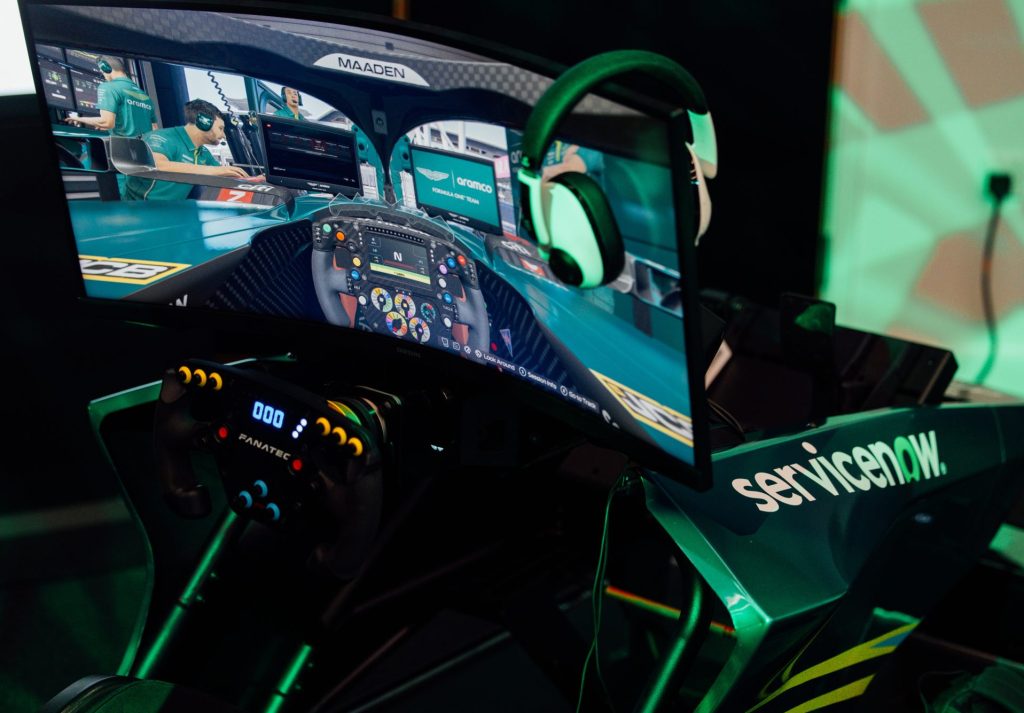
At the beginning of October, The Manufacturer’s Molly Cooper visited Silverstone and Aston Martin’s headquarters. The media day focused on innovation and technology, showcasing the automotive giant’s latest partnership with ServiceNow.
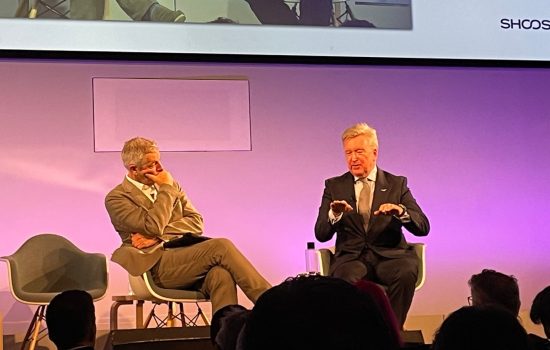
Molly was given the chance to sit down with Fabrizio Pilotti, Chief Innovation Officer at Aston Martin F1. Beginning his role in July, he is new to the team, but not to the sport. Fabrizio spent almost 11 years with Mercades AMG High Performance Powertrains as Chief Information Officer.
“As an Italian, Formula One is a huge sport, almost as big as football, and I’ve been a fan since I was a child. So, once I graduated, I tried to pursue a career in the sport,” said Fabrizio.
He discussed the upcoming changes in Formula One, the impact on innovation and the most important technologies in the sport.
How are you preparing for the upcoming challenges in the 2026 F1 season?
FP: The imminent changes are the biggest we have seen in the history of the sport, in one go. There’s never been one set of changes that encompass everything and it will result in very different races playing out on our screens.
For spectators, things will change. The engine will be different, so the noise will change. We’re also working on the gearbox as part of an integration partnership with Honda.
Changes like this require huge amounts of work across the whole organisation and we’re changing many of our processes as well as our internal manufacturing. You could say the changes are just part and parcel of Formula One, but I don’t recall anything of this magnitude before.
Yet, even without the upcoming changes, we’re always forcing ourselves to improve. We are choosing to view the number of changes as the potential to achieve a significant advantage. In this situation we really need to sit and think, and rethink how we do things. It’s a continuous loop of trial and improvement.
Where will you need to be most innovative when the changes come in?
One big challenge that will require us to be innovative is how we manage fuel strategy. In turn, this will impact on the race strategy itself. There is a focus on the energy that the car deploys, meaning we must look at all the parts including the chassis, gearbox, tyres, engine and fuel. It will be interesting to see the impact on the overall strategy as it is a regulation that is very convoluted. You can use biofuel; you can use synthetic fuel and flux. What you use will determine the energy and that will determine the strategy.
Alongside that change, there will be lots of conversation with the drivers themselves around this which will be new for the sport.
Being the greenest team, not only in colour but in sustainability, how has the team built this into your operations?
We have introduced new IT systems to help with all the emissions measurements, allowing us to be very accurate and precise. Our sustainability journey has focused on measuring and it’s been a gradual change. Twenty years ago, no one would have cared about the amount of CO2 or energy consumption of the taillights, but now they do. The same applies to other areas such as the heating and air conditioning in the car.
We have a database where we manage all these numbers and look at them to figure out the areas we need to improve. Within those numbers there’s the winning equation to become more sustainable in the sport. It’s an exciting journey to be on.
What do you value most in a technological partner such as ServiceNow?
Firstly, it’s how fast they can get the solution implemented and how much time we can save within the learning loop.
Secondly, when we introduce a new tool, we want the time between the innovative idea and the team’s driver winning the race, to be as fast as possible. Then, it’s important to loop that back into the manufacturing and engineering processes.
Whatever this tool may be, its purpose is to ensure greater precision and speed. It needs to help us work more accurately and efficiently across the many stages of a complex process, which includes hundreds of sub-processes.
An example of this would be if a tool helps us to improve two steps in our usual processes, we then save half an hour in performing, producing or measuring; that would be huge. Those 30 minutes, multiplied across 100 days or more, would add up to a significant time saving and give us a meaningful advantage in our overall learning and improvement cycle.
Throughout your long career, how have you seen F1 innovations benefit the wider automotive industry?
A Formula One car has more similarities to a military jet rather than a typical road vehicle. However, we do have a department which looks at materials, software, fuel consumption, tyres, the gearbox and other elements of data that can be transferred into a commercial car.
Over the last 20 years, there have been innovations that have travelled from Formula One into the commercial space, such as the semi-automatic gearbox. The fuel efficiency of a commercial car also stems from Formula One, as does hybrid cars.
There is huge return of knowledge from Formula One to automotive as many engineers who leave Formula One go to work within an automotive group at some point, and with that they also bring the mentality of the sport. Although that is not measurable, the attitude is. An engineer in Formula One is very focused and detail oriented due to the focus on each lap. Having that mindset within their operations can be a huge benefit to an automotive company.
What excites you about digital transformation as it keeps growing over the next five to ten years?
The biggest result from new technologies will be the near automatic decisions that will be made based on the data we create. We have extremely powerful algorithms and AI tools that we use in decision making.
By 2035, I can imagine a significant amount of race strategies will be completely automated. There is the possibility to elaborate on strategies in an extremely sophisticated way, such as the way you approach the race before, during and after.
Fifteen years ago, there weren’t many computers involved within the sport at all. The data we did have was found within Excel spreadsheets. Now we have powerful high-performance computing systems – with more on the way – intensely targeting AI tools and algorithms.
For more articles like this, visit our Innovation channel.