For decades, footwear manufacturing has followed the same trajectory as much of the wider manufacturing industry, with factories closing across the US and Europe as brands chased lower costs overseas. Twisted X President and CEO, Prasad Reddy, has watched story unfold from the inside for over 50 years, and he’s one of a shrinking number of industry leaders who can speak to what was lost with real, first-hand authority. Here, he shares his insights with The Manufacturer…
Reddy’s career began at Wolverine Worldwide in the 1970s, shortly after he completed a master’s degree in industrial and systems engineering. At the time, Wolverine operated 18 shoe factories across the United States and owned brands including Hush Puppies and Saucony. Later, Reddy became involved with a footwear business in Wisconsin that operated two factories before semi-retiring in the mid-2000s. Twisted X pulled him out of retirement in 2009, and he’s been its down-to-earth CEO ever since, making a point of visiting the company’s production facilities wherever he travels; from China and India to El Salvador, Mexico and the company’s American factories.
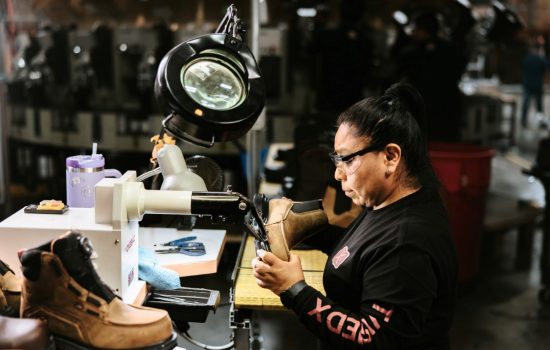
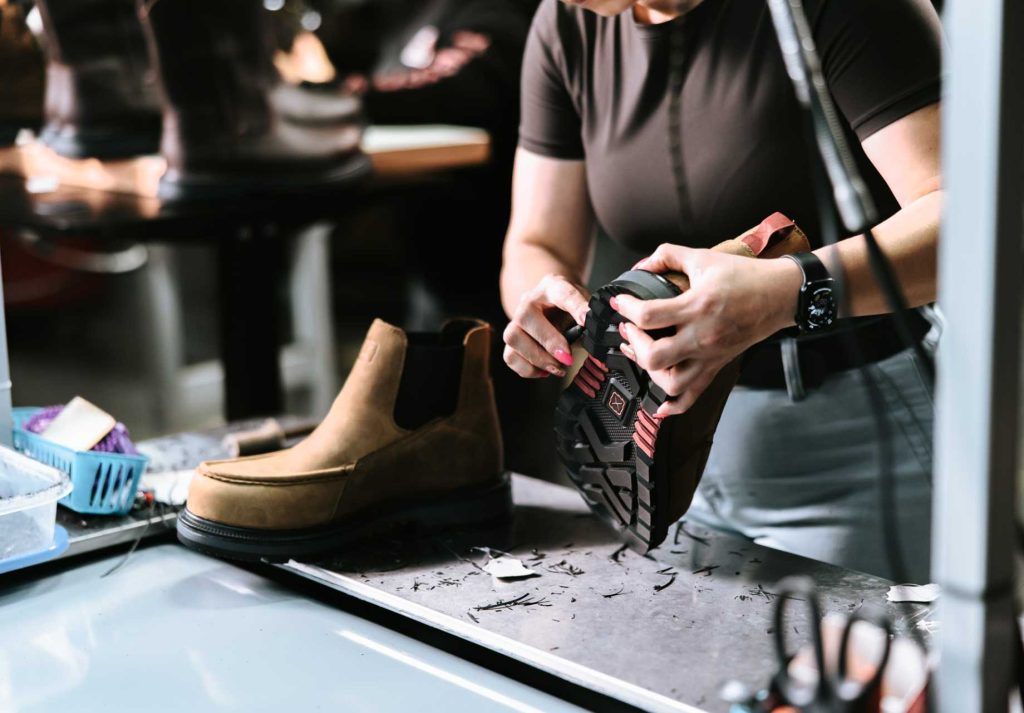
Today, Reddy is trying to prove that there is still a place for footwear manufacturing in the United States, but not by attempting to recreate the industry of the past. Instead, Twisted X is looking at how automation, product redesign and more sustainable manufacturing processes can overcome some of the fundamental cost challenges associated with making footwear domestically. To that end, Twisted X recently announced the launch of its Built in the USA Collection, a new footwear range assembled in the US using globally sourced materials.
The company has six manufacturing facilities globally, with plans to expand that number to eight, and has been pursuing a broader strategy of manufacturing closer to its markets, including increased production in Mexico and El Salvador. Its latest US initiative represents another step in that strategy.
“We’ve always been very interested in the manufacturing side of footwear,” Reddy explained. “Whenever opportunities came, we wanted to manufacture product here.”
Twisted X had previously manufactured in the US before pausing production during the COVID-19 pandemic. Manufacturing restarted around a year before Reddy’s interview with The Manufacturer, and the company is now planning to double its domestic output over the following nine months.
But while the decision to manufacture in America has been influenced by supply-chain considerations, customer expectations and the wider geopolitical environment, Reddy argues that the economics are more complicated than simply comparing the cost of American and overseas labour.
Political momentum behind reshoring stretches back to the first Trump administration. But the more immediate logic is operational, rooted in two problems Reddy flagged almost immediately: the loss of the American component supply base, and the environmental regulation that pushed chemical-intensive processes like tanning offshore in the first place.
Set against those obstacles is a straightforward commercial advantage. As a stock brand, Twisted X carries finished inventory rather than manufacturing to order, so long overseas lead times mean tying up more capital in product sitting in transit or in warehouses. Domestic assembly shortens that chain considerably. “The biggest advantage is being right here, quick to the marketplace,” Reddy explained. “Even though it’s a bit more expensive, the investment in inventory is not as much as when you have long lead times.” That speed also lets the company push new styles into stores faster, what he calls quick-trip-to-market, or QTM.
See what’s next for American manufacturing Join thousands of manufacturing leaders at Smart Manufacturing Week U.S. in Detroit, April 19–22, 2027, and discover the technologies, ideas and connections shaping the future of industry. Register your interest today ⬇️
What ‘Built in the USA’ really means

The label is doing more nuanced work than it might first appear. Twisted X’s domestic production isn’t a closed-loop, start-to-finish American supply chain; it’s a hybrid model, and Reddy is upfront that it applies to only part of the range, not the whole product line.
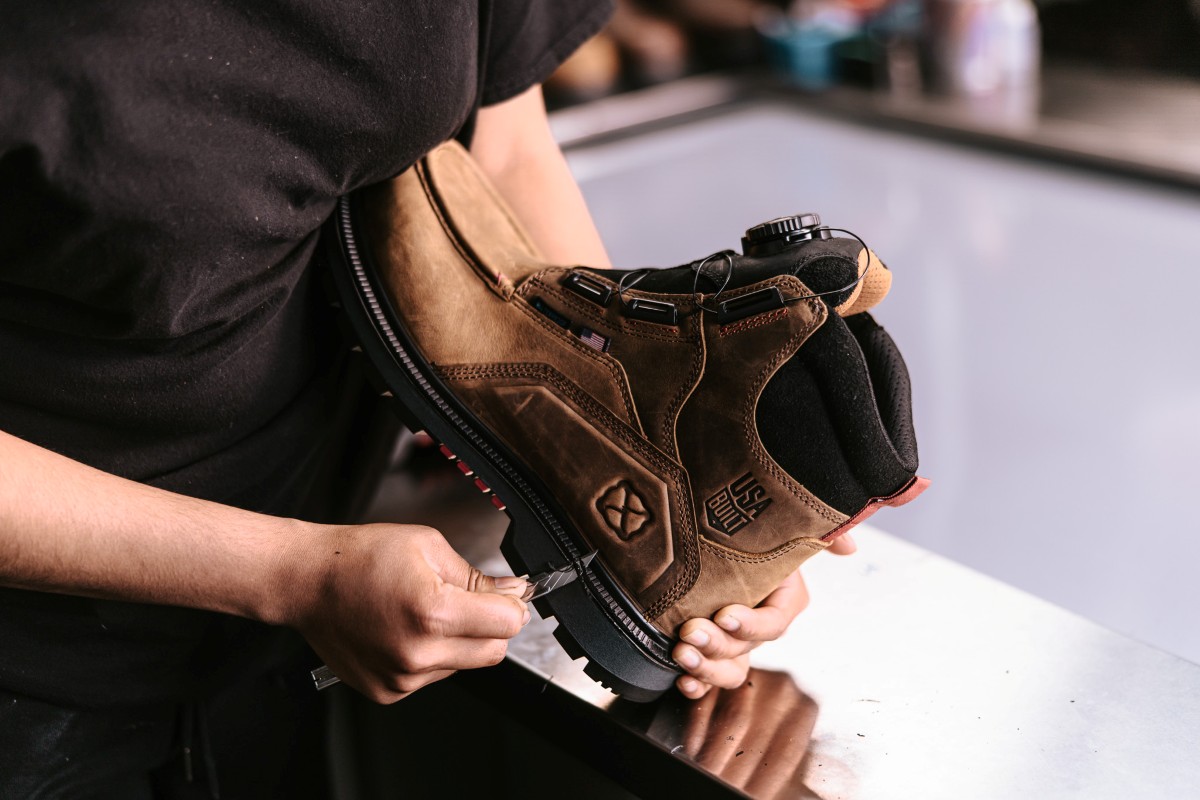
Leather arrives from Brazil, Argentina and the US. Some uppers are stitched overseas, in China or India, or closer to home in Mexico, before being shipped to Twisted X’s American facilities. There, the company applies what it calls a direct-injection process: PU compound chemicals are injected straight onto the upper to form the outsole, fusing the two into a single, finished, cushioned boot.
It’s a genuinely global product finished on domestic ground and, crucially, only certain styles can currently carry the “Built in USA” claim. Pressed on whether a customer buying a Twisted X boot could reliably assume it was assembled domestically, Reddy is careful not to overstate the position: “Not all of the products, but some of them, yes. Where we definitely say that, this is Built in USA.” It’s an honest distinction, and one that matters for a trade audience thinking about how reshoring claims get made and substantiated across the industry.
Beyond leather and uppers, the company sources what it can domestically where practical – packaging materials and shoe boxes among them – while relying on established overseas partners for components that infrastructure gaps make impossible to source at home for now.
The economics: automation over cheap labour
Reddy doesn’t pretend US manufacturing is cost-competitive on labour alone. “It is more expensive to make in the USA. There is no doubt about it,” he said. Instead, Twisted X has leaned on automation and process redesign to close the gap.
The most significant innovation is what the company calls its “0X” process, a glueless, chemical-free method of stitching the upper directly to the outsole. In traditional footwear manufacturing, the “lasting” process – shaping and attaching the upper to the sole – accounts for roughly a third of total labour. Twisted X’s 0X process eliminates around 80% of that step entirely, while also cutting out the solvents and adhesives that would otherwise need careful environmental handling. Reddy frames it as something closer to a genuine industry first than an incremental tweak. Development began roughly six or seven years ago, originally intended for the company’s home base in Texas, before COVID-19 interrupted those plans. “No one has been doing it,” he said of the approach, a claim that, if it holds, positions Twisted X as a genuine process innovator in a category not typically associated with manufacturing R&D.
Alongside process innovation, the company has invested in reengineering the product itself. Reddy describes a deliberate discipline around this, one which involves revisiting components and assembly steps to ask how they could be simplified, rather than assuming existing methods were fixed. The result, he said, was a product-cost reduction of almost 5% within three to six months, achieved purely through reengineering rather than by squeezing suppliers or cutting corners on materials.
A genuinely global supply map
Even as it builds out US capacity, Twisted X continues to manufacture internationally, and the map of where its materials originate is broader than a simple “overseas vs domestic” framing suggests. As mentioned, uppers are currently sourced primarily from China, with some from Mexico. Leather comes from Brazil and Argentina as well as the US, and other components are drawn from India. The overall picture is not one of a single offshore supply chain, rather a deliberately diversified network, built country by country around where quality, cost and capability line up.
Reddy is candid about why certain materials simply won’t come home. More than 90% of American tanneries have closed, largely because of the environmental costs of the tanning process and the scrutiny that draws from the Environmental Protection Agency – chemicals released during tanning are heavily regulated domestically in a way they aren’t in some of the countries Twisted X currently sources from. Leather sourcing will likely remain overseas for the foreseeable future, a trade-off Reddy is okay with.
Where the company does source internationally, quality control is treated as non-negotiable. Twisted X works with a small number of long-standing suppliers, some relationships going back three or four decades, chosen deliberately to keep the supplier base tight and dependable rather than opportunistic. The company places its own inspectors inside partner factories during production, rather than relying solely on finished-component checks at the point of delivery. “We don’t do the trust part,” Reddy said. “Control is better than trust. We want the manufacturing processes – process control. That’s important for us too, not just the finished component.”
The real barrier to scaling up
Perhaps the most striking theme to emerge from the conversation is how clearly Reddy separates ambition from infrastructure. Twisted X is doubling its US production over the next nine months for the product types current processes support, but scaling further, he says, depends on the return of America’s component manufacturing base, a factor that is largely outside the company’s control
Footwear is a far more componentised product than it might appear. For example, a single boot can involve as many as 20 to 25 different parts, compared with the comparatively simpler bill of materials in apparel. That complexity makes reshoring harder to coordinate. A mold, die or last manufacturer needs enough combined demand across multiple brands to justify re-establishing US operations, and no single company can offer that certainty alone. “One or two or three manufacturers’ brands are not going to be enough for them to come back,” Reddy said. “There has to be certain incentives also.” He’s raised the issue directly with US officials through the Footwear Distributors and Retailers of America (FDRA), including at a Washington meeting last spring. So far, nothing concrete has followed.
Reddy believes the reason why there hasn’t been much movement is because government attention is focused elsewhere. “I think the focus is more on high-tech manufacturing industries, like chips and automobiles, where job-creation numbers are larger,” he said.
Sustainability, built in
Running alongside the reshoring story is a sustainability commitment Reddy describes as embedded in the company’s culture rather than bolted on. “Every product we make must have a sustainable component to it,” he said. “It’s not something we think about, it’s automatically embedded in our DNA.” Twisted X eliminated single-use plastics company-wide in 2016 and became carbon neutral in 2020, making it among the earliest footwear companies globally to reach that milestone, according to Reddy.
The commitment extends into materials engineering as much as corporate policy. Around 85% of the company’s footbeds are made from reclaimed EVA scrap pulled from its own factories, and leftover leather offcuts are reconstituted into new leather material rather than discarded. With the footwear and apparel sector estimated to account for roughly 12% of landfill waste, Reddy sees the chemical-free 0X process as both a manufacturing innovation and an environmental one.
He’s also careful to frame sustainability as a commercial differentiator rather than a purely ethical stance. Retailers and customers, he says, increasingly “associate Twisted X with comfort and sustainable features,” a positioning he sees as reinforcing, rather than competing with, the domestic manufacturing story.
On the manufacturing side, Reddy also points to the athletic footwear sector as an ongoing source of inspiration. It’s a category he says has historically led on materials innovation and efficiency, and one that a more traditional Western and work-boot brand like Twisted X continues to draw lessons from. Innovation in footwear, he suggests, rarely happens by standing still. New machinery and materials are “constantly evolving,” and staying competitive means continually asking how waste and chemical use can be reduced further.
A measured five-year outlook
Asked to look five years ahead, Reddy resists the temptation to overpromise. Production will keep growing, he said, and the company will keep hunting for more efficient processes. But without progress on the infrastructure question, he’s reluctant to call the initiative transformative just yet.
“We have to do our part,” he said. “We have to constantly look for ways, and we will. We’ll also see if we can entice some of the component people to restart domestic operations. He singles out molds, dies and lasts as categories he’d like to see return, while acknowledging that tanning, given the environmental constraints, “probably will not come back, which is okay.”
Beyond production, Twisted X’s near-term investment priorities include expanding its product lines and continuing to develop proprietary comfort technologies, an area Reddy is visibly proud of; the company holds several patents in this space already. Despite the company’s growing manufacturing ambitions, he’s careful to note that Twisted X remains a modest player next to the giants of athletic footwear. “We’re still not a huge company by big standards,” he said. “We still have long ways to go. We’ll try to keep on improving.”
It’s a candid note to end on. Twisted X is a company genuinely committed to bringing manufacturing home, clear-eyed about what’s working, and equally clear-eyed about the industrial gaps that stand between a first step and a full-scale shift. Reddy has spent over fifty years watching American shoe factories come and go, and that history seems to inform his caution as much as his ambition. He’s not interested in overselling a moment he’s already seen unravel once before. Whether the surrounding infrastructure catches up to meet Twisted X’s own ambition, as Reddy is the first to admit, isn’t entirely in his hands.
Never miss a North American manufacturing story
Sign up for our free weekly North American Manufacturing Digital Briefing to receive the latest industry news, insights and analysis direct to your inbox every Monday.