When catastrophe hits, clean drinking water becomes the first essential and the fastest to fail. Floods sweep sewage through communities, earthquakes rupture pipelines and conflict displaces families into environments where water sources are dangerous. In these moments, water purification is not a convenience, and chemical manufacturing is the frontline defence against disease.
For the global aid community, this demand creates a unique manufacturing challenge. They require water purification solutions that are not just effective, but robust, instantly deployable and guaranteed to perform when everything else has failed.
For over 50 years, Hydrachem has worked at that frontline, manufacturing OASIS Water Purification Tablets designed to protect life in the harshest conditions.
The chemistry that protects communities
The active ingredient in Hydrachem’s OASIS tablets is troclosene sodium, a chlorine-releasing biocide used around the world for safe, reliable disinfection. Its strength lies in how it behaves in water.
When the tablet dissolves, not all of the ‘chlorine’ is released at once. It operates in an equilibrium where some ‘chlorine’ is released immediately to neutralise harmful pathogens, and some remains in reserve until needed.
Additionally, when dissolved in water, troclosene sodium provides enhanced biocidal performance by releasing free available chlorine as hypochlorous acid, which is significantly more potent than other commonly used chlorinating agents, such as sodium and calcium hypochlorite.
In real-world humanitarian conditions, where a bucket of purified water may be re-contaminated the moment someone dips in a hand or dirty utensil, that reserve of available chlorine can be lifesaving. It means treated water stays protected for longer.
Unlike sodium hypochlorite (bleach) or calcium hypochlorite, which rapidly degrades, has a shorter shelf life and releases all of its active chlorine at once, Oasis tablets remain stable for three to five years, even in challenging environments. This long shelf life, combined with consistent performance, has seen them used by global health authorities, NGOs and emergency response teams for decades.
Built to perform when everything else fails
The technical challenges don’t end with the chemistry. When humanitarian organisations like UNICEF, WHO or Médecins Sans Frontières need water purification tablets, they require them to perform consistently whether they’re stored in the desert, high humidity or freezing conditions.
Hydrachem engineer the tablets for simplicity: drop one in water, wait 30 minutes, drink. That ease of use proved critical during the company’s work with the Brightwater Foundation in Ghana, where Hydrachem co-funded education programmes teaching local populations about water treatment.
The results were dramatic. Sickness and lost work and school time dropped substantially. Even though sustaining such programmes long-term remains challenging, the impact demonstrates what’s possible when effective products meet committed outreach.
Inside a factory built for rapid mobilisation
The greatest challenge in humanitarian manufacturing isn’t technical, it’s timing, as a crisis rarely comes with a warning. A factory producing emergency water treatment tablets must be ready to deploy vast volumes of product instantly. Hydrachem hold significant emergency stock because when a humanitarian organisation calls, they need product now, not next week.
The company’s manufacturing facility is designed for rapid scale-up: additional production can be activated swiftly, and the company makes conscious decisions to prioritise readiness over financial efficiency.
This philosophy evolved from experience. During 2023 and 2024, as global crises accumulated, demand surged continually and our supply chain was stretched. In response, Hydrachem redesigned its approach and now maintain sufficient inventory to respond immediately to most emergency requests.
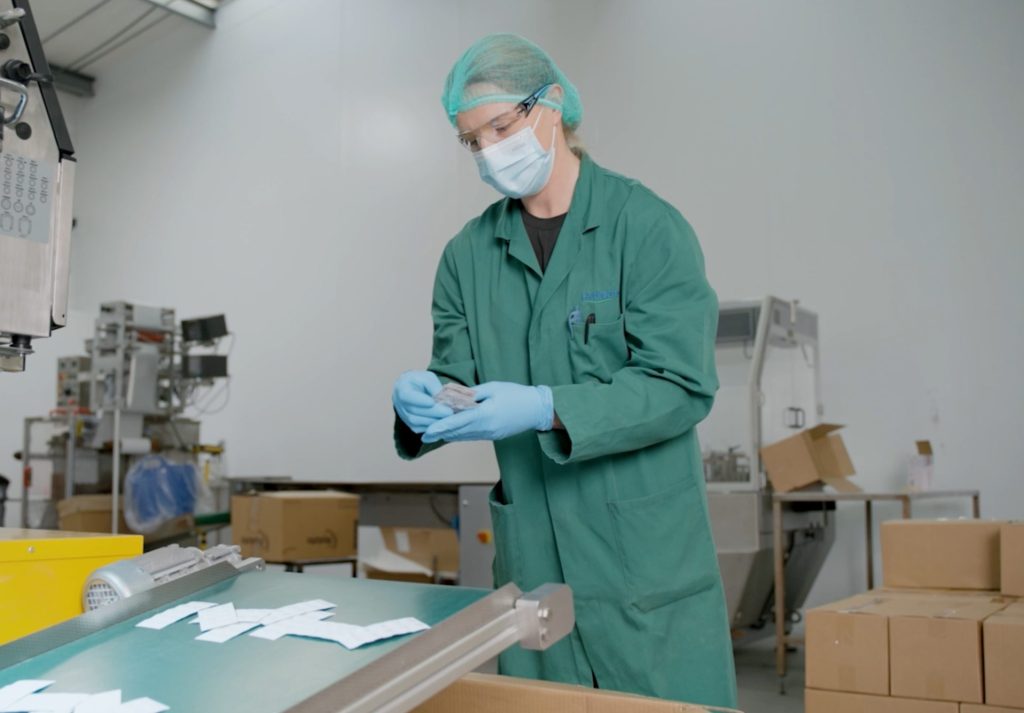
Beyond capacity, the company’s reliability is underpinned by rigorous quality control. Hydrachem are certified to ISO 9001 and BRC (British Retail Consortium) standards, and are regularly audited to GMP Pharmaceutical standards by UK medicines regulators and organisations like UNICEF.
Every batch undergoes rigorous testing for compliance against global frameworks, including the WHO International Scheme to Evaluate Household Water Treatment Technologies.
Why the packaging matters
Humanitarian supply chains are unpredictable. Boxes can be split, shipments are divided across agencies, and donations are re-packed by local volunteers. Hydrachem, therefore, design its packaging for the reality of crisis logistics.
All instructions, warnings and dosing guidance are printed pictorially on every single strip – if a box is broken apart or gets redistributed, the user still has everything they need. This multi-language approach is vital for rapid deployment across diverse populations.
This simplicity is intentional, as the product must be effective even when no training is possible.

When politics interrupts aid
The humanitarian landscape shifted dramatically in 2025 when political decisions suddenly cut major funding streams. Around April last year, orders reduced substantially due to cuts to US aid programmes, but there’s still people in need. Hydrachem has even made donations at times when people don’t get the aid they urgently require.
Recent months have shown funding thankfully returning through private sources, though the comparison year-on-year remains difficult. Through it all, one constant remains: disasters don’t wait for politics to resolve, leaving contaminated water to be one of the fastest killers in crisis situations.
Looking forward
Hydrachem continues investing in capabilities that strengthen emergency response. While the OASIS tablet addresses the pathogenic threat, the company is also innovating to tackle other complex water quality issues.
The company is working with universities to develop new products designed to remove heavy metal water contamination, such as arsenic and mercury, a growing problem in areas affected by activities like gold mining. The challenge is to not only solve the chemistry problem but to manufacture the solution at a cost low enough that it remains accessible for global aid efforts.
For Hydrachem, advanced manufacturing is not just about output; it is a critical line of defence. It is about converting chemical expertise into a dependable solution for delivering clean water, without delay, to communities in need. In an increasingly uncertain world, that kind of readiness matters more than ever.
For more articles like this, visit our Innovation channel