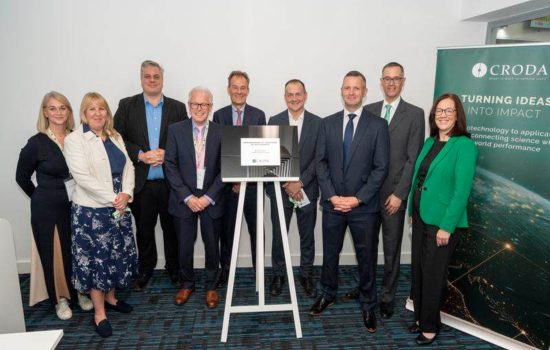



Croda has published a new white paper examining how artificial intelligence could accelerate agricultural R&D, from analysing historical data to improving seed quality assessment.
Croda has brought together experts from agriculture, life sciences, academia and artificial intelligence to examine how AI is changing the way new agricultural products and solutions are developed.
The company’s new white paper, How Artificial Intelligence is Transforming Agricultural Innovation, draws on expertise from Croda Agriculture and its seed enhancement business Incotec, alongside contributions from organisations including BASF, Rijk Zwaan, Dotmatics and the University of Amsterdam Business School.
The report explores how AI can help researchers identify promising opportunities more quickly, extract insights from historical datasets and support decision-making throughout the research and development process.
For agricultural manufacturers and suppliers, the technology could provide new ways of understanding complex scientific data and shortening the path from research to commercial application.
One example highlighted in the report comes from Incotec, where AI and X-ray imaging are being used to support the assessment of tomato seed quality.
By combining X-ray images with historical germination data, researchers can identify patterns associated with seed performance. The approach can then be used to inform decisions around seed treatment and quality selection.
Data and collaboration
Croda said the development of AI-enabled agricultural innovation will depend on more than the technology itself, with data quality, organisational capabilities and collaboration also identified as important factors.
The report brings together perspectives from across the agricultural value chain, with contributors examining how businesses can connect scientific expertise, data and technology to develop solutions for growers.
Thomas Riermeier, President of Life Sciences at Croda, said AI was already changing how the industry approached agricultural innovation.
“The question is no longer whether artificial intelligence will influence agricultural innovation. It is already transforming the way our industry discovers, develops and delivers solutions to some of agriculture’s biggest challenges,” he said.
“Success depends on bringing together scientific expertise, trusted data and strong partnerships across the agricultural ecosystem.”
The report also highlights the importance of organisations developing the skills and working practices needed to make effective use of AI.
For manufacturers and R&D teams, this includes establishing robust data foundations and ensuring researchers have the expertise to interpret AI-generated insights alongside established scientific knowledge.
Finn Bauer, Vice President of R&D, Life Sciences at Croda, said AI was already helping researchers work with increasingly complex scientific datasets.
“AI is already helping researchers uncover insights from complex scientific data and identify promising opportunities more quickly,” he said.
“The greatest impact will come when we combine these emerging capabilities with deep scientific expertise and closer collaboration across the agricultural value chain.”
Croda said the findings point towards a more collaborative approach to agricultural innovation, with researchers, suppliers, manufacturers, technology companies and growers increasingly sharing expertise and data.
The company said this will be important as the agricultural sector looks to develop more productive, resilient and sustainable solutions while responding to increasingly complex challenges facing growers worldwide.
Read more stories like this in our Industrial Data & AI section