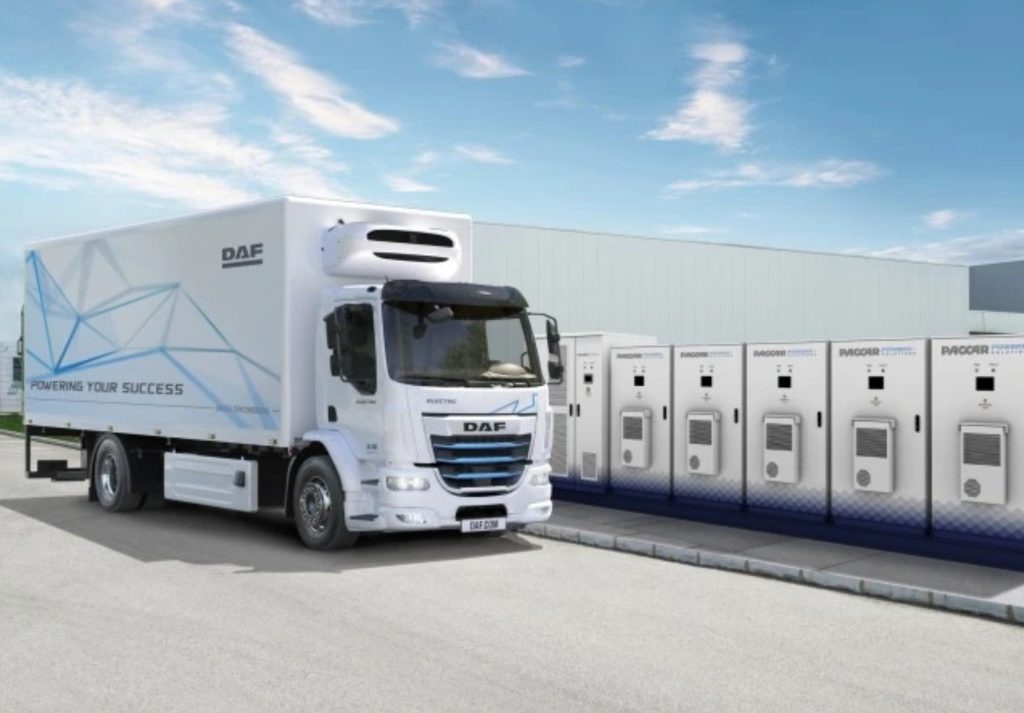
What do you do when a manufacturing line currently building a mix of medium and heavy-duty trucks must be adapted to produce up to 30 battery electric vehicles (BEVs) per day, yet existing vehicle build takt times suggest only ten can be built?
This was the challenge faced by Leyland Trucks, part of the PACCAR Group. Working alongside Expert Technologies Group and HSSMI, the company set out to solve it through the ZETTA project, a 27-month collaborative programme launched in April 2023 under the Advanced Propulsion Centre UK (APC) collaborative R&D funding programme.
The project focused on preparing Leyland Trucks for large-scale zero-emission vehicle production while maintaining the flexibility required for mixed-model manufacturing.
Delivering a flexible manufacturing strategy
For Leyland Trucks, the project delivered a flexible and dynamic manufacturing strategy capable of supporting both internal combustion engine (ICE) and battery electric vehicle production. Key outcomes included:
- Development of a mixed ICE/BEV manufacturing strategy, supported by an end-of-line performance study.
- Introduction of automated testing processes for battery electric vehicles.
- Development of high-voltage (HV) manufacturing safety protocols for the Leyland facility.
- Creation of a dual-powertrain manufacturing process supporting both diesel and battery electric systems.
- Modification of the site’s automated guided vehicle (AGV) system to accommodate mixed powertrain production.
During the initial review of manufacturing operations, the end-of-line test process was identified as a significant production bottleneck. Automated testing procedures were also highlighted as an area requiring further development to support future production volumes.
The planned introduction of in-house battery assembly created additional challenges around safety. As a result, new processes were developed to ensure the safe management, extraction and removal of batteries and vehicles from the facility when required.
The project also contributed to capability development within Leyland Trucks through the establishment of a dedicated Advanced Manufacturing Team and the recruitment of a controls apprentice.
Advancing automation
Expert Technologies Group was selected to provide production automation and manufacturing development expertise. While the company had previously collaborated with Leyland Trucks on smaller initiatives, the ZETTA project created opportunities to explore broader automation applications, including the deployment of AGVs within powertrain sub-assembly operations.
As part of the programme, Expert Technologies developed several solutions:
- Battery Health Monitoring System (BHMS): The company developed a Battery Health Monitoring System that is now part of its commercial manufacturing offering. Installed on battery modules during sub-assembly, the system continuously monitors critical operating parameters. If pre-set limits are exceeded, the BHMS automatically alerts the control centre and initiates procedures to safely remove the battery from the facility.
- Automated battery fuse installation: A robotic solution using collaborative robots and machine vision was developed to install the battery fuse and Manual Service Disconnect within the required production cycle time. This automation eliminates what would otherwise be a two-person operation requiring full high-voltage personal protective equipment.
- Robotic development and training cells: Two robotic automation development cells were created to support both manufacturing evaluation and workforce development. These cells enable the Advanced Manufacturing Team to assess potential automation opportunities while providing practical robotics training for the wider Leyland workforce.
Creating a digital factory
The third project partner, HSSMI, brought expertise in digitalisation and virtual manufacturing, developing a battery manufacturing blueprint for the Leyland facility.
As part of the digitalisation workstream, HSSMI conducted a review of Digital Twin technologies and selected the NVIDIA Omniverse platform as the most suitable simulation environment for Leyland’s requirements.
A full LiDAR scan of the manufacturing facility was then completed, enabling the creation of an accurate 3D digital model of the production line. Combined with live data feeds from the shop floor, the digital environment provided the capability for virtual commissioning and production simulation before physical implementation.
HSSMI also completed an optimised battery pack manufacturing feasibility study, covering process design, manufacturing definitions, facility layout, cost modelling and production planning.
Eliminating a production bottleneck
Recognising the impact of end-of-line testing on throughput, the project team undertook a detailed analysis of the process. Specialist automation provider JW Froehlich was engaged as a subcontractor to support this activity.
The result was a dramatic reduction in vehicle test times, from 24 minutes per vehicle to less than two minutes, significantly improving production efficiency and removing a key manufacturing constraint.
Exceeding expectations
Completed in June 2025, the ZETTA project exceeded its original objectives and deliverables. The programme has provided Leyland Trucks with the capability to build up to 30 medium-duty battery electric trucks per day on a flexible mixed-model production line.
The knowledge and experience gained through the project have also raised Leyland Trucks’ profile within the wider PACCAR Group. Project leaders have since presented the programme’s achievements at Manufacturing Round Table events in the United States, sharing lessons learned with colleagues across the organisation.
The ZETTA project demonstrates how government-backed innovation programmes can accelerate the transition to zero-emission vehicle manufacturing, strengthen the UK’s automotive supply chain and enhance manufacturing competitiveness. As the industry continues its transition towards electrification, projects such as ZETTA highlight the importance of collaboration between manufacturers, technology providers and research organisations in delivering future-ready production capabilities.
For more articles like this, visit our Innovation channel