

The future for manufacturers lies in playing tag – argues Stephan Pottel, Industry Director, Manufacturing, EMEA at Zebra Technologies – attaching tiny electronic labels to everything from products to packaging and then reading them wirelessly.
When it comes to identifying a technology to ensure manufacturing succeeds into the 2030s, you could describe RFID as a… Really Flipping Important Development.
With its unique ability to identify and track everything from parts to products to packaging, the future role of Radio Frequency Identification (RFID) to the global supply chain should not be underestimated.
Here at Zebra Technologies, we believe it’s time for boardrooms to think seriously about RFID’s potential as a game-changer for manufacturers worldwide. As an industry, manufacturing is slow to move forward but relying on legacy machinery and deeply-embedded traditional processes is no longer an option.
For many already working on the ground, the potential for RFID is clear, even if C-Suites above them are hesitant to inject the time, budget, and energy into its introduction and adoption.
However, without doing so, it will be tough to meet the complex challenges ahead, from economic and geopolitical uncertainty to new ways of working dominated by the arrival of artificial intelligence.
For instance, managing Work-in-Process (WIP), inventory accuracy, and production efficiency, will be critical to keep operations running. That’s where RFID comes in, using electromagnetic fields (radio waves) to communicate with objects through the dedicated electronic tags affixed to them.
Previously, this would be handled by individually scanning barcodes with a handheld device. But doing so on the factory floor, in a retail warehouse, or within a logistics facility is time-consuming and requires intense amounts of manual labour. RFID tackles this, saving time and redirecting it to boost productivity elsewhere.
A wireless exchange of information
Unlike barcodes, RFID tags do not require direct line of sight for scanning. Each stores data on a miniscule chip, exchanging those details wirelessly with an RFID reader. The tags themselves come in various types, for example, passive ones need no battery and are inexpensive, but that means a shorter range. They are ideal for bulk use on everything from cans of soup to items of clothing to the insides of cartons filled with multiple individual goods sent from production lines to stores.
Active RFID is a costlier type; its internal battery means a longer range to embed these in factory machinery, tools, warehousing units, and vehicles such as forklifts. They are also capable of acting as sensors, e.g. knowing if a perishable package – such as fish, veg, or meat – is at the right constant temperature and alerting remote monitoring systems immediately if these get too hot or too cold and risk spoiling.
This variant of RFID can also recognise when manufacturing equipment has broken down or is at risk of failing, while also being used to track expensive portable items if they go missing. This saves much time searching for the likes of an electric torque wrench, which can so easily be misplaced.
Searching can waste as much as 20% of an employee’s daily time but Active RFID costs can mount fast. Therefore, it’s best used within closed loop scenarios such as RTI (Returnable Transport Items), and so passive solutions can still be “good enough” at a fraction of the price.
Maintaining a competitive edge
In recent years, manufacturers have implemented various digital transformation techniques to be more productive and profitable. RFID is the next step in that rollout to have the edge over competitors and ensure bottom lines are healthy.
These tags may be tiny, but their impact is huge, and those brave enough to have begun integrating RFID are quickly seeing its power to reduce scanning errors or avoid over-ordering parts when you already have some tucked out of sight.
Smarter and faster workflows follow its integration with inventory accuracy improved through real-time visibility 24/7. This is especially useful to manage supply and demand or respond quickly to changing weather patterns, hyperlocal needs, or times when a rush order is placed and immediate clarity is needed to see if it can be done.
RFID excels at quality control too. There’s no need to search through, or scan, multiple piles of boxes to find faulty goods or out-of-date raw materials; the wireless tag attached will find it fast. Other key areas for RFID include:
- Waste and Shrinkage to monitor levels of loss on manufacturing lines or in post-production to identify possible sources of internal/on-route theft of goods
- Access Control through RFID-enabled badges and passes that allow entry to only the right employees, while also confirming when they were inside
- Strategies for Just in Time and Last Mile offering granular levels of data that will show what (and who) is where and when to help manage these journeys
From the simplest to the harshest environments
It’s all too easy to laud any technological advance as “the next big thing”. However, when it comes to RFID, it is certainly one that will define how manufacturing shows up as a growth industry over the next decade.
At Zebra, our solutions can enable its embedding, integration, and implantation, without forcing factories or warehouses offline for days. RFID can be adopted with very little fuss, seamlessly connecting to existing infrastructure and software.
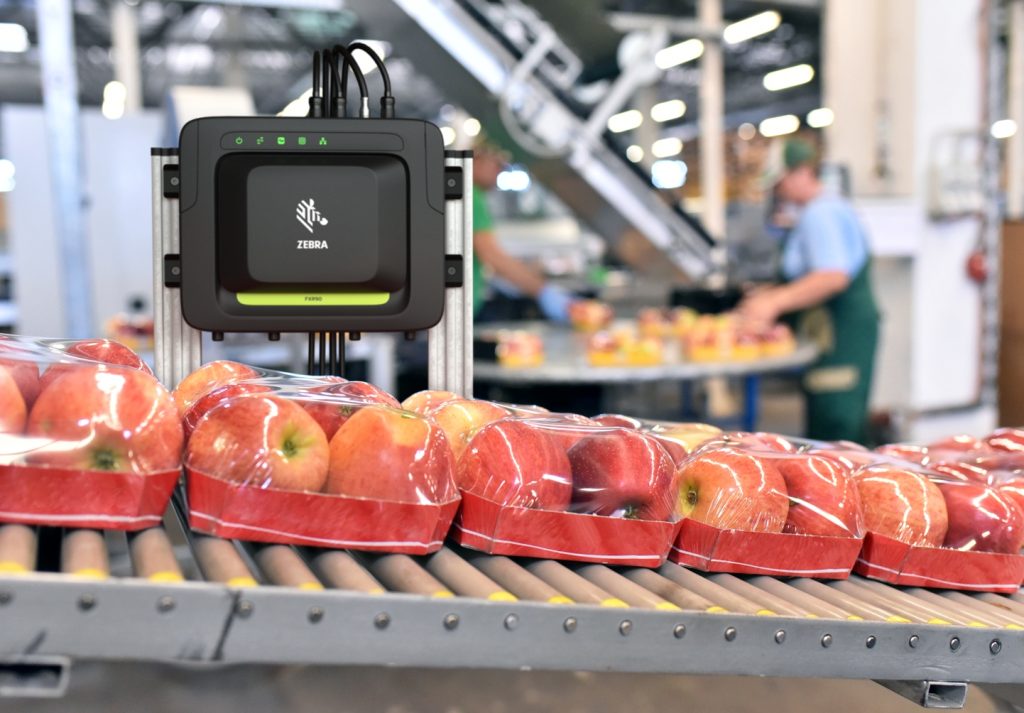
RFID is built to work in the simplest and the harshest manufacturing environments, whether inside a cold storage facility – they won’t freeze – or when detected by a fixed reader that constantly monitors from above using a wide-angle antenna to recognise tags within a single coverage zone. Zebra also has equipment capable of ultra-fast RFID scanning – for example, 1,300+ tags per second – augmented by printers that produce RFID access cards.
Across global manufacturing, RFID is now gaining strong but limited traction.
Decisions taken yesterday by teams in procurement, finance, maintenance, and IT are delivering cost-savings, enhanced insights, and speedier production cycles.
To fully embrace the potential, it will be the important decisions taken today and tomorrow – and not next year – that will show how RFID is a serious way to play tag.
https://www.zebra.com/gb/en/products/rfid.html
For more articles like this, visit our Digital Transformation channel.