At the end of last year, The Manufacturer team visited Bisley, a furniture manufacturer in Newport, South Wales.
Molly Cooper spoke to CEO Richard Costin and Lead Designer, Chris Fowler, about how the business is keeping up with a rapidly-changing world.
FAQ’s
- Why is diversification important in manufacturing?
- How is hybrid working affecting office furniture design?
- What is an employee ownership trust (EOT)?
Key takeaways
- Bisley is moving through the paperless-office era by pivoting its production from high-volume steel cabinets into a high-value mix of wood and metal furniture.
- The business is using digital automation for the foundation of its production but keeping skilled craftsmen for the unique finishing details.
- Bisley has combated shipping and supply chain volatility by bringing more processes in-house and partnering with local subcontractors.
- The company is moving beyond hardware by integrating smart technology that provides customers with real-time data and analytics.
- The business is improving recruitment and long-term retention by transitioning to an Employee Ownership Trust that gives employees a direct stake in success.
A legacy of manufacturing excellence
If you’re sat at your office desk while reading this article, take a few seconds to look around. There’s a fair chance you will catch a glimpse of a Bisley product in your vicinity. Known initially for its filing cabinets and office furniture, the company – founded in the 1930s – began manufacturing its iconic steel storage units in the 1950s. These quickly became globally popular and remain a design classic to this day.
Why diversification is key to modern manufacturing
Bisley is also a leading example of a manufacturer that has embraced diversification in recent years to keep up with modern-day trends, as offices turn increasingly towards paperless operation and employees work around a more hybrid pattern.
Adapting materials and product strategy
“Bisley started as a family business and has been operating for over 94 years. It initially began as a purely steel manufacturer of office storage systems,” said Richard Costin, CEO at Bisley Group.
The company once produced around 20,000 tonnes of steel storage products each year, which over time has reduced to around 7,000 due to the increased diversity across the product range in order to incorporate a wider range of materials, such as wood.
“As of now we are the only manufacturer in the UK that can provide both wood and steel storage units,” Richard added.
Responding to workplace trends and hybrid working
Designing for modern office environments
Bisley is helping businesses bring a homely touch into the workplace, to incorporate those people now returning to the office after years of being used to working remotely since the COVID pandemic.
“One of the trends we are seeing is biophilia; bringing greenery into the office landscape and a mix of materials in the furniture. For us, a mix of steel and wood has been very positive.”
Chris Fowler, Lead Designer, Bisley Group
 “One of the trends we are seeing is biophilia; bringing greenery into the office landscape and a mix of materials in the furniture. For us, a mix of steel and wood has been very positive.”
Blending steel and wood in production
The Bisley site processes its steel at a very early stage. “We begin with the fundamental flat steel panels and work all the way through to piercing, notching and folding those parts to make the sub-assemblies. There is then a process of finalising the finished components to go on the paint line,” he said.
After that, the parts move into final assembly which is where drawer bodies, decorative fronts, handles, locks and the like are added. Having the whole process within one factory allows for a seamless progression that can take anywhere from six to eight hours to complete.
However, wood product creation is kept separate behind an internal firewall and has a different flow line. “The wood line is mainly a panel based construction with no paint process required, so that’s an assembly line that incorporates more hand tools,” said Chris.
Balancing automation with craftsmanship
The way in which Bisley incorporates automation into its processes is based around logistics, as Chris added: “We use automation to create product codes so purchasing and planning can stay on schedule. But we require a human touch for the finishing stages of production. There’s an opportunity in modern design to use automation for the foundation, while letting craftsmen handle the features that make a product unique.”
Smart workplace solutions and product innovation
Meeting the needs of flexible working
In February last year, Bisley launched its BeSmart range, bringing a more personal touch to its product offerings.
Richard Costin, CEO, Bisley Group
 “As a business we are seeing technology driving people back to the office and BeSmart offers a solution to make that transition easier.”
Many employees are now looking for some personal space and storage in the office in the era of hotdesking. “People need somewhere to store various business and personal items such as gym clothes, a change of shoes or bike helmet and our manufacturing expertise, combined with our global smart technology lock partners, has delivered this. Each product is designed and developed alongside the customer to meet the needs of its people,” explained Richard. This includes fitting bespoke products to small, confined spaces, branding cabinets and making the right product for the right budget.
In the corporate world safety is a number one priority. “There are many companies offering a solution like this, but it’s not as easy as merely selling the technology. It needs to integrate with the organisation’s Wi-Fi for example, and that of course involves cyber security.”
Using technology and data to enhance user experience
Not only that but the technology also provides Bisley with tangible customer data. “We can help organisations to make decisions on how many lockers they need for the amount of staff activity coming through the office,” explained Richard.
Driving digital transformation in manufacturing
Investing in advanced manufacturing technology
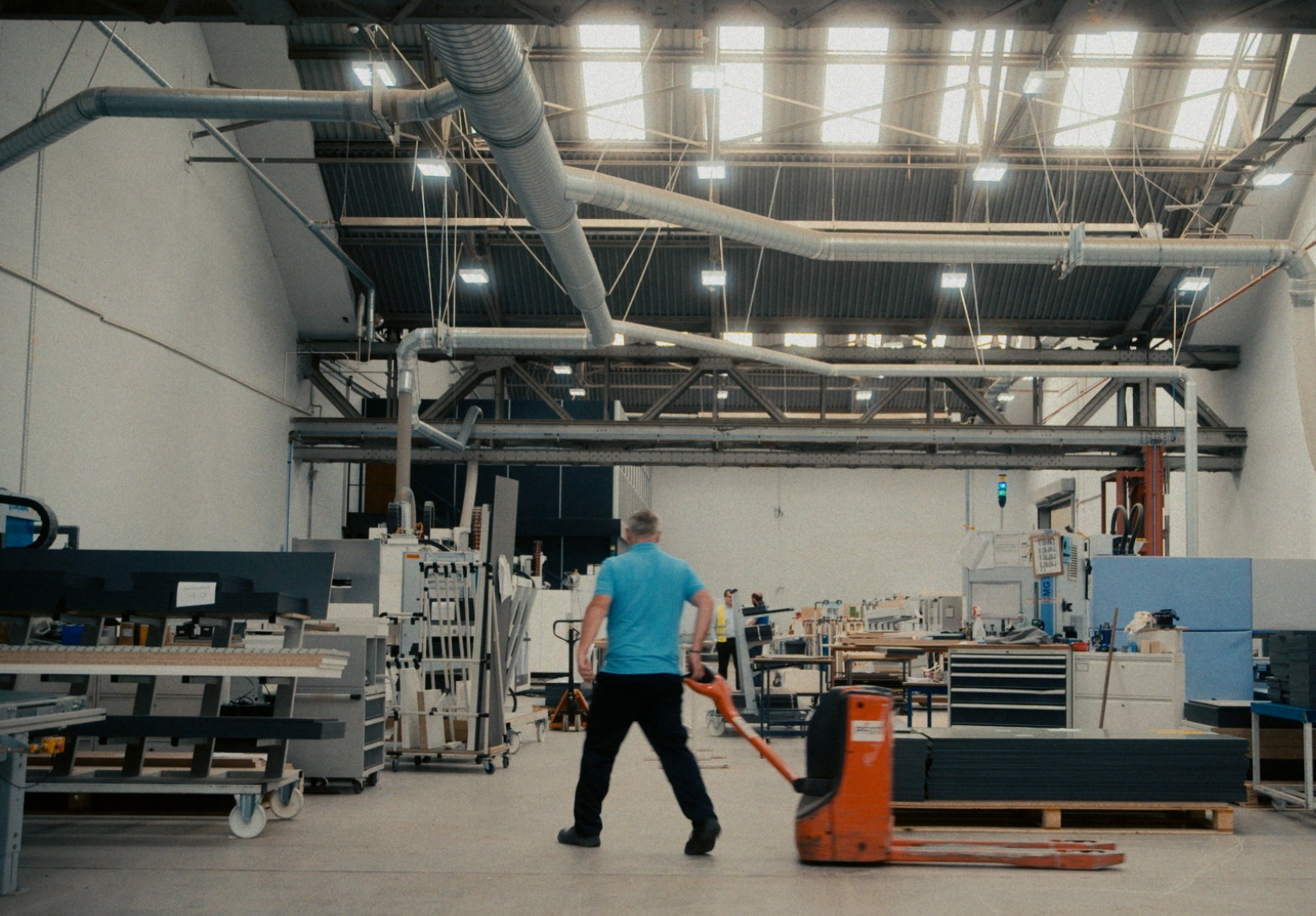
When walking around the factory, Chris highlighted the £80m investments that Bisley has been incorporating into its machinery, assets and overall production facility. “For us, digitalisation is essential. When you look at our machines, rather than seeing people operating them manually, you have an example of how everything can be pre-programmed digitally,” he explained.
Connecting design, production and customer experience
This starts at the design stage and continues right through the order process. “All of our assets are programmed directly from the design, which then drives how the products are manufactured.”
Bisley has also diversified into incorporating more intelligent tools on its website. “Now, when putting a quotation together, the customer is able to specify exactly what they are looking for and the pricing is provided,” said Richard.
This is then transferred to the customer service team who then process the order. “That’s then transferred through to the factory on the MRP system, and then through to invoicing, delivery and finally, track and trace,” he added. “Many of Bisley’s employees in the UK have been with the company for many years and have become used to production and processes.
But they have also embraced new technology and automation, and it’s been fantastic to see how they’ve adapted,” said Richard.
Navigating supply chain challenges post-Brexit
“As a UK business, we ship to over 50 countries worldwide, including our own subsidiaries, so that has presented us with logistical challenges since Brexit. We initially made some minor errors due to the change in paperwork requirements involved in the process. However, we took the time to train and educate our teams on the changes needed to ensure it was completed correctly. If your paperwork is incorrect, the delivery will not make it into its destination country,” added Richard.
Strengthening local supplier networks
To further aid this process, Bisley is attempting to diversify and find more local suppliers to help address and tackle some of the supply chain challenges that have faced the sector over the last few years. “Our mantra is to be as vertically integrated as we can by bringing as much of those processes into the Bisley fold as possible,” said Chris.
As the business begins new product journeys it is also looking for local suppliers and subcontractors to provide support on that path. “We’ve welcomed those suppliers, got on board with them, and visited their sites to develop an understanding of their issues as well as our own. It is a valuable front-end experience,” said Chris.
Learning from cross-industry collaboration
He also highlighted that this experience has served to broaden his horizons by allowing him to look at other industries to find out what they do and how they go about it. “As a designer, I’m naturally inquisitive about what can be achieved. Everyday I’m learning something new, continuing to evolve and push forward our product offering.”
Employee ownership and workforce engagement
Bisley was a family-owned business, founded by Freddie Brown who then passed and sold the company on to his son, Tony. And part of Tony’s legacy was the introduction an Employee Ownership Trust. “Right now, we have around 500 staff globally and every one of those employees participate in our Employee Ownership Trust after one year of employment,” explained Richard.
How the employee ownership trust works
Bisley gifted 51% of the ownership of the group to its beneficiaries (the staff members) free of charge. “They are not shareholders, but rather a beneficiary of the organisation. This means that should the company be sold in its entirety in the future, 51% of the value would be paid to the beneficiaries,” said Richard.
Improving retention and attracting talent
Bisley has found that the scheme has been a strong motivator for staff retention.
Not only that but Bisley can also offer EOT bonuses to its employees on a yearly basis, tax-free subject to performance and profitability. “It’s hugely attractive for prospective employees,” he added.
Future growth and business strategy
Bisley is on an upwards trajectory and for Richard, the company’s growth is focused around its selling channels. “We have diversified into online, working with B2C and B2B. I don’t want to start creating lots of new projects but rather, focus on delivering against our current objectives,” Richard added.
Expanding materials and market opportunities
Bisley plans to continue using wood, laminate, plastics, upholstery and soft furnishings as well as introducing a wider range of new materials to be used in furniture making. “While office furniture is still our stronghold, there are no boundaries around us gaining business in other sectors. When we are handed a customer floor plan we want to know that we can deliver what they’re asking, but if not, we can also work with partners to create their vision. That’s the driving force of the business,” said Chris.
Further reading
- Workplace trends and office design insights: British Council for Offices – research and guidance on modern workplace environments in the UK.
- Manufacturing digital transformation resources: Made Smarter UK – support and case studies on adopting digital technologies in manufacturing.
- Supply chain resilience and UK manufacturing: Make UK – industry insights on supply chain strategy and UK manufacturing trends.
For more articles like this, visit our Innovation channel.