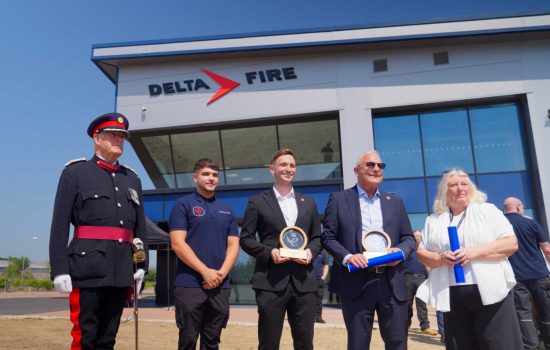


Delta Fire, a UK-based manufacturer specialising in high-performance firefighting equipment, won the Sustainable Manufacturing category at The Manufacturer MX Awards 2025. The Manufacturer editorial team paid a visit to find out more about the business and the secret sauce behind the award win.
While Delta Fire supplies fire and rescue services, defence and industrial sectors around the world, the company, based just outside Norwich, is best known for its high-performance fire nozzles, including the award-winning Attack Pro range, which has been widely adopted across UK fire services and exported to over 70 countries.
Key takeaways
- Delta Fire’s sustainability strategy is a major competitive advantage: The company won the Sustainable Manufacturing category at the 2025 MX Awards and also received a King’s Award for Enterprise. Sustainability is embedded across its operations, products, and long-term strategy rather than being treated as a standalone initiative.
- The company invested heavily in a net-zero manufacturing facility: Delta Fire spent £5.5m building a purpose-built sustainable factory featuring 100% rooftop solar generation, battery storage, air-source heat pumps, and rainwater harvesting. The facility helped the company achieve its 2025 net-zero energy goal while improving operational efficiency.
- Digitalisation and automation are driving manufacturing performance: Delta Fire uses robot-tended CNC machining, real-time machine monitoring, performance dashboards, and data-driven decision-making to improve productivity, quality, and waste reduction. The company views digital transformation as both a technology and people challenge.
- The firefighting industry is evolving due to new risks: Climate change, urbanisation, and emerging hazards such as lithium-ion battery fires are creating more complex firefighting challenges. This is increasing demand for innovative equipment, fluorine-free firefighting solutions, and more sustainable fire suppression systems.
- Long-term success depends on aligning sustainability, technology, and people: Delta Fire emphasizes that manufacturers should not treat digital transformation, sustainability, and workforce development as separate initiatives. The company has strengthened resilience through supply-chain diversification, apprenticeships, skills development, and a culture that encourages innovation and responsibility.
FAQs
- Why did Delta Fire win the Sustainable Manufacturing category at the MX Awards 2025?
- What sustainability features does Delta Fire’s new manufacturing facility include?
- How is Delta Fire using digital technology to improve manufacturing?
- What challenges is Delta Fire facing in the firefighting and manufacturing sectors?
- What advice does Delta Fire give manufacturers pursuing sustainability goals?
Delta Fire supports the extinguishing of the majority of fires in the UK every day and that impact is built on precision engineering, rigorous testing and continuous product refinement to meet the evolving demands of modern fire and rescue operations.
As a third-generation family business, Delta Fire combines engineering excellence with a strong focus on innovation, real-world operational performance and of course – as proved by last year’s award win – sustainability.
The business is ISO14001 registered, which provides a framework for implementing an environmental management system that can help the company deliver operational efficiency and sustainability.
Trends, processes and technology
Within the fire and rescue sector, Delta Fire has identified a clear shift towards more complex and volatile fire risks, driven by climate change, urbanisation and new hazards such as lithium-ion battery fires.
Alongside this, there is growing demand for fluorine-free firefighting solutions and again, more sustainable system design.
From a manufacturing perspective, digitalisation and automation are becoming essential, not optional, while defence and infrastructure investment – particularly in nuclear and energy – is creating new growth opportunities for the business.
Delta Fire’s manufacturing is vertically integrated, combining solar powered robot tended precision CNC machining, assembly, testing and quality assurance under one roof. The company designs and engineers products in-house, supported by advanced simulation and real-world testing facilities. This allows Delta Fire to maintain tight control over quality and continuously refine performance based on feedback from frontline users.

Of course, much of this advancement is underpinned by the deployment of digital technology, which is playing a key role in improving efficiency, quality and decision-making. Delta Fire is increasingly using real-time machine data, performance monitoring and digital dashboards to optimise production and reduce waste.
Like many manufacturers on a similar journey, challenges have emerged around integration; linking legacy systems with new platforms and ensuring the workforce is confident and trained to use these new tools effectively. However, Delta Fire has identified that this process is as much a people transformation as it is a technical one.
Additional challenges
The company has further recognised the supply chain issues of recent years. At The Manufacturer we’ve often spoken about two prerequisites for manufacturers wanting to strengthen their supply chains – namely to broaden sourcing options and to invest in existing partnerships.
Delta Fire has done exactly that and has built resilience through supplier diversification, stronger relationships and increased visibility across its supply chain. Where possible, the company has also brought more capability in-house to reduce reliance on external suppliers. The situation has stabilised compared to recent years, but volatility remains, particularly around geopolitical factors and raw material pricing.
Sustainability has evolved from a responsibility to a strategic priority at Delta Fire, which is integrated into production methods, energy usage and long-term strategic decision-making.
Challenges have emerged around technology integration, but this process is as much a people transformation as it is a technical one… It is vital to align digital, sustainability and people, rather than treating them as separate initiatives.
Jordon King, Head of Business Development, Delta Fire

Additionally, attracting and retaining talent has been a challenge for Delta Fire. Mitigation measures have seen the business actively engaging with schools, colleges and universities, offering apprenticeships and clear career pathways. Culture has also played a big part, and there has been a clear focus on giving people responsibility early, encouraging cross-functional learning, and showing that manufacturing can be innovative, purpose-driven and impactful.
While the company we keen to remind others about the importance of being proactive – such as investing early in digital capability, taking a long-term view on sustainability, and treating skills development as a strategic priority – it is even more vital to align these areas – digital, sustainability and people – rather than treating them as separate initiatives.
Blazing a trail
Delta Fire’s future strategy is focused on scaling the core product range globally, particularly in defence, nuclear and export markets. Alongside this, the business is set to continue its investment in R&D and intellectual property, ensuring it remains at the forefront of firefighting innovation. Unsurprisingly, sustainability will remain central to this strategy, not just in terms of operations, but also in the solutions Delta Fire provides to its customers.
Sustainability’s critical importance
As well as picking up the award in the Sustainable Manufacturing category at last year’s The Manufacturer MX Awards, Delta Fire also won a King’s Award for Enterprise for its sustainable development, recognising the company’s holistic approach, combining operational sustainability with product innovation.
Jordon King, Head of Business Development at Delta Fire, speaks about the role of sustainability within the business, the investment the company has made in this area and the award win.
Why has sustainability become so important to Delta Fire?
JK: Sustainability has evolved from a responsibility to a strategic priority at Delta Fire. As a business operating in fire and environmental protection, it was a natural progression for us. The increasing impact of climate change – particularly wildfires – has reinforced the importance of developing solutions that are both high-performing and environmentally responsible.
As a third-generation family business, we don’t have to prioritise shareholders, external finance providers or investors, so it’s been easy to focus on what’s important to us. Sustainability and doing right for the planet, people and our supply chain customers have always been close to our heart.
Delta Fire invested £5.5m in building a new sustainable facility – what did this entail?
We had lots of ideas on how we wanted to address and tackle climate change, focus on our sustainability objectives, and align them with the wider goals of the business.
This was always going to be a challenge in our old-world facility. We didn’t have ownership of the site, and that limited what we were able to do as an organisation. As such, we decided to take the leap and invest in our own facility.

Building our own site from the ground up allowed us to really invest in sustainability across the organisation This has resulted in a purpose-built, energy-efficient manufacturing site, featuring 100% rooftop coverage solar generation, battery storage, air source heat pumps and rainwater harvesting systems. It was designed not just to reduce emissions, but to improve operational efficiency and support future growth.
What were the key drivers behind the facility reaching its 2025 net zero goal?
Long-term resilience, cost stability and alignment with our values as a family business were integral to this investment. The main challenges were upfront capital investment, integrating new technologies and ensuring operational continuity during the transition. Achieving net zero required a whole-business approach rather than isolated initiatives, and a culture-driven process of continuous improvement.
Operating from a net zero energy manufacturing facility demonstrates that high-performance engineering and environmental responsibility can work together. Sustainability is integrated into production methods, energy usage and long-term strategic decision-making.
This approach supports increasingly stringent procurement requirements focused on carbon reduction and responsible supply chains, while maintaining the performance standards expected by fire and rescue services.
What advice would you give any manufacturers on a similar journey?
Start with a clear baseline and focus on the areas where you can have the greatest impact. Don’t underestimate the importance of leadership buy-in and workforce engagement. It’s also important to view sustainability as an investment rather than a cost.
Clear communication is also critical; without it, it’s very difficult to achieve meaningful change. We ensured that sustainability was embedded into the company culture, with regular updates, clear targets and visible leadership commitment. People need to understand not just what you’re doing, but why it matters.
We also measure sustainability success by tracking a range of metrics including energy usage, emissions across Scopes 1, 2, and 3, waste reduction and resource efficiency. KPIs are set based on both regulatory frameworks and internal targets, with a focus on continuous improvement rather than one-off achievements.
Is there a balance between profit and planet?
There can be in the short-term, particularly when it comes to investment decisions. However, in the long-term, sustainability and profitability are increasingly aligned. Efficient use of resources, energy independence and strong ESG credentials all contribute to a more resilient and competitive business.
Rather than being just a metric we measure, sustainability is becoming a significant differentiator. Customers are increasingly factoring sustainability into procurement decisions, particularly in public sector and large industrial projects. However, it must be backed up by performance – sustainability alone isn’t enough.
Our approach is integrated rather than superficial. Sustainability is embedded across our operations, products and strategy. Combined with high-performance engineering, this allows us to offer solutions that meet both operational and environmental requirements.
The next phase in our sustainability journey is about scaling impact, continuing to reduce emissions, expanding sustainable product innovation and supporting both customers and suppliers in their own transition journeys. We are also exploring new and complementary technologies such as a vertical wind-turbine (subject to planning approval) and approaches to further improve efficiency and resilience.
What was it like to enter and win at The Manufacturer MX Awards 2025?
The awards process is really thorough, which I think is a strong USP of the programme. It’s challenging, and it really sets you apart from other organisations if you win.
There’s so much credibility around the awards, to the extent that even being a finalist and getting through to that stage is a huge achievement and recognition.
I think the judges really liked our products which have been designed to be modular, so every part is replaceable. So, we’re able to educate our customers on the longevity of the product, reduce its emissions and optimise its lifecycle. It’s something our competitors simply aren’t doing as much.
For more articles like this, visit our Sustainability channel