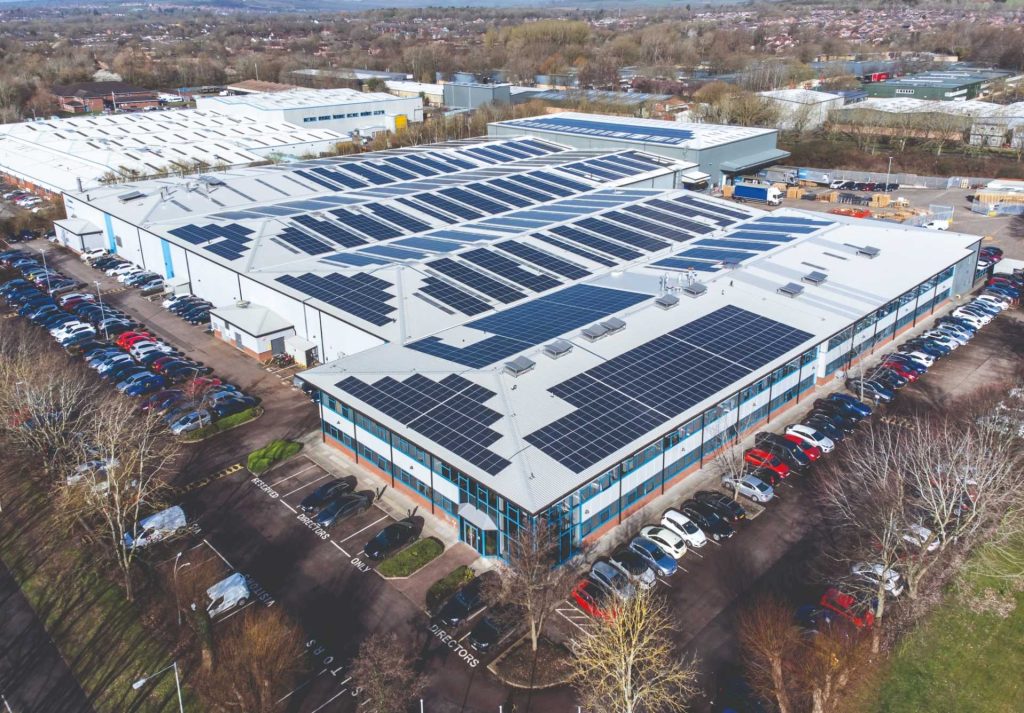
As FW Thorpe subsidiary Thorlux marks 90 years since it was founded in Small Heath, Birmingham, Non-Executive Chairman, Mike Allcock, reflects on what has kept the business competitive – resisting the temptation to outsource and offshore and instead backing local manufacturing and long-term investment in technology, with a consistent focus on innovation and quality.
During a trend of offshoring, why has local manufacturing remained important to Thorlux?
 MA: Historically, British engineering was highly regarded around the world and associated with quality, reliability and excellent products.
Today, the picture is different. For me, quality is designed into a product, it isn’t simply determined by where it’s manufactured. If you design quality into a product, it can be manufactured successfully in different parts of the world.
What has changed is that overseas manufacturers have become extremely capable. As a result, the argument for local manufacturing has shifted. Today, the benefits are often environmental and operational rather than purely quality-driven.
Manufacturing locally reduces transport emissions and therefore lowers the carbon footprint of our products. It also enables much higher service levels. We can respond quickly to customer requirements, shorten lead times and deliver products faster.
For a business like Thorlux, which offers hundreds of thousands of potential product variations, local manufacturing is especially important. It simply isn’t practical to wait weeks for highly customised products to travel around the world. Being close to the customer enables us to remain responsive and flexible.
Are there any technologies that Thorlux invested in that ultimately proved to be the wrong choice?
Honestly, I can’t think of any major technology investment that failed to deliver positive outcomes for the business.
What’s probably more significant are the technologies we deliberately chose not to pursue. OLEDs are a good example. At one point there was a great deal of discussion about OLED technology moving beyond displays and becoming a mainstream lighting solution, for example with illuminated ceilings and walls. I never really saw a compelling case for that becoming a dominant form of general illumination, so we chose not to invest heavily in it.
There have certainly been occasions where we’ve decided not to follow a particular trend because we couldn’t see a strong long-term future for it. But I can’t recall a major strategic technology investment that didn’t ultimately create value for the business.
How do you decide which technologies are worth investing in?
Broadly speaking, there are two ways to develop products. The first is to respond to market demand by developing products that customers already know they want. The second is to create something new that customers haven’t yet asked for but will eventually realise they need.
The iPhone is a classic example of the second approach. Before it existed, there wasn’t a widespread demand for a device that combined a phone, music player and internet browser. Somebody at Apple had the vision to see that opportunity before the market itself recognised it.

Personally, I’ve always preferred starting with known customer demand. If customers are already asking for a solution, you begin with a very strong commercial foundation because you don’t need to convince people that they need it.
The challenge, of course, is that competitors can see the same demand and are often developing similar products. That’s why the ideal situation is to identify genuinely unique opportunities, develop something original, secure intellectual property protection where appropriate and take it to market before anyone else.
When you achieve that, you’re competing in a much less crowded space.
Are there any products that exemplify the balance between market demand and long-term invention?
SmartScan, our lighting control platform, is probably the best example because it moved the business beyond luminaires alone and into energy management, lighting controls and data-led services.
In recent decades, SmartScan has become one of the technological foundations of our business. It’s a wireless energy management and lighting control platform, but it’s also a powerful data platform.
We write the software ourselves from top to bottom. Today, more than a million luminaires communicate with our servers every day, reporting their status and operational information. We built that capability in a unique, patented way and it fundamentally transformed the business.
Without SmartScan, I genuinely believe we would have struggled to remain competitive.
More broadly, we’ve had to reinvent ourselves several times over our ninety-year history as lighting technology has changed.
We’ve moved from incandescent lighting to fluorescent technology and high-intensity discharge lighting, compact and T5 fluorescents and then LED technology, and now the wireless revolution of lighting controls. Each transition required significant investment, new expertise and, in many cases, a complete rethinking of our products.
Kodak is often cited as an example of a company that failed to adapt when photographic technology changed. In lighting, we’ve faced equivalent technological shifts multiple times and have had to evolve each time in order to survive.
When I joined Thorlux in 1984, a typical luminaire consisted of a metallic enclosure, a ballast, a capacitor, a starter switch and a lamp. Today, a single luminaire can contain thousands of electronic components and tens of thousands of lines of software code. In effect, lighting has become a high tech manufacturing sector.
That transformation has required us to embrace electronics, software and connectivity while maintaining our traditional engineering strengths.
What role has training and developing your people played in the Thorlux story?
A good example of our approach is the leader of our software development department. He started here almost twenty years ago. Originally, he was brought in to implement our CRM platform – and had never written software. We identified his keenness to learn very early on, invested in his personal development and gradually expanded his responsibilities.
Over the years we’ve supported employees through external training, university collaborations and specialist development programmes. A particularly successful partnership with De Montfort University helped us embed advanced software expertise into the business.
That approach reflects a wider philosophy. We don’t simply buy in capability, we invest in developing it.
By building expertise internally, we’re able to retain knowledge, maintain control over our technology and respond much more quickly to changing customer requirements.
For more articles like this, visit our Innovation channel