Industrial agility among UK manufacturers and distributors has fallen to its lowest level in five years, according to the 2025 Industrial Agility Assessment from HSO and The Manufacturer.
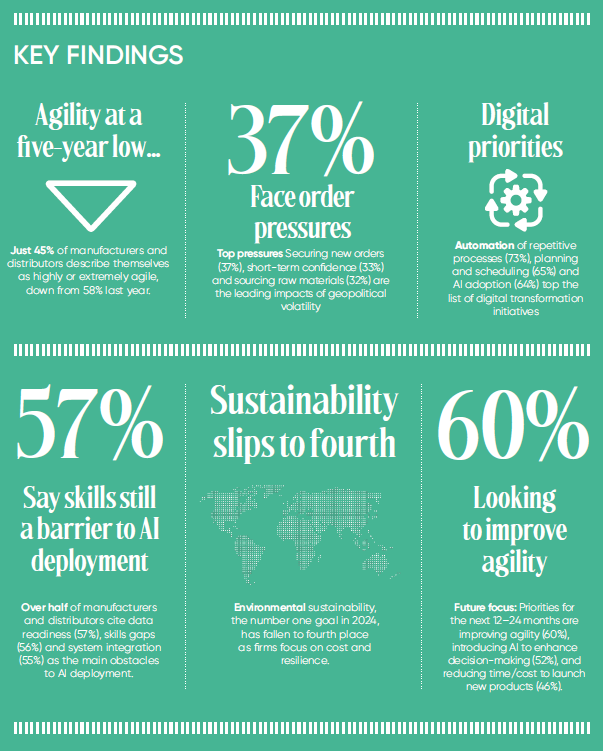
Indeed, just 45% of companies now describe themselves as “highly or extremely agile”, down sharply from 58% last year — a sign that industrial resilience is being tested by sustained disruption and organisational fatigue.
The report, now in its fifth year, paints a picture of a sector that has matured in its response to turbulence but is struggling to maintain pace under constant strain. While many firms are continuing to adapt, confidence and flexibility have eroded amid geopolitical instability, cost pressures, and talent shortages.
“Maybe we are more agile, but we’re still not agile enough, given the environment,” said one food and beverage managing director, capturing the growing sense of “agility fatigue” across the sector.
A fatigue born of constant change
The report notes that while manufacturers demonstrated remarkable flexibility during the pandemic, the challenge today is sustaining that agility in a climate of overlapping crises — from inflation and labour costs to volatile demand and shifting trade regulations.
Executives interviewed described a loss of momentum as repeated pivots drain energy and resources. Many cited “risk aversion” as a growing constraint, with overcapacity in some sectors and a more defensive investment climate limiting freedom to act.
“The more political volatility you have, the more companies tighten their risk posture,” observed one pharmaceutical leader. “That reduces the number of other risks you can take — and overall agility goes down.”
The result, according to the report, is not that manufacturers have lost the ability to change, but that change has become harder to sustain. Businesses are still responding quickly, but with less confidence and greater fatigue than in previous years.
Digital transformation continues, but unevenly
If agility is the outcome, digital transformation remains the key enabler. This year’s findings show manufacturers are prioritising automation of repetitive processes (73%), improvements to planning and scheduling (65%), and AI adoption (64%) as the main drivers of productivity.
However, progress remains uneven. Smaller firms in particular face barriers linked to investment capacity, skills, and legacy infrastructure. More than half of respondents cited data readiness (57%), skills gaps (56%), and system integration (55%) as the top challenges to deploying AI effectively.
For many, the emphasis is shifting from large-scale transformation to targeted, incremental improvements. As one SME leader put it: “We know what needs to be done, but the investment and the skills aren’t easy to find.”
AI adoption, while increasingly common, is also tempered by caution. Companies are using the technology to enhance planning, design and service operations, but are wary of over-reliance. “It’s useful to start the work,” said one food manufacturing director, “but you still need humans to check and correct it.”
Supply chain fragility and sustainability setbacks
The report highlights that geopolitical volatility continues to weigh heavily on industrial confidence. Securing new orders (37%), maintaining short-term business confidence (33%), and sourcing raw materials (32%) are the top areas affected by global instability.
Supply chains remain fragile, particularly for smaller producers competing for supplier attention against larger firms. Cross-border trade friction — particularly between the UK, Ireland and Northern Ireland — was cited as a persistent challenge due to shifting regulatory frameworks.
Meanwhile, sustainability has slipped from first to fourth place in manufacturers’ priorities. Once seen as a leading driver of innovation and competitiveness, environmental goals are now being overshadowed by cost and resilience pressures. Nonetheless, many firms continue to pursue sustainable practices where they align with efficiency or customer demand.
“If I can repair a £40,000 pump shaft for £10,000, that’s sustainability in action,” said one engineering leader. “We’re reducing waste and cost at the same time.”
Cautious optimism and a focus on fundamentals
Looking ahead, manufacturers’ top three goals for the next 12–24 months are improving agility (60%), introducing AI to enhance decision-making (52%), and reducing the time and cost of launching new products (46%). The emphasis, however, is on stability and measured investment rather than aggressive expansion.
Executives described a renewed focus on operational discipline and profitability. “We’ve shifted from pure growth to profitable growth,” said one food manufacturing leader. “You can’t just grow at all costs anymore — you need solid foundations and balance.”
This cautious sentiment runs throughout the report. While the sector continues to modernise, its ambitions are grounded in pragmatism. Leaders are investing in technologies that deliver tangible efficiency gains and resilience rather than chasing transformative change for its own sake.
Resilience over reinvention
Ultimately, the 2025 Industrial Agility Assessment concludes that UK manufacturing is entering a phase of consolidation rather than reinvention. Industrial agility remains essential, but it is now defined by the ability to adapt sustainably — balancing technology investment, workforce capability, and risk management without exhausting people or resources.
“Agility today is about building the resilience, efficiency and flexibility to adapt without burning out,” the report states. “Manufacturers are not standing still; they are strengthening their foundations for the next wave of change.”
Download the full report now to find out more
You’ll open the report PDF immediately.