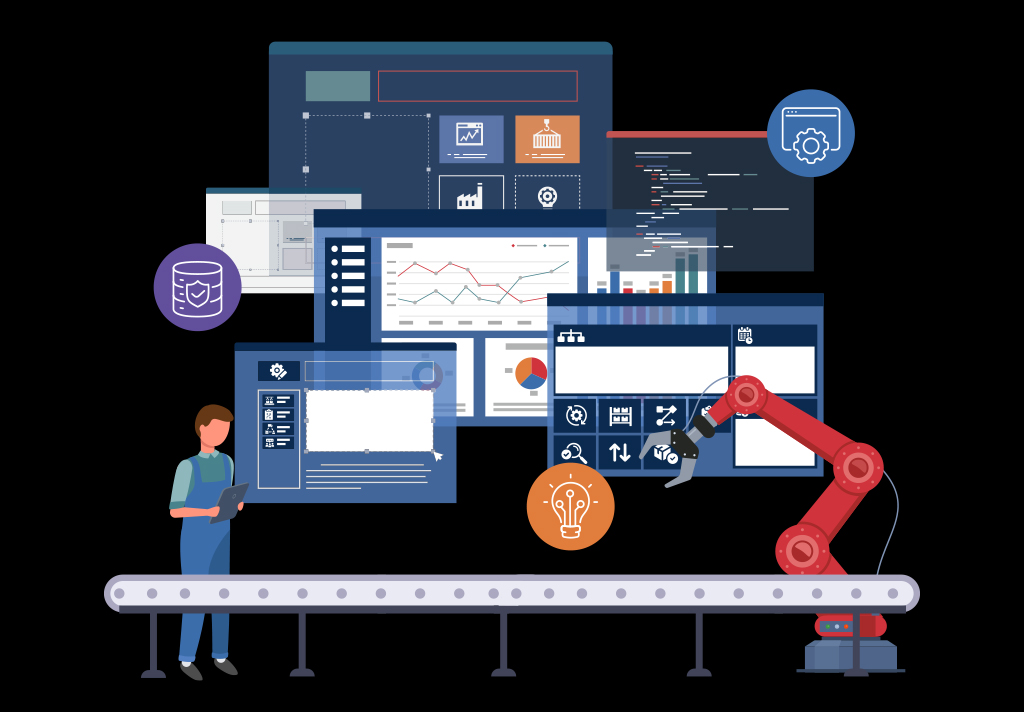
Rising quality demands, labour shortages, and rapid change are pushing MES back into focus as a foundation for more adaptable manufacturing. Manufacturers have lived with Manufacturing Execution Systems (MES) for decades. The systems were supposed to deliver efficiency and control. And in many cases, they did. The problem was the cost. Projects stretched on for years, burned through budgets, and left behind systems that could not bend when operations changed.
MES is changing. The latest systems are easier to run, quicker to deploy, and give manufacturers space to adapt. The real story is not just about software, but about giving operations the flexibility to keep up with markets that never stand still.
Why MES is back on the agenda
ABI Research recently found that MES and MOM (Manufacturing Operations Management) software now rank ahead of ERP, PLM, and even analytics on the list of technology priorities. Without a strong execution layer, all the data pouring out of machines and enterprise systems rarely turns into real improvement on the floor.
So, what is driving the shift?
- Labour shortages. The shortage of skilled people shows up on nearly every shop floor. MES cannot fill the gap, but it can make everyday processes easier to follow, preserve knowledge from experienced staff, and cut the time it takes for new people to get comfortable.
- Quality pressures. In aerospace, automotive, and medical devices, recent failures have made customers more demanding. Manufacturers need quality built into every step, not only checked at the end.
- Frequent product changes. Demand swings and customization mean lines must change often. Systems that cannot flex quickly become a drag.
- AI readiness. AI only works if the data feeding it is structured and reliable. MES provides the foundation for that.
From heavy systems to flexible platforms
Older MES platforms were often massive and difficult to adapt. That model no longer works. Companies now want modular systems that can start small with traceability or quality and expand as needs change.
Configuration is easier too. Today’s systems include most of the functions plants require right out of the box. Low or no-code tools also give operations teams the ability to tweak workflows themselves rather than relying on IT.
The effect is clear. Companies that can adapt quickly to new products or supply chain shocks are the ones that hold their ground. MES has become part of that agility.
The deployment question
Executives weighing a new MES often start with deployment. Should it live in the cloud, or stay on site? Both approaches can work.
Cloud MES is a good fit for companies that prefer not to manage their own server infrastructure. The real advantage lies in shifting maintenance, updates, and IT overhead to the provider. Shifting maintenance to the cloud reduces the load on internal teams and supports faster scaling.
Cloud takes some of the strain off internal teams and makes growth easier. But plenty of manufacturers still want the control that comes with running systems on site, even if it puts more on the shoulders of IT. What you see most often now is a mix. Certain processes stay local while others shift to the cloud. That way, companies can adapt without being locked into one approach.
Making data work for you
The challenge on the shop floor is no longer collecting data. It is figuring out what to do with the flood of it.
An agile MES ties together machine signals, operator input, design information, and quality records in one place. That kind of context gives teams a clearer, more trusted picture of what is really happening.
The benefits show up fast:
- Root causes of defects are found sooner.
- Predictive maintenance becomes more accurate.
- Traceability improves, which helps compliance.
- Operators gain confidence in the data they see.
Industry standards for data exchange are making a difference. By giving systems a common framework, they reduce the need for one-off integrations and help lower both cost and rollout effort across sites.
Empowering the workforce
Most factories are still feeling the pinch of tight labour markets, and there is little sign of relief.
Low or no-code MES can close some of that gap. It allows frontline teams to adjust dashboards, workflows, and even simple applications themselves. Tasks that once needed IT programming can now be handled on the floor.
The impact is twofold. Deployment moves faster and costs less, while the system itself becomes easier to adapt when lines or products change. For IT, it removes a backlog. For operators, it creates ownership and confidence.
Looking forward
MES is no longer something you install and then ignore. It has become the foundation for improvement, real-time decision making, and closer collaboration between people and machines.
When evaluating MES today, executives should ask:
- Will it help IT and OT teams work together rather than apart?
- Does it provide the data structure needed to make AI and analytics practical?
- Can it grow with us instead of holding us back?
- Do the deployment options fit our long-term strategy?
MES is not just about passing audits. If the MES solution is deployed well and culturally adopted as an integral part of the manufacturing operations, it gives manufacturers the structure to manage complexity, keep quality consistent, and finally get value out of digital programs.
Next steps
For those who want a deeper view into these issues, such as cloud and on-premises choices, low or no code, and data contextualization, the latest ABI Research whitepaper, developed with Aegis Software, offers practical guidance. It explores trade offs, shares best practices, and explains how MES is evolving to meet the challenges of today’s factories.
Click Here to Download Whitepaper

Deb Geiger
Deb Geiger is VP of Global Marketing at Aegis Software, brings extensive experience in global marketing leadership across enterprise software and manufacturing technology sectors.
For ore articles like this, visit our Digital Transformation channel.