

A collaborative trial at the National Manufacturing Institute Scotland (NMIS) has demonstrated how private 5G networks could help manufacturers meet growing demands for secure, reliable and high-capacity connectivity as production environments become increasingly data driven.
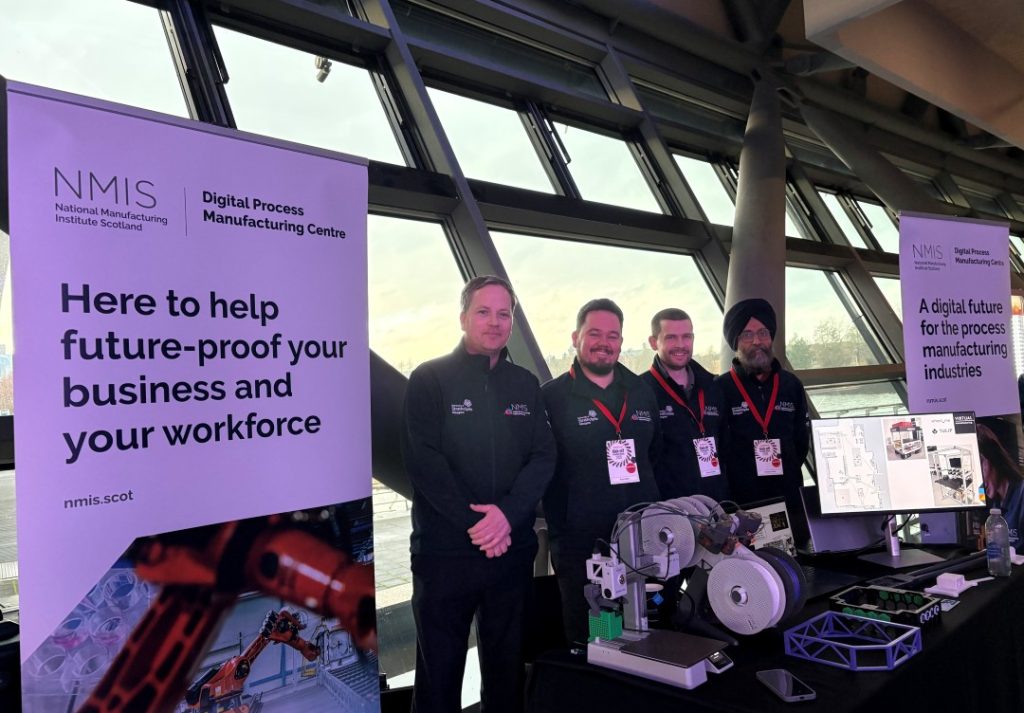
The project, conducted at NMIS’s Digital Process Manufacturing Centre (DPMC) in Irvine, explored how private 5G infrastructure performs under manufacturing-style conditions, providing practical insight into a technology that many businesses are still evaluating for future deployment.
Part-funded by the Department for Science, Innovation and Technology’s 5G Innovation Programme in Ayrshire, the initiative brought together NMIS, Merck, North Ayrshire Council and Folk Consulting to test the capabilities of a private 5G mobile network within a controlled industrial setting.
To replicate real-world manufacturing conditions, engineers created a simulated plant room environment based on industrial processes used by Merck. The testbed incorporated representative manufacturing equipment, including pumps, fans and control systems, while avoiding the use of live operational data.
Working alongside Folk Consulting, NMIS developed and validated a data generation approach designed to mirror industrial data flows. The network was then subjected to progressively increasing loads to assess performance under growing demand.
Testing recorded average data throughput exceeding 97 megabits per second (Mbps), with peak speeds surpassing 100 Mbps. According to the project team, the results indicate the network could support hundreds of similar industrial environments simultaneously.
The findings come as manufacturers continue to explore digital technologies that can support greater automation, real-time monitoring and data-driven decision-making. Reliable wireless connectivity is expected to become increasingly important as more assets, machines and processes are connected across factory environments.
Ross Miller, senior engineer at the DPMC, said the project was designed to move the discussion around 5G beyond theory and into practical application.
“There’s a lot of discussion around what 5G could mean for manufacturing, but far less clarity on how it performs in practice. By testing a realistic industrial scenario, we’ve been able to demonstrate how private 5G could support future manufacturing environments and help businesses better understand the opportunities it could offer.”
Beyond demonstrating network performance, the project also established a repeatable methodology that manufacturers could use to benchmark private 5G systems against existing connectivity solutions before making investment decisions.
Merck, which supported development of the industrial use case, approached NMIS to investigate how advanced wireless connectivity could support the next stage of its digital transformation journey. The company already operates advanced manufacturing facilities globally and has experience using connected technologies across its operations.
The project also reinforces the role of the DPMC, operated by the University of Strathclyde and part of the High Value Manufacturing Catapult, as a test environment where manufacturers can assess emerging technologies before committing to large-scale deployment.
Louise Kirk, director of regional economy at North Ayrshire Council, said the initiative highlighted the benefits of collaboration between industry and the public sector.
“This project demonstrates what can be achieved when industry and the public sector work together with a shared purpose. By creating an environment where businesses can test and explore technologies like 5G in a controlled, practical way, we can build confidence locally and attract the investment needed to support the infrastructure required for the next generation of manufacturers.”
Jack Waland, 5G specialist at Folk Consulting, added that the project provides a practical framework for manufacturers considering future adoption of private 5G technology.
The work forms part of the Ayrshire 5G Innovation Region programme, a key element of the wider Ayrshire Growth Deal, which aims to accelerate the adoption of advanced connectivity technologies through infrastructure development, skills programmes and industry collaboration.
For more articles like this, visit our Digitalisation channel