

A circularity ethos and hand-made heritage are at the core of Lancashire-based shoe manufacturer LANX. The Manufacturer Editorial team headed north to find out more about what makes this British success story tick.
Situated just outside Clitheroe in Lancashire, LANX has been manufacturing its various ranges of footwear for just shy of a decade and is the brainchild of Founder, Marco ‘Marv’ Vaghetti.
Q&As
- How did LANX get started?: LANX was founded by Marco “Marv” Vaghetti after a 2016 trip around Asia, where he studied traditional, hand-made shoemaking. The business launched in 2018 with a small collection of men’s footwear, initially selling through Lancashire market stalls. This gave LANX direct insight into customer needs and helped shape the business into the £10m+ company it is today.
- How does sustainability influence LANX’s approach?: Circularity is central to LANX’s business model. Through its RE-LANX service, customers can have footwear repaired or trade in worn shoes for credit. LANX then restores and resells suitable footwear, helping extend product life and reduce waste. The company is also working towards zero landfill and replacing plastic packaging components with more recyclable alternatives.
- What makes LANX’s footwear more durable?: LANX focuses on using high-quality, durable materials designed to last and develop character over time. Its footwear typically uses 1.6–1.8mm leather, compared with an industry standard of around 1–1.4mm. The company also embraces natural marks and variations in leather rather than discarding hides that have character, supporting its “Get ’em worn” philosophy.
- How important is UK manufacturing to LANX?: British manufacturing and Lancashire heritage are key parts of LANX’s identity. All of its accessories and the majority of its footwear collections are made in the UK, while carefully selected partners in countries such as Portugal and India provide additional expertise and capacity. This approach allows LANX to maintain quality while building a more resilient and flexible supply chain.
- What are LANX’s plans for the future?: LANX plans to continue growing while expanding its manufacturing capabilities in the North West. The company wants to build on its core product range, strengthen its Lancashire factory and continue combining British craftsmanship with durability, repairability and sustainable design. Its aim is to demonstrate that sustainability and commercial growth can work together rather than being trade-offs.
A 2016 road trip around Asia saw Marv pay a visit to ten different countries where he absorbed as much as he could about highly-skilled, traditional, hand-made shoe manufacturing. He identified a niche in the market to bring something new to consumers, and so, two years later, LANX went live, offering a small collection of men’s footwear – the original identified target market.
But LANX’s story is one of gradual growth. Rather than moving directly into a factory environment, the company’s early years were spent promoting and selling the first ranges on Lancashire market stalls. These humble beginnings enabled the business to get up close and personal to its key customer base. “Those early days were the perfect playground to understand what consumers actually wanted,” commented Matt Yates, Product Director at LANX.
This has helped shape the company into a £10m+ business today, and one that is not afraid to challenge the norm and take risks. Today, the range includes Chelsea boots, boat shoes, trainers and sneakers – sold to a 50-50% male/female clientele – as well as accessories such as bags, belts and wallets.
Repair, reuse, recycle
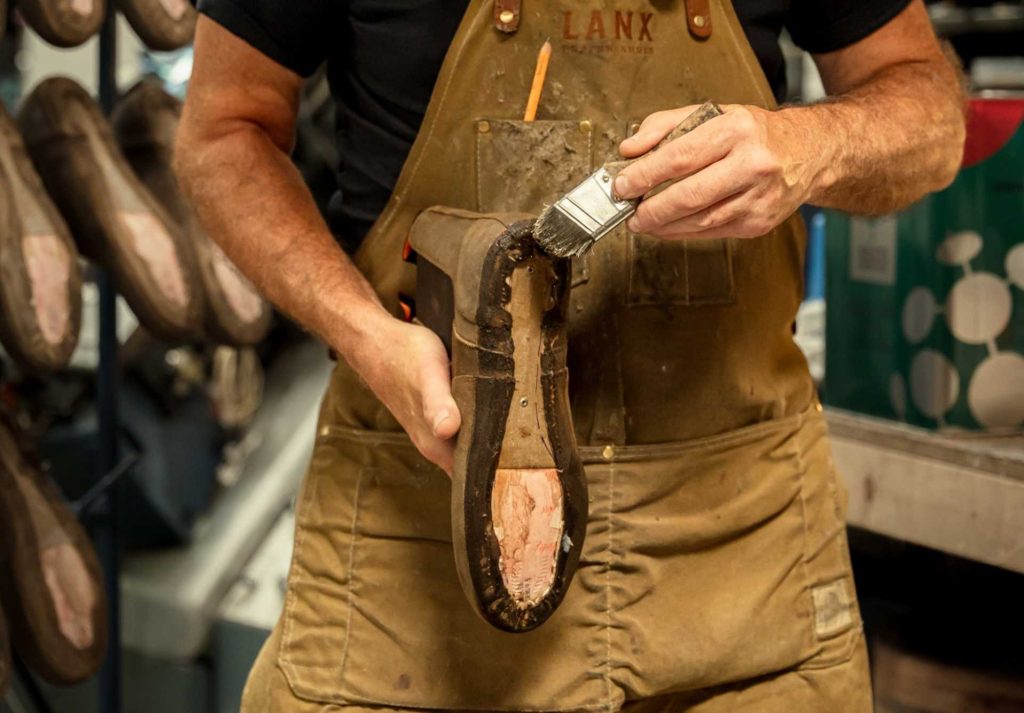
Not only that but circularity is at the heart of the LANX ethos, and the company also offers an in-house repair and trade-in service, RE-LANX. Based at its Whalley factory, all LANX footwear can be restored using the same materials, machinery and expertise used to make the original product. Not only that but feedback from the repairs team helps improve future designs.
“RE-LANX is an opportunity to give boots a new lease of life,” Matt added. “We can either perform a repair for the original owner, or we have a trading system where customers can send worn footwear to us in exchange for credit. We can then use like for like components to bring that pair of shoes or boots back to life, and then sell them onto the market for a considered price. That footwear will then go to a new, loving home.”
LANX is also working towards zero landfill by taking back worn products, disassembling them where possible and partnering with recycling specialists to keep materials in use for longer.
In addition, the company take a considered approach to how it sources and uses the key component in the manufacture of all its products – leather. To ensure durability and longevity, LANX footwear typically uses 1.6–1.8mm thick leathers, well above the industry standard of 1–1.4mm.
Matt added: “This method may be more expensive, but it simply results in a better end product. We just know that the more attention that we can give to these characterful leathers, the more our customers will wear them, and to us, that is more sustainable in the long run. And it plays into our ‘Get em’ worn’ ethos.”
LANX only use LWG (Leather Working Group)-rated tanneries, ensuring full transparency through material biographies and verified standards around restricted substances.
Many of the leathers used by LANX are designed to age, patina and develop character over time. This is something the business consciously leans into, including areas of the hide that other manufacturers might discard, such as those with vein marks, oil variation and natural surface character.
Matt added: “With leather being the main material in our shoes, we’ve taken a lot of time to carefully source the hides we use and the different tanneries we work with. We have to do a lot of forward planning while also making sure we’re ordering enough leather in good sizes so that we can achieve good colour consistency.
“For example, we recently looked at moving from a shoulder leather – which has done really well for us in the past – to a side leather, because it gives a better appearance. Although it’s more expensive, it enables us to cut down on waste. Financially it might cost a little more, but it’s more sustainable.”
Increased data has also enabled LANX to make much more informed decisions, based around its customer profiles. For example, the business has just undergone a full revamp of its Craftsmen range, taking all the leathers that have performed well in other ranges, and bringing them together into the Craftsmen collection.
“We also know that customers, on average, buy 1.4 pairs of shoes from us each year and one of our goals is focussed on increasing that. We will therefore set up a seasonal wardrobe for our customers,” Matt added.
“For example, if we know that our Garstang Chelsea Boot is a high first time purchase, we know that a second time purchase shoe might be one of our sneakers, so our merchandising is driven by data around what is a common first time/second purchase etc. Having that visibility helps us to determine if we’re on the right path.”
Sustainability and locality is also key to the future direction of the business as most of the cardboard used in LANX’s packaging is made locally at Cardboard Box Co. while the business is also moving away from plastic handles on its boxes entirely, replacing them with a cotton lace for in-store orders by the end of this year.
For online orders, boxes will be sent without handles entirely in order to reduce waste. Foam dividers inside the shoeboxes are also being phased out in favour of other recyclable materials by 2027.
The close work with the local community is part of the reason why LANX has taken a conscious decision not to rely on carbon offsetting – instead, focussing on reducing impact from the beginning of the manufacturing journey.
“I’m sure carbon offsetting is valid for some other businesses, but for us, that’s not a big driver,” added Matt. “We’re much more focused on extending the life of our products, and designing them so that they can be repaired in-house.”

UK heritage
Although the majority of LANX’s purchases are made online, the company is also staying true to its roots and wants to maintain the philosophy of its beginnings. As such the company is still selling at in person events and county shows, and has recently attended the Royal Highland Show in Edinburgh, taking the opportunity to keep in touch with customers and raise brand awareness.
Footwear manufactured at LANX’s Whalley factory is predominantly cementlasted (or cemented) construction, a method where the upper is bonded directly to the outsole using adhesive, creating lightweight, flexible, durable footwear efficiently. Though they are generally difficult to resole, the evolution of technology is making this far more practical for LANX today.
That being said, the business also offers Goodyear welted footwear across its partnership network; a premium shoe construction method where a strip of leather or rubber (the welt) is stitched to the upper, lining and a canvas rib on the insole.
The outsole is then stitched directly to the welt, creating a durable, waterresistant shoe that can be easily resoled – something that LANX haven’t had to worry about just yet, as the business only launched in 2018 (with the life on its premium products being somewhat longer than that).
“Historically, Goodyear welted has always been easier to re-sole,” Matt continued. “However, more research has been done in recent years to find better binding agents, where at a certain temperature, the glue can reactivate. This makes it easier to replace worn soles with new ones. And that’s something we’re doing across the business now, including on our entry level products.”
The British made heritage, and the company’s Lancashire roots, are something that is certainly a key part of the LANX DNA. All of the company’s accessories and the majority of the footwear collections are made in the UK, which helps maintain a close connection to the local community, and a commitment to the highest level of quality control.
That’s not say that the company is closed off to assistance from elsewhere, as Matt continued: “We have overseas factories in places like Portugal and India which are very important to us. We opt to work with overseas partners for our entry level products and where we perhaps lack specific skills in the UK. For example, if we are manufacturing a waterproof boot, there are suppliers abroad who are much more geared up for this construction. This ensures the products are the very best they can be.
“Since the disruption caused by the COVID-19 pandemic in 2020, we’ve recognised the importance of building a resilient and flexible supply chain. While we’re proud to manufacture footwear in Lancashire, we also work with a carefully selected network of manufacturing partners and suppliers in both the UK and overseas for footwear, leather and components.
RE-LANX is an opportunity to give boots a new lease of life. We can either perform a repair for the original owner, or we have a trading system where customers can send worn footwear to us in exchange for credit.
We can then use like for like components to bring that pair of shoes or boots back to life, and then sell them onto the market for a considered price. That footwear will then go to a new, loving home.
Matt Yates, Product Director, LANX
 RE-LANX is an opportunity to give boots a new lease of life. We can either perform a repair for the original owner, or we have a trading system where customers can send worn footwear to us in exchange for credit.
“This diversified approach helps us maintain a consistent supply of materials and finished products throughout the year. If one supplier, or even an entire region is affected by unforeseen disruption, we’re able to adapt quickly by sourcing from alternative partners.
“For us, supply chain resilience isn’t just about maintaining production; it’s about protecting the long-term sustainability of the business. It enables us to continue serving our customers, provide stability for our workforce and support the skilled jobs that are central to the future of British footwear manufacturing.”
Looking ahead LANX is aiming to continue the trajectory of growth that it has established over the past eight years. Plans are in place to build on the strong core range and to grow its manufacturing capabilities in the North West.
“We’ve got quite a small factory at the moment, but ambitious ideas,” added Matt. “Running a factory in Lancashire is not an easy thing to do, but it’s something that is important to us.
“We’ve been in existence for less than ten years, so in terms of where we’re trading versus our competitors who have been in business a long time, it can be quite daunting that we’re now positioned alongside them. We differ because our footwear has a more rough and rugged look which plays into our ‘Get ‘em worn’ ethos.”
From market stalls to a thriving £10m business, LANX has built its success by combining British craftsmanship with a commitment to durability, repairability and thoughtful design. There is often a misnomer in manufacturing that investment and focus around sustainability and circularity will ultimately mean trade-offs in other parts of the business, however, this Lancashire brand is proving sustainable growth and quality can go hand-in-hand.
For more articles like this, visit our Sustainability channel