

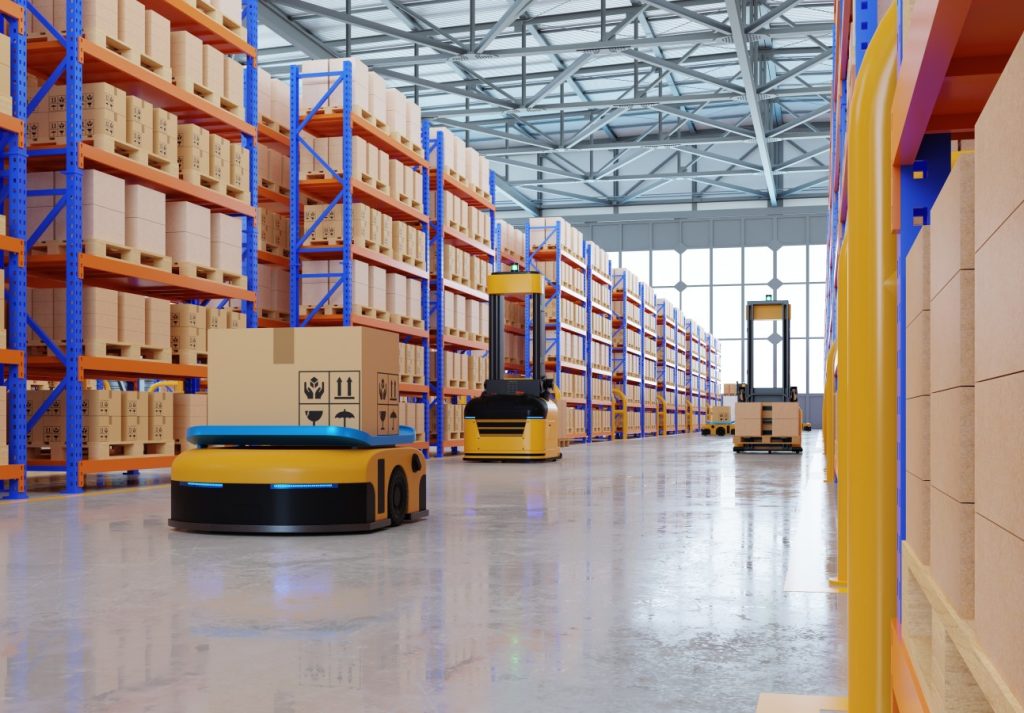
In this exclusive op-ed for The Manufacturer, NXP Semiconductors’ Dr. Nicolas Lehment argues that truly productive autonomous mobile robots (AMRs) depend not just on bigger batteries but on safety-driven sensing, intelligent power management and certified reference designs that turn every joule into useful work while extending runtime, reliability and fleet scalability.
Dead robots don’t move pallets. Anyone who manages a fleet of AMRs knows that battery capacity quietly dictates every KPI that matters – runtime, mission throughput, charge-bay density and, ultimately total cost of ownership (TCO). But raw watt-hours are only half the story.
To keep platforms productive, a battery-smart architecture is required, and it needs to include safety-first sensing, intelligent battery management, and system-wide power discipline so every joule does useful work instead of disappearing as heat or idle overhead.
Safety and sensing: the must-haves in a modern BMS
Let’s start with fundamentals. A robust battery management system (BMS) should continuously measure cell and pack voltage, current, and temperature, and use those inputs for both protection and optimization. The goal is to maintain peak performance without compromising safety or battery longevity. Ultimately, a well-designed BMS ensures that high-power subsystems receive adequate energy while minimizing unnecessary draw during low-demand periods.
That means fast, deterministic responses to over/under-voltage, over-current and over-temperature; fault-tolerant isolation paths; and cell balancing to prevent localized stress that shortens life. Just as important, the BMS must understand context: whether the robot is accelerating, lifting, docking or idling, because safe limits and available power are different in each state. Modern battery systems rely on embedded controllers to continuously track voltage, current, temperature, and charge-discharge cycles.
Adaptive power scaling: stretching every charge
AMRs can waste surprising amounts of energy, such as perception pipelines (step-by-step process that turns raw sensor data into a live understanding of the robot’s surroundings) processing more pixels within their imaging sensors than the task needs, compute cores idling at peak clock frequency, and radios unnecessarily chattering at full transmitting power. A battery-smart robot ties those loads to mission context and battery state.
This is where low-power microcontrollers (MCUs) and real-time control domains are truly valuable. A common pattern is to split the platform into a real-time safety and power domain (BMS, motor drives, watchdogs) on deterministic MCUs, and a variable-performance domain (navigation, mapping, perception) on application processors that can dynamically change performance points.
Dynamic power scaling allows processors to throttle frequency and voltage based on workload intensity. For example, during idle periods or between tasks, non-essential components can enter low-power states. Likewise, wake-up modes allow the system to resume full operation without the need for a full reboot.
Modern AMR reference designs show how to wire this together with distributed compute at the edge: imaging sensors pre-process data locally to reduce bandwidth; navigation cores
focus on fusion and planning; and MCUs orchestrate subsystem sleep states, clocking and voltage scaling. This keeps big CPU/GPU clusters in low-power states for longer. In practice, it’s possible to trims milliseconds of latency, saving watt-hours across a shift without sacrificing navigation quality.
Reference designs that de-risk certification
Design teams don’t have the luxury of discovering safety the hard way. Using proven reference designs around battery management accelerates both development and certification.
Such designs integrate protection circuitry, communication interfaces, and embedded algorithms for charge estimation and health diagnostics. By leveraging these building blocks, developers can shorten design cycles while developing power systems that meet regulatory and performance standards.
Reference designs for AMR subsystems include perception, navigation, motor control, and BMS also make it easier to demonstrate system-level behaviors that auditors care about. This could be anything from fail-safe braking on power faults, to deterministic emergency-stop technology, to safe recovery. Combined with a distributed compute architecture, the loss of a high-level computer doesn’t necessarily compromise power safety, with low-level controllers able to bring the vehicle to a safe state.
Closed-loop motor controls which embed encoder and sensor feedback can also trim wasted watts in starts, stops and alignment. It may not seem like a big issue, but small control errors add up to big energy drains across multiple robots and shifts.
Safer packs, longer shifts, better robots
Engineer the battery and power management as a first-class, all-encompassing system, incorporating accurate sensing, conservative protection, adaptive performance, and audited design references, and designing a better, smarter AMR gets easier.
Planning is steadier, certification is faster, and fleets of robots scale without surprises. In the end, the best robot is the one that’s doing useful work, and the smartest AMR is the one that’s still moving when others are searching for charging ports.
About the author
 Dr. Nicolas Lehment is Segment Lead, Robotics at NXP Semiconductors.
He leads NXP’s robotics team and oversees the industrial system innovation board. Before joining NXP, he designed cutting-edge computer vision and robotics systems for ABB and Smartray. He has collaborated on research papers for topics ranging from ML-driven video classification over human pose tracking to collaborative robotics. This academic work earned him a doctoral degree at the Technische Universität München.
For more articles like this, visit our Automation channel