
Nobody has ever mass-produced the nickel-hydrogen battery that powered the Hubble Space Telescope, so there was no off the shelf equipment to buy. In this exclusive op-ed for The Manufacturer, Henning Rath, Chief Executive of EnerVenue, explains how the company designed every machine on its new line in Changzhou, how the line is built to grow, and what a battery made to last thirty years means for industrial sites.
The cell that comes off our new line in Changzhou is about two metres long and weighs 70 kg. It is a sealed steel tube wrapped in glass-fibre composite, with a water-based electrolyte inside, and it looks a good deal more like a scuba tank than anything most people would call a battery. On 24 September we opened the first high-volume manufacturing line built anywhere in the world to manufacture it as scale.
The chemistry inside the cell is proven in the harshest conditions. Nickel-hydrogen cells powered the Hubble Space Telescope and the International Space Station for decades, in the one place where a failed battery could never be repaired or replaced. Those cells were built largely by hand, around a platinum catalyst, and the cost limited them to space missions. Professor Yi Cui’s laboratory at Stanford replaced the catalyst with low-cost materials, and EnerVenue was founded in 2020 to take the result to market. The challenge from there was manufacturing: producing the cell in volume, with every one identical, at a cost that makes long-life storage systems competitive for utilities and industrial customers.
Machines nobody had needed before
You can’t buy a stacking machine or a winding machine for an Aqueous Metal Cell, because until this year nobody needed one. Every machine on the Changzhou line was designed specifically for this factory. We placed the equipment order in October 2025, and three vendors each built a section of the line to our specification. Our engineers then integrated those sections into a single continuous production line, with every station reporting to one manufacturing execution system. Ground was broken in April, the first production cells came off the line at the end of September, and the line is ramping to full rate through November.
Every one of those machines was first engineered and tested on our development line, six kilometres from the factory. That is where our engineers worked out the solutions, refined each process and settled the settings, so every machine arrived on the high-volume floor ready to run. In my view that discipline is the main reason a line that had never existed before could open on schedule.
Built to last 30 years
The cell is designed for 30,000 cycles, up to three a day for thirty years, so the factory has to make each one exactly like the last. That requirement shaped every station.
The electrode stack is assembled on a high-speed stacking machine that positions each plate to within 0.05 mm, builds stacks of up to 48 layers and places ten electrode plates in 6.6 seconds, under a vision system that learns from what it sees. The steel tube is welded, and its end caps are laser-welded and inspected by camera. The power, focus and temperature of every weld are logged to the manufacturing execution system and backed up on the machine itself, so the record survives even if the network drops. The tube is then wound in glass fibre at 150 metres a minute, with the tension on each strand held within 1%, because that composite layer gives the cell its strength for the whole of its working life. Electrolyte fill, sealing and activation follow.
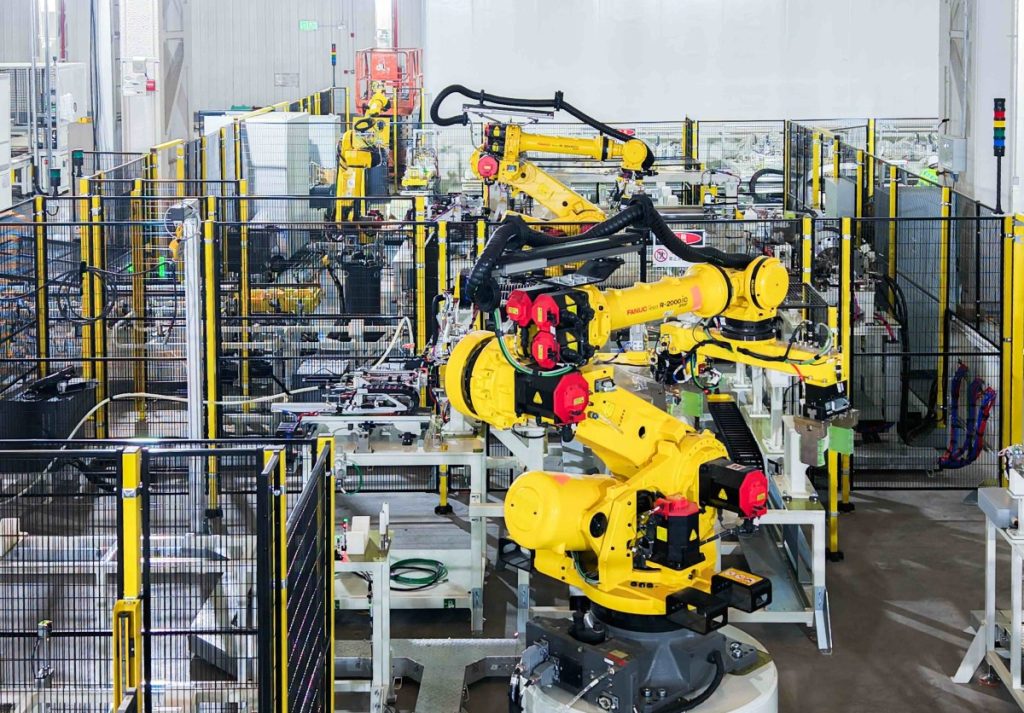
Thirty-two automated guided vehicles and 40 robots of three types move and handle the cell, so it crosses a hall 280 metres long and 72 metres wide without anyone carrying it. Along the way every cell passes 41 quality checks at 11 test and measure stations, covering weld integrity, electrolyte fill and leak testing. TJ Hua, who runs production, puts it simply: “Anyone can make one good cell. The job is making the ten-thousandth one exactly the same.”
Finished cells go fifty at a time into 150 kWh Energy Racks, which are assembled and tested on site before they ship. The rack line is designed to finish six racks a day, enough to take the full output of the cell line.
Capacity added one station at a time
The factory will produce 250 MWh of cells a year, around 300 cells a day at full automation, with production ramping to 1 GWh in 2027 and to multi-gigawatt-hour scale in 2028 as capacity expands. Its stations are standardised, so when a bottleneck appears we add another of that station rather than rebuild the line, and the floor plan already has details for a second phase of the same size in the same complex.
Changzhou gives us the industrial base to grow quickly. Around 160 battery-industry companies operate in the city, and most of what we need, from equipment makers to materials suppliers, sits within 50 to 100 kilometres of the plant. That lets us manufacture at scale and iterate on our designs quickly, because the people who build and adjust our machines are close by. EnerVenue is headquartered in the United States, where our intellectual property is held and our research and development is based, in Fremont, California. It is the model Apple and Tesla have both used: design in the United States, and scale production where the industrial base is deepest.
The cell is built from abundant materials, steel, nickel, glass fibre and a water-based electrolyte, with no lithium and no rare earths, which makes local-for-local manufacturing possible over the longer term. We intend to expand manufacturing into North America, and the Middle East and Europe are other potential regions.
What it means on the factory floor
Plenty of readers of this magazine are weighing battery storage for their own sites, to cut peak demand charges, store power from rooftop solar, or keep critical processes running through an outage. For that buyer, a storage system built on a cell designed for three cycles a day for thirty years, with no scheduled augmentation, behaves like any other piece of long-life plant: installed once and run for the life of the site.
The cell also carries zero risk of fire from thermal runaway. The electrolyte is water-based and non-flammable, and the chemistry does not produce the chain of events that ends in a battery fire, so storage can sit close to production lines, inside buildings and on sites where fire is the first thing a safety manager asks about. Fire protection is fitted wherever local codes require it.
The same chemistry comes in several sizes: the 30 kWh Energy Core for smaller and remote sites, the 108 kWh Energy Cube for in-building duty such as backup power, the 150 kWh Energy Rack for commercial and industrial sites, and Energy Prism containers for larger installations. A system with Towngas at Jintan, also in Changzhou, has been running since November 2025. EnerVenue cells have shipped to customers in the United States, Belgium and Saudi Arabia, and our customers include PowerSecure, Radiance Energy and Horizon Power. Our first multi-megawatt-hour commercial order is for 26 Energy Prism containers at an oilfield in northern China, a site where fire safety is a primary requirement, and the first of those containers ship in December.
About the author
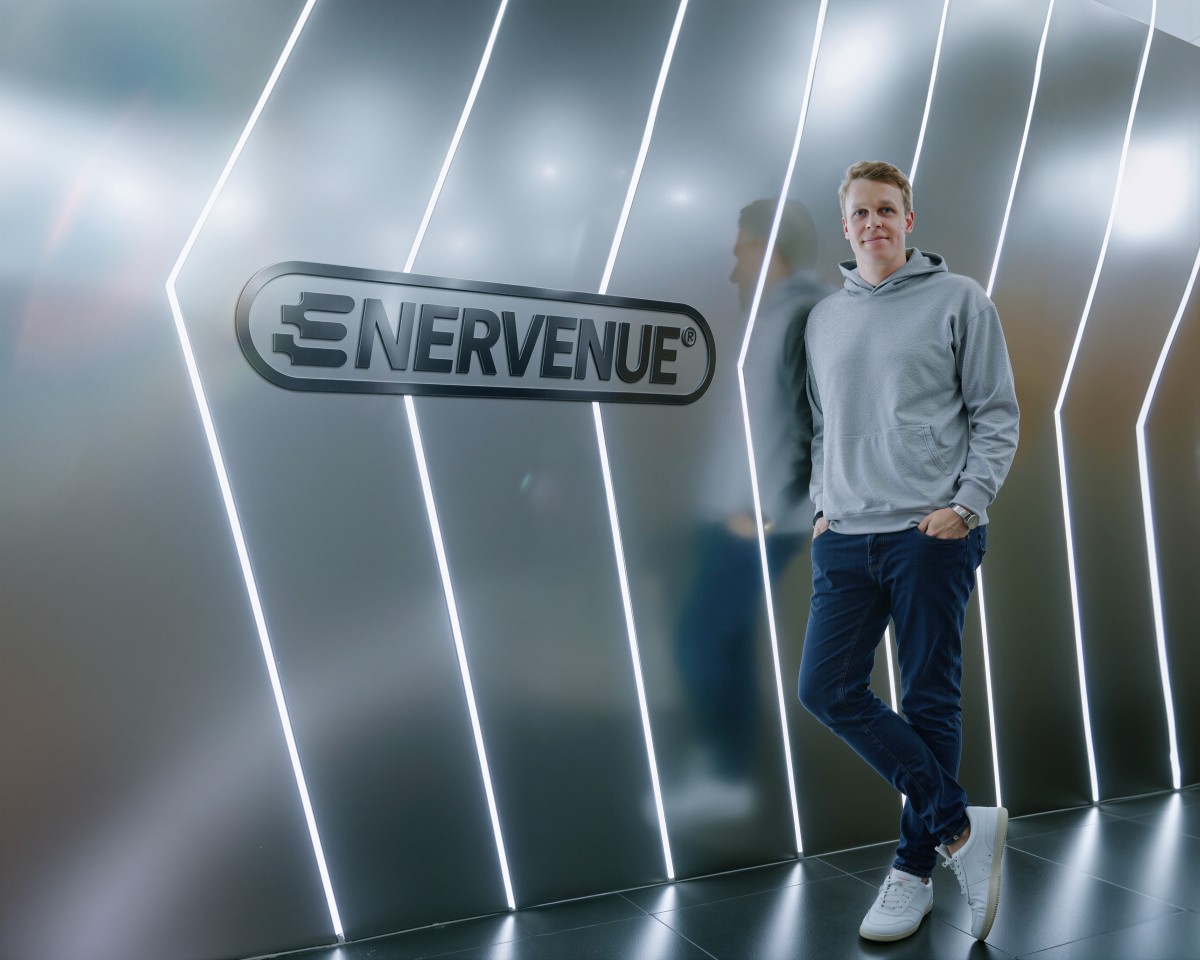 Henning Rath is Chief Executive Officer of EnerVenue, where he is focused on energy storage designed as infrastructure: endurance, safety and lifecycle economics ahead of short-term optimisation.
A German-born entrepreneur and technology executive, he has started and scaled companies at the intersection of climate, mobility and technology.
Before EnerVenue he was Managing Director and Chief Supply Chain Officer at Enpal, Germany’s leading residential renewable energy provider, working from China on supply chain strategies for cost, performance, sustainability and risk. Earlier he built Circ, the Berlin electric scooter subscription company acquired by Bird in 2020. He trained as an engineer and holds an MBA.
For more articles like this, visit our Automation channel