
In this exclusive op-ed for The Manufacturer, John Crane’s Mike Eason argues that manufacturers can make measurable progress on sustainability by using reliability-led engineering to reduce methane leakage, cut water and utility consumption, and prevent equipment failures without compromising production, safety or cost.
Manufacturers are being asked to reduce environmental impact without compromising production, safety or cost. The case for action is immediate: methane leakage accelerates warming and wastes valuable product; unnecessary water use adds pressure to clean supplies; and avoidable failures consume energy and materials while raising costs.
Reliability is central because many important losses occur continuously at equipment level. Methane escapes through seals and connections, clean water is consumed by sealing systems, and degradation can go unnoticed until an asset fails. Preventing these losses links environmental progress to uptime, resource security and business resilience.
That link matters amid economic uncertainty, technological change and volatile energy costs. Sustainability cannot wait for better conditions. Manufacturers need measurable improvements inside today’s plants, particularly in energy- and utility-intensive industries such as LNG, chemicals and mining.
The engineering response can be practical. Targeted equipment and maintenance interventions do not always require major capital projects. Better sealing, earlier diagnostics and lower utility demand can deliver measurable results, often within planned maintenance windows and without compromising uptime.
Methane reduction starts with preventable loss
Methane is one of the most important greenhouse gases to address. The International Energy Agency (IEA) estimates that it is responsible for nearly 30 per cent of the rise in global temperatures since the Industrial Revolution. Because it remains in the atmosphere for much less time than carbon dioxide, cutting methane can have an important effect on near-term warming. The IEA’s Global Methane Tracker 2026 estimates that fossil fuel operations emit 124 million tonnes of methane a year, around 35 per cent of methane emissions from human activity. The business case is also clear: concerted action in oil and gas could make nearly 100 billion cubic metres of natural gas available annually.
Containment remains important as industry adopts new energy carriers. Hydrogen is not a direct greenhouse gas, but hydrogen released into the atmosphere can reduce the hydroxyl radicals available to remove methane, extending methane’s lifetime and creating an indirect warming effect. Leakage control therefore matters across energy systems. On
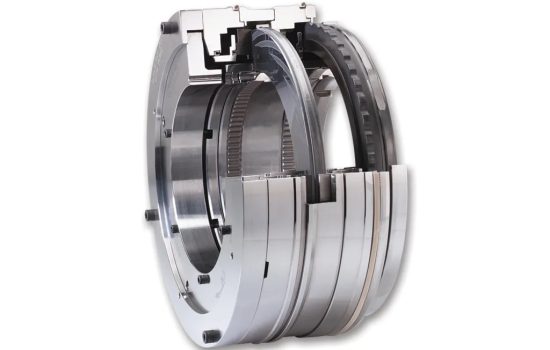
compressors, emissions can be influenced by seal selection and supporting systems. In a representative application modelled by John Crane, seal gas recovery could avoid the equivalent of more than 5,600 tonnes of carbon dioxide equivalent (CO2e) annually by capturing seal leakage that might otherwise be vented or flared. Actual savings will vary with the application and operating conditions. This intervention can also reduce product loss and improve asset performance.
Reducing water and utility demand at source
Water efficiency has an urgent human and operational dimension. The Intergovernmental Panel on Climate Change reports that roughly half of the world’s population experiences severe water scarcity for at least part of the year. Clean water must support communities, ecosystems and industry, so unnecessary industrial consumption adds pressure to constrained supplies. Equipment-level savings cannot determine how water is allocated, but they can reduce withdrawals and improve resilience to drought, restrictions and rising treatment costs. Treating, pumping, cooling and disposing of water also consume energy, so reductions can support lower-emission operations where those savings are measured.
At an LNG export facility in Louisiana, US, high-temperature hot well pumps had historically relied on an API Plan 32 continuous demineralised water flush, an effective but water-intensive approach. A targeted sealing upgrade maintained stable operation while largely removing the need for the external flush. Daily water use fell from around 7,570 litres (2,000 US gallons) to 11-15 litres (3-4 US gallons), an approximate 99.8 per cent reduction for that application.
The benefits reach beyond the pump itself. There is less load on water treatment and supply systems, less operational attention spent managing flows and fewer dependencies that can create downtime risk if conditions change.
The same principle applies in mining, where water stewardship is under growing scrutiny and pumping and treatment costs continue to rise. Seal water can be overlooked because it sits inside routine operations, but on continuously operating equipment even modest improvements compound quickly.
Underflow thickener pumps sit on the critical path of tailings handling. They move high-density slurry, so interruptions can have an immediate impact on production. In abrasive service, traditional packing arrangements can also drive high sealing-water consumption and frequent maintenance.
At a major copper mining operation, a mechanical seal retrofit on a production-critical tailings pump reduced the clean sealing water required by around 288,000 litres per day, based on comparison with a parallel packed pump and subject to site operating conditions. The retrofit was designed to align maintenance with the site’s planned annual major service interval, reducing the need for additional intrusive work and the associated safety and downtime exposure.
These examples show why water use deserves a place alongside emissions in industrial sustainability programmes. Saving water is not identical to reducing carbon, but both start with the same discipline: identify persistent sources of waste, establish a credible baseline and engineer them down without compromising reliability. This can ease pressure on shared resources while reducing cost exposure and system-level dependencies.
Digital diagnostics can reduce downtime and waste
Reliability-led sustainability is no longer solely a hardware question. Condition monitoring and diagnostics matter because they make hidden degradation visible early enough to act on it. When teams can spot abnormal behaviour before it becomes a failure, they can plan targeted interventions, avoid unnecessary strip-downs and reduce the emergency work that carries higher safety risk, higher waste and, often, higher emissions.
Modern sensor-based monitoring and near real-time diagnostics can support predictive maintenance by giving operators a clearer, continuous view of equipment health and performance. At one LNG facility, digital diagnostics identified abnormal behaviour early enough to help prevent an estimated eight-day unplanned shutdown. As well as protecting output, avoiding unplanned downtime reduces the knock-on disruption that often drives inefficiency elsewhere, from scrappage and expedited logistics to unstable restarts and repeated stop-start cycles.
A practical way to prioritise fast wins
For most operators, the challenge is not ambition but prioritisation. A practical reliability-led programme can start with three steps.
First, make the quiet loads visible. Map where continuous utility streams exist, such as seal water, cooling flows and nitrogen purges, and quantify consumption over time.
Second, target critical continuous-duty equipment. Focus on pumps and compressors that run around the clock or sit on the critical path. Small improvements compound quickly.
Third, measure outcomes in operational units. Track litres per day saved, tonnes of CO2e avoided and hours of unplanned downtime prevented. Record the baseline and assumptions so results can be verified and reported with confidence.
Decarbonisation and water security require long-term change, but manufacturers cannot wait for perfect conditions. Credible progress starts with the basics: contain climate-critical gases, cut persistent water and utility demand, and intervene before failure. Reliability turns these environmental priorities into measurable action while protecting production, safety and cost.
About the author

Mike Eason is Chief Technology Officer at John Crane, responsible for leading the company’s global innovation team.
Prior to joining John Crane in 2023, Mike served as the Divisional Board Director at James Walker, initially as the Technical Director and more recently as the Technical and Quality Director. Mike’s expertise covers sealing products for both rotating equipment and static seals, with extensive industry knowledge in oil and gas, wind, carbon capture, and hydrogen sectors.
Mike holds a Ph.D. in polymer science from the University of Warwick. He is a chartered engineer, fellow of the Institute of Materials, Minerals and Mining (IOM3), and a member of the Institution of Mechanical Engineers. Mike is also a member of the European Sealing Association executive committee.
For more articles like this, visit our Sustainability channel