

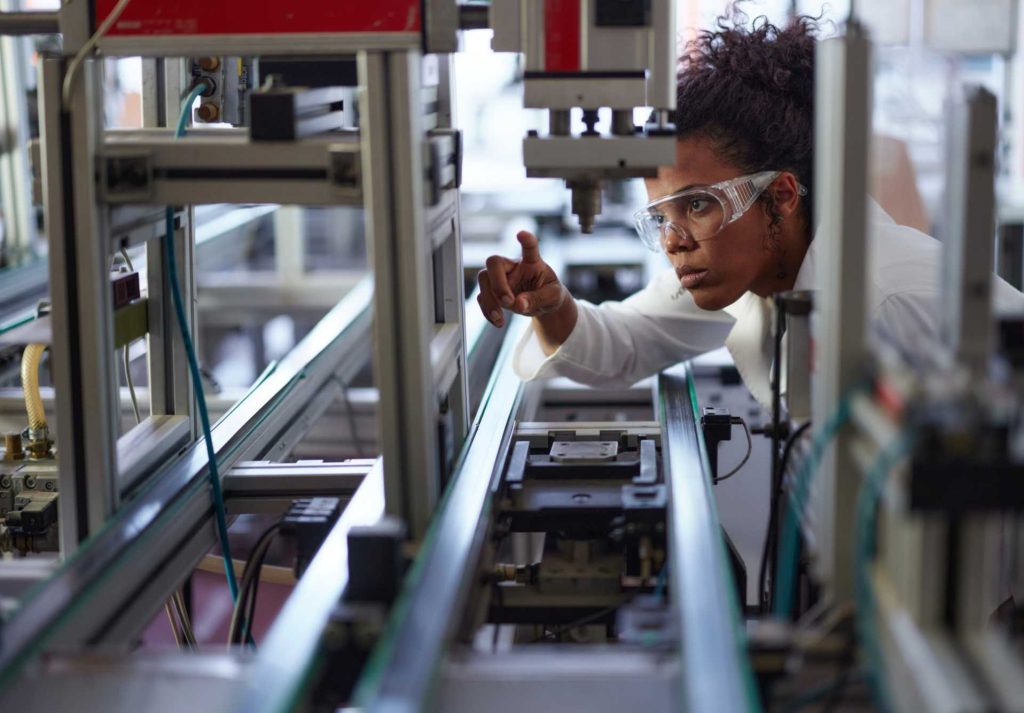
The gap between the adoption of AI, automation and digital tools in the manufacturing sector and the safety evidence behind it can be balanced, and this balance is critical to supporting confidence in, and enabling innovation.
Download The impact of emerging technology on safety at work to find out more.
This article from Nancy Hey, Director of Evidence and Insight at Lloyd’s Register Foundation, draws on research from the Global Safety Evidence Centre to explore the impact of new technology on safety at work and how the scale up of safety evidence, organisational readiness and regulation in the face of rapid adoption can be supported.
Key takeaways
- AI and emerging technologies offer major safety benefits, but evidence is lagging behind adoption: Technologies such as AI, automation, AR/VR, wearable devices, digital twins, and robotics can significantly improve workplace safety. However, many are being adopted faster than there is robust evidence to prove they are consistently safe and effective across different manufacturing environments.
- Some technologies improve safety, while others can introduce new risks: Tools like smartphone safety apps and AR/VR training have demonstrated positive impacts, including better safety engagement and improved training outcomes. In contrast, technologies such as algorithmic management, emotional AI, wearables, and cobots can increase stress, raise privacy concerns, and negatively affect worker wellbeing if not implemented carefully.
- Evidence gathering should be continuous, not a one-time exercise: Rather than waiting years for long-term studies, organisations should use pilot projects, case studies, and feasibility trials to assess new technologies early. Safety evidence should evolve alongside the technology through ongoing testing, monitoring, and adaptation.
- Successful adoption depends on organisational readiness, governance, and collaboration: Manufacturers should balance innovation with risk assessment by evaluating both the potential rewards and safety implications before deployment. Collaborative initiatives like the Safetytech Accelerator and regulatory sandboxes help companies test and implement new technologies more safely and efficiently.
- The future requires stronger regulation, better research, and shared industry learning: As technologies such as generative AI, autonomous systems, IoT, and digital twins become more common, manufacturers, regulators, researchers, and technology providers need to work together to build stronger evidence, improve regulation, and share best practices to protect workers while enabling innovation.
FAQs
- How can AI and emerging technologies improve safety in manufacturing?
- What are the risks of introducing new technologies too quickly?
- Why is evidence important when adopting new safety technologies?
- How should manufacturers evaluate new safety technologies?
- What role does collaboration play in improving workplace safety?
A new technological age
‘Emerging technologies’ are defined by five attributes: radical novelty, fast growth, coherence, prominent impact, and uncertainty and ambiguity. As highlighted in The impact of emerging technology on safety at work, a recent report from the Lloyd’s Register Foundation Global Safety Evidence Centre, these technologies may be designed specifically to improve safety (safety tech), or they may affect safety while having been introduced for other reasons. In the safety context, new technologies can have many positives, though they may also pose new risks.
In the specific context of worker safety, safety tech examples include:
- Smartphone apps that warn of adverse environmental safety conditions or prompt people to adopt healthy habits.
- Augmented (AR) and virtual reality (VR) used to simulate situations and carry out safety training.
- Wearable devices that can monitor workers’ temperature or heart rate or track them in hazardous locations.
- Robots, collaborative robots (cobots) and drones that undertake dangerous tasks instead of or alongside people.
- Digital twins (digital representations of industrial systems) to monitor risks in real-world settings.
On the other hand, other technologies that risk impacting safety include:
- Algorithmic management that uses software to assign tasks and assess the performance of workers.
- Emotional artificial intelligence (AI) that uses machine learning to monitor workers’ emotional state.
- Internet of Things (IoT) technology to enable connected devices to communicate and automate tasks and to capture real-time safety data.
Many examples of safety tech currently lack strong data and evidence to prove their effectiveness. Similarly, for technology with other purposes to be established as safe for continued implementation (safe tech), there is also a requirement for robust, context-specific evidence, as well as ongoing monitoring and governance. Companies, including in the manufacturing sector, often don’t have a full understanding of their potential impacts.
From looking at historical innovations and changes in the workplace, it is clear that technologies can and have transformed workplace safety. By understanding previous lessons, employers and decision makers can ensure emerging technology is designed and used in ways that support safe work for everyone. But without these lessons, technology risks doing harm as well as good to workers if implemented in haste.
Understanding risk vs reward
In the impact of emerging technology report, Lloyds mapped the evidence on the interaction between emerging technologies and occupational safety and health, reviewed the evidence for key sectors and brought in expert voices through interviews and a workshop.
Findings showed that more established technologies, such as smartphone apps and AR and VR, have some robust evidence demonstrating positive impacts. Smartphone apps, for example, are used to prevent and manage safety and health risks in the workplace and are often combined with training or other support. AR and VR also had largely positive impacts on workers across a range of occupations in manufacturing. The report showed improved engagement across 13 industries where AR and VR were in use.
Evidence shows that apps used across a range of occupations and settings, including offices and high-risk sectors such as manufacturing, is highly effective at ensuring managers prioritise worker safety. This includes mental health and wellbeing as well as physical safety.
However, there are also plenty of use cases where unsafe technology presents risks to workers. Algorithmic management, wearable devices, cobots and emotional AI have been named as sources of increased stress, anxiety and health and wellbeing issues for workers. In one example, emotional AI was implemented during the COVID-19 pandemic to spot signs of ill health in remote workers led to these workers reporting having to engage in additional ‘emotional labour’ to remain positive even when faced with stressful situations.
It’s not just keeping up appearances that worries workers, but also concerns about privacy and personal data. A 2023 study found that workers were reluctant to participate in company-initiated mental health programmes due to worries about confidentiality and stigma. Many feared that their conversations could negatively affect their careers if shared beyond the AI tool.
Improving the evidence base
Much of the evidence that is currently available focuses on concerns about the technology without looking at the actual effects on safety. This can make it challenging for companies and stakeholders to get a full picture of the benefits and potential risks and to implement new processes in a way that works for employers and workers.
There is a shared thought process across industries about the importance of ‘first mover’ advantage when it comes to the adoption of new technologies. Building in the early step of calculating risk and reward before bringing a new system on board will pay dividends in the long run. The speed at which many companies will be eager to introduce technologies should ultimately be decided in line with mitigating risks to safety and health.
The absence of long-term evidence does not mean that innovation should slow its pace. Research from Global Safety Evidence Centre has found that pilot projects, feasibility studies and case studies have a key role to play in making early progress where large-scale studies are not yet possible.
The analysis of 26 innovation projects across several safety-critical industries showed that case studies provide valuable insights into challenges around implementation, while highlighting potential safety benefits that can help organisations make informed decisions as technologies mature.
For technologies in the early stages of development, it may also be that organisations need to focus on success indicators, including detection accuracy, reliability, and worker acceptance ahead of looking at the long-term results, such as reductions in workplace injuries.
This approach lends itself to the way innovation often occurs; through cycles of testing and adaptation. Because of this, evidence gathering should be treated as an ongoing process that develops alongside the technologies to ensure that safety, efficacy and adoption are continually being assessed.
Innovative implementation
Many emerging technologies have the potential to generate rich data for workplace-centred evaluations that could be used to understand worker safety. New technologies can also be used to transform safety in highly practical, cost-effective ways – if implemented correctly. That’s where organisations such as the Safetytech Accelerator can offer support.
The project, created as a joint initiative between Lloyd’s Register and Lloyd’s Register Foundation, was established to apply emerging technology to the world’s toughest safety challenges in high-risk industries. By partnering with corporates, regulators and industry bodies across safety-critical sectors, the initiative collaborates with venture investors and start-ups to bring new technologies safely into markets.
This is done through corporate innovation, ecosystem acceleration programmes, tech and venture assurance, regulatory or government sandboxes, affiliate partnerships, and investing.
In 2023, Safetytech Accelerator launched the Cargo Fire & Loss Innovation Initiative (CFLII), the world’s only collaborative innovation programme dedicated to solving cargo fire and loss in shipping. CFLII runs hands-on technology trials, applies lessons from other industries and accelerates the adoption of proven safety solutions into real-world use. This is an effective example of how cutting-edge technology can be applied to save lives in the highest risk industries, to prevent the loss of human life.
Projects like this are integral points of reference for companies looking to integrate safety solutions without the risk, cost or delay of going it alone.
The Global Initiative for Industrial Safety (GIFIS) offers practical guidance for manufacturers to improve how they identify and adopt technologies for industrial safety and add to the industry’s collective knowledge to make sure new tech are safe and effective.
Recent research findings
Studies should focus on the effectiveness of safety tech interventions as valuable evidence can then be embedded into safer working practices. This will enable the development of new technology adaptations, design improvements and implementation that reduce the risks of harm. This is combined with the need for a better understanding of how and why technology affects safety, so practical solutions should be developed and tested as part of these primary studies and reviews.
As some new technologies are being implemented at such a fast pace, practitioners, workers and tech innovators can provide essential early information to shape research and guidance. This is especially the case for manufacturers who are adapting their processes and implementing new technology as a result of climate change[1] and recent leaps forward in AI.
Practical steps for employers and organisations include implementing the 4Ps framework; Prevention, Precaution, Prediction, and Protection, to evaluate safety technologies based on how they reduce hazards, lower the likelihood of incidents, or mitigate their consequences.
Looking to the future
While our report focused on six particular technologies, evidence is also needed on other emerging tech interventions, such as:
- Generative AI and AI productivity tools
- Autonomous vehicles and transport safety
- The IoT
- Smart education
- Digital twins
It is also important to consider how different groups of workers or occupations are affected.
One example of how collaborations can improve evidence-informed practice is the ‘Smarter Regulation Sandbox’ (SRS) approach operated by the Safetytech Accelerator.
The ‘Smarter Regulation Sandbox (SRS)’ brings together regulators, tech companies and industry to test how digital technology can make it easier to access safety regulation information. It demonstrates how digital technology can enhance compliance, improve efficiency and productivity, and reduce regulatory burdens, while supporting innovators to bring emerging digital products to market.
The Sandbox, featuring participation from regulatory organisations, industry, and technology providers, aims to create an innovation-friendly environment for:
- Industry to explore how to increase assurance, confidence, and clarity on compliance.
- Regulators with a pro-innovation environment to design smarter interventions.
- Tech companies to understand how to access and utilise smarter regulatory information.
Manufacturing professionals have a responsibility to share insights with the wider industry to ensure that technology can be implemented safely. This will be vital to safeguarding workers as the state of technology continues to go through rapid change.
For more articles like this, visit our Industrial Data & AI channel.