
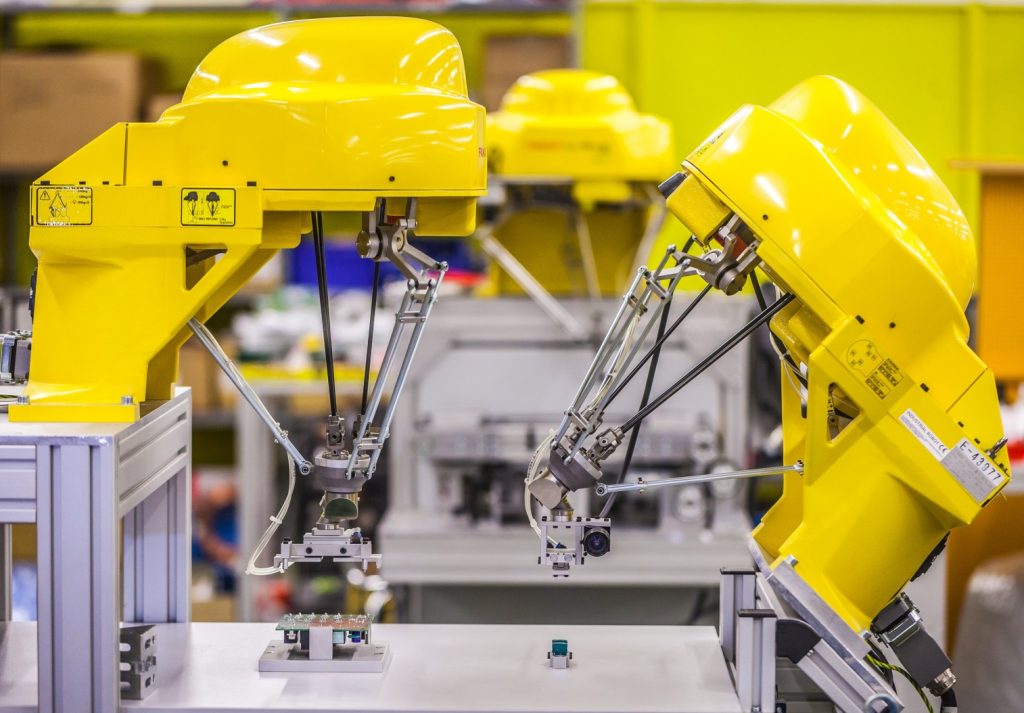
The industrial automation sector is heading into a transformative year, as manufacturers increasingly turn to robotics and AI to boost efficiency, address labour shortages, and ensure consistent product quality. Oliver Selby, Head of Sales at FANUC UK, has highlighted three key trends he believes will define the industrial robotics landscape in 2026.
AI-driven robotics to accelerate deployment and collaboration
Selby says artificial intelligence is making robots smarter, safer, and faster to implement. “AI is transforming industrial automation through voice-controlled operation, adaptive motion, and virtual commissioning using digital twins,” he explains.
One of the biggest advantages, Selby notes, is speed. AI-assisted code generation allows non-specialists to program robots using natural language, reducing the engineering workload and delivering faster returns on investment. “It also enables manufacturers to retrofit existing production lines without extensive modifications,” he adds.
AI is also expanding the potential for collaboration. Robots with AI-driven voice control can interpret spoken instructions and autonomously generate the code needed to perform tasks. Integrated vision systems further enhance safety, detecting obstacles and recalculating motion paths in real time to operate safely alongside human colleagues.
Smart, scalable automation addresses labour and cost challenges
Automation is also becoming more flexible. According to Selby, smart, scalable robotic solutions allow manufacturers to adjust systems as business needs evolve, reducing risk without compromising quality or reliability.
Smaller, agile automated systems are helping manufacturers tackle labour challenges, particularly for repetitive tasks such as picking, placing, and palletising. Simplified teaching methods, AI-enabled voice control, and technologies like vision and force sensing are making deployment faster and easier than ever.
Selby points out a shift in how companies assess return on investment. “Manufacturers are increasingly considering total cost of ownership—maintenance, downtime, and energy consumption—rather than just upfront purchase price,” he says. These smarter systems are making automation more accessible, cost-effective, and practical for businesses of all sizes.
Open ecosystems and partnerships fuel innovation
Finally, Selby emphasizes the growing role of open platforms and industry partnerships. FANUC is collaborating with technology leaders including NVIDIA to bring AI solutions to market, and supports the open-source robotics platform ROS 2, which enables programming in Python.
“Open platforms lower the barrier to entry and allow developers, researchers, and companies to build AI-driven robotics applications on proven industrial hardware,” Selby says. He highlights the educational impact: ROS 2 and Python are widely taught in universities, and their use in industrial equipment helps young engineers apply familiar skills directly in manufacturing environments.
These open ecosystems also foster innovation, enabling companies to customise and scale AI-augmented robotics solutions while leveraging their own software expertise on top of FANUC hardware and NVIDIA’s advanced simulation infrastructure.
As manufacturers continue to navigate labour shortages, rising productivity demands, and the push for safer workplaces, Selby predicts that AI-driven, scalable, and collaborative robotics will be central to the factories of 2026.
For more articles like this, visit our Automation channel