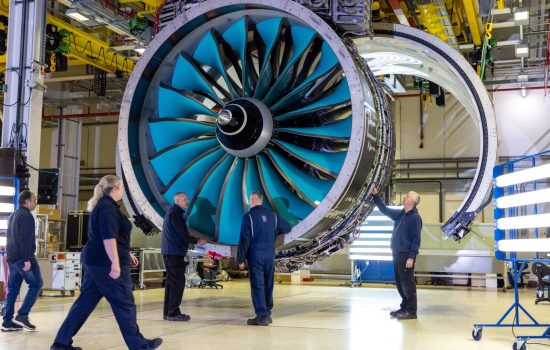

Ioana Hera, Head of Lean at Rolls-Royce Civil Aerospace, is speaking at Manufacturing Leaders’ Summit in November 2025. But before taking to the stage, she sat down with Molly Cooper to discuss the topic of her talk – lean manufacturing.
FAQ’s
- What is lean manufacturing?
- What is the most crucial factor for lean success?
- How can leadership support lean efforts?
- What are common obstacles to lean implementation?
Key Takeaways
-
Lean is about removing waste: people continuously improving processes to deliver the best quality for customers
-
Success in lean comes from engaging people who own the process, not just applying mechanical tools
-
Leadership plays a crucial role in setting vision, supporting experimentation and sustaining belief in the lean journey
-
Resistance and failure are part of the process, but with persistence, feedback and alignment on vision, businesses can maintain momentum
-
True progress in lean is measured not only by hard metrics but by the culture, mindset and engagement of people on the ground
What is lean manufacturing?
Lean manufacturing and its tools are something all manufacturers want to work towards. But what is it in reality? And where can you start? Lean manufacturing is a way of making products that focuses on using less time, materials and effort while still giving customers the best quality. It’s about working smarter, cutting out waste and improving – little by little – every day.
At Rolls-Royce this approach is brought to life by Ioana Hera, Head of Lean at Rolls-Royce Civil Aerospace, whose role is to enable capability so that the company’s plants can deliver operational excellence. “I focus on lean coaching and training, supporting our plants to transform into a high-performing, competitive, resilient and growing business,” she said.
Building on existing knowledge
When it comes to lean manufacturing, Ioana has always been fortunate to be able to build upon existing knowledge and experimentation. “Even if you go into a start-up, everyone will have at least some level of experience with lean,” she said.
Designing the aspirational future state
When she is faced with enhancing the application of lean tools in the factory, Ioana has two go-to approaches, and will deploy one or the other, or perhaps even both. The first is to help the factory design an aspirational future state.
“I ask what the factory wants to achieve, be it next year or even in five years’ time, and how that local vision aligns to our strategic initiatives. Then, we work through the logical steps, ensuring safety, operational effectiveness and customer service,” explained Ioana. The teams work together to look at the steps needed to get to that aspirational state from where they currently are. People and product safety come first – then the company can begin to create flow and work towards the perfect lean solution.
Identifying and solving bottlenecks
The second approach is to work with each area within the factory and help identify what the biggest problem is and the right tools to solve it. “You might have a process that has been identified as a bottleneck, for example. Why has this occurred and what are the losses being incurred?” said Ioana. “The team can then work together to improve the process.”
Ioana’s approach will depend on whatever is right for that place of business – whether a factory, warehouse or office.
Engaging people in the lean process
The best way to solve a problem is engaging the people who own the process where the problem is located. More often than not, they will have the right solution. But before that, business leaders need to identify the metrics they want to improve. “I work with the team and help them through that problem solving process, because more often than not, they have the solutions, but they might not know it,” said Ioana.
“I work with the team and help them through that problem solving process, because more often than not, they have the solutions, but they might not know it.”
But it wasn’t always that way for Ioana. As a task-oriented person, it took her a while to understand that lean transformation isn’t just about what you’ve got in your toolbox, but about engaging people to use those tools.
“Around ten years ago, I was at a plant where we were trying to move from the current state – okay, but not great – to fantastic performance, and we did this by using a sequence of lean improvements. However, it was a very mechanical process,” explained Ioana.
She had the backing from senior leadership who had set out a vision for her to execute. However, she was met with passive resistance by those on the factory floor. There was a lack of trust and credibility due to Ioana being new to the plant. “Not only that, but there was a lack of belief in the future vision. They were unable to see that what I was asking of them would be better than what they were already doing,” she said.
Due to having a good coach and the support from the leadership team, Ioana was able to overcome the resistance and get the teams to engage in the process.
“Since then, I not only make sure I understand who my key stakeholders are, but also that they are supporting the journey and that their concerns are listened to and addressed. I don’t always get it right, but I learn from my mistakes. I spend a lot of my time listening and talking to the people who work those processes,” Ioana added.
Overcoming obstacles to change
Resistance to change in any company is always going to be a challenge. The future state always looks beautiful on paper, but it doesn’t always pan out that way, and the disruption that is sometimes required to get there can be daunting.
As such, there are obstacles which Ioana says manufacturers need to be aware of when beginning the lean process:
-
Fear of the unknown: People will have their own ideas of how they can move from the current state to their preferred future state, but that cannot be done in isolation. It must be done as a team, and the team will make assumptions because they don’t have all answers. Once you start defining the future state and working towards it, you’ll discover hidden problems which you’ll have to unpick.
-
Lack of patience: Lean takes time. If you don’t allow for time, the changes won’t be sustained. You must be prepared for a variety of unknowns to arise.
-
Vision: Resistance to change will also appear when teams do not share the same vision and are not working towards the same goal. Therefore, it’s important to relate the changes to what people are doing in their everyday work. Explain the vision and how lean will make their roles easier and remove frustrations.

The role of leadership in lean transformation
In any business it is leadership’s role to set the vision and the strategy, which is a key enabler for any lean transformation journey. “Day in and day out, I see leadership enabling growth. They want to be more efficient and keep processes simple, which lean can help with,” said Ioana.
Best practice for leadership is to be present and visible where the work is taking place, rather than being seen as directing operations from afar. “They need to show their support, coach by asking the right questions and set aspirations. By linking daily actions to the long-term vision, they will begin to see people believing in the lean journey,” she explained.
Allowing experimentation and learning
Another important role for leadership is to allow experimentation. The main concern when beginning a new project is often around the consequences of failure. “All sorts of things happen that are out of our control, so leadership need to give their teams permission to experiment with different methods and encourage the implementation of new ideas. Celebrate successes, learn what’s working and keep driving that journey forward,” said Ioana.
Failure is part of the journey
“There is plenty of research around failed lean initiatives and it’s true to say that many end up that way. But lean is not a short-term initiative – it doesn’t have an end point, but rather is a journey of continuous improvement,” said Ioana.
“Lean is not a short-term initiative – it doesn’t have an end point, but rather is a journey of continuous improvement.”
Ioana has worked in a variety of roles in her career, all of them focused on improving processes. However, for Ioana, it’s certainly more than just a title. “Lean is a way of life; each day, people do things based around lean practices without even realising it. You don’t tick a box or earn a badge and move on. It’s a constant pursuit of perfection,” she explained.
Sustaining momentum and vision
Yet, some projects don’t take off or fizzle out due to lack of persistence. This could be for several reasons. “It could be a lack of trust, the absence of a vision to work towards or people not understanding why they need to do it,” said Ioana.
As such, before they start on lean, businesses must ensure that their vision is understood by the team and that they are clear on what they’re driving towards.
“It takes a lot of effort to keep going and in many cases, businesses are not equipping their leaders with the right tools to ensure they can sustain change. It’s more of an afterthought,” she said. In fact, she stressed that some businesses need to consider whether a project fizzled out or if it even started in the first place.
“I don’t get things right every time; there will always be nuances I don’t catch at the start or even during the process. But with a strong feedback loop, you can recover, keep moving forward and maintain momentum,’ said Ioana.
Measuring true progress
When starting any project, companies aim to measure hard metrics: safety, quality, cost, delivery and people. And there are several layers within each category.
“When tracking safety, are you measuring where the risks are or how many incidents occurred? With quality, do you track product defect rate, right first time or process inputs? And you can go through each metric and look at different angles. Selecting the right driver measures is important. However, that is not the only way to measure progress,” said Ioana.
The importance of culture and mindset
Progress is also measured by the conversations you have with the people in the workplace, what you see and how it feels. “How do people talk to you? What is their body language? I can tell when people are excited to tell me the things they have done. They grab me and show me the improvements they have made. They may not always say ‘this is lean’ but it has made a significant difference to their role,” she said.
The hard metrics can appear to show that you may be heading in the wrong direction due to factors that are outside of the plant or area’s control. But as Ioana explained: “When you have the right culture, metrics will get back on track. The right mindset is the key enabler.”
Final advice for businesses
For Ioana, the best advice is to maintain the flame. Businesses will always be faced with problems and challenges to solve.
“Keep going back to the vision, look at what specifically you want to achieve, which allows you to continuously improve. This can be via a small change in how you work, bettering process capability on an operation, creating flow in an area or removing waste – these are all steps that take you closer to the vision,” said Ioana.
“Keep going back to the vision, look at what specifically you want to achieve, which allows you to continuously improve.”
Lean is easy to understand and to action if businesses can get the right level of engagement from its employees. “Keep refreshing and constantly challenge your aspiration; just because you had this vision and you’ve achieved it, you shouldn’t stop evolving. Your competitors aren’t going to stop, so challenge your aspiration, reset the standards and do what you said you would do,” she concluded.
Further reading
- What is lean manufacturing? The top 7 principles for manufacturers to improve processes
- The Essence of Lean
For more articles like this, visit our Leadership channel.