

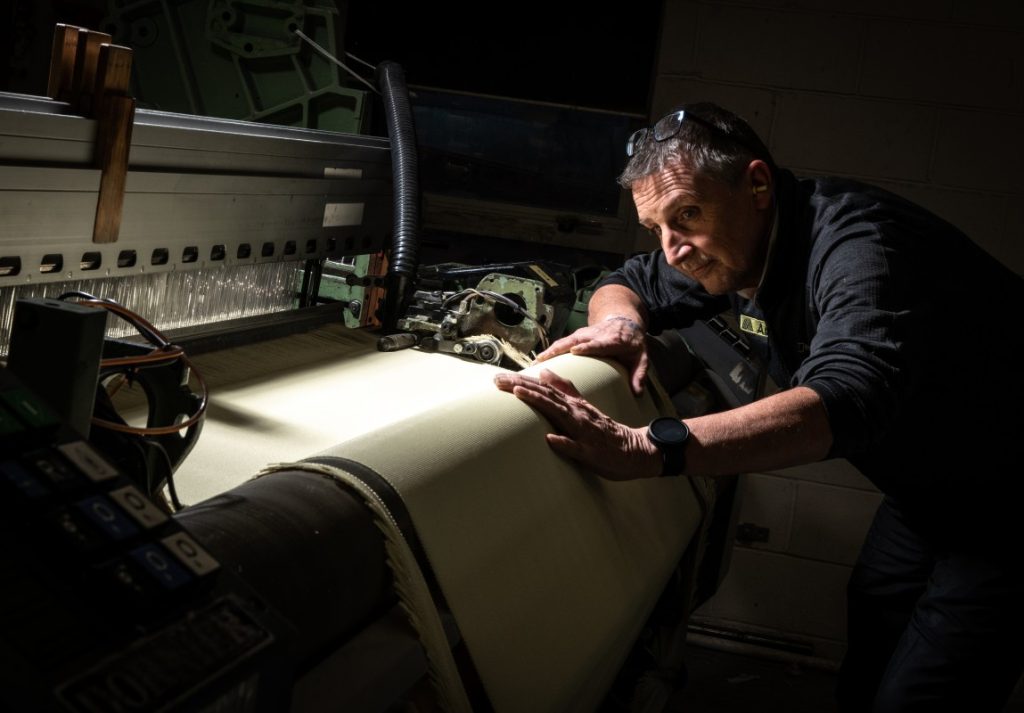
Many people associate Britain’s textile industry with fashion, heritage mills and traditional craftsmanship. Yet behind that perception lies one of the UK’s most innovative manufacturing sectors. The Manufacturer’s James Devonshire explores how Britain’s technical textile manufacturers have established themselves as world leaders in advanced materials, which underpin everything from aerospace and defence to healthcare and infrastructure.
When NASA’s Perseverance Rover descended through the Martian atmosphere in February 2021, it was a critical component manufactured by on a Devon industrial estate that ensured its safe landing. Said component wasn’t an engine, sensor or computer; it was a parachute, the fabric for which had been made by Heathcoat Fabrics from a hi-tech material developed to withstand extreme temperatures and be strong enough to float the £1.93bn rover down safely.
Having travelled more than 140 million miles, the parachute bloomed open, slowing the rover’s descent onto the Jezero Crater. Cameras filmed the moment and something that caught many people’s attention was the canopy’s seemingly random orange and cream markings. However, the design was anything but random. It was a binary message that once decoded, read ‘Dare Mighty Things’.
It’s as good a starting point as any for understanding an industry that has spent decades quietly achieving extraordinary feats while often remaining in the shadow of its fashion counterpart. But technical textiles don’t necessarily want to be seen. They’re built into aircraft seats negating the need for foam; laminated onto military vehicles to conceal them from drone surveillance; and woven into bearings so quietly effective that engineers forget they were ever made from anything else.
As Adam Mansell, CEO of the UK Fashion & Textile Association (UKFT), put it: “Technical textiles are unseen because predominantly, the actual material itself is unseen. But they feature in pretty much every part of our lives.”
The irony is that the more successful technical textiles become, the less visible they are. Unlike fashion brands, the sector rarely appears on the high street or in consumer advertising. Its customers are engineers, defence contractors, aerospace manufacturers and infrastructure companies rather than shoppers. That lack of visibility has created perhaps the industry’s greatest misconception.
“When people hear ‘textiles’, they often think it’s just clothes,” said Tara Hounslea, UKFT’s Director of Communications. “But actually, technical textiles are tackling big global challenges. They’re performing structural necessities and life-saving operations, but because they’re not visible products, people simply don’t know they’re there.”
Beyond the catwalk
Ask most people what the UK textile industry looks like today and the answer will likely involve catwalks, high street brands, or perhaps a fading memory of northern mill towns. It’s an understandable assumption, but an increasingly erroneous one.
Paul Daynes, Sales Manager at Toray Textiles in Nottinghamshire, put a number on just how far the dial has shifted. Lightweight fashion textiles now make up just ten per cent of the company’s sales volume, compared with 100% 25 years ago. That side of the business has migrated to Asia, as it has across much of Europe, with Italy remaining the last significant European stronghold for high-value fashion textile manufacturing. What’s replaced it in Britain is something far less visible but considerably more valuable.
According to UKFT, the UK’s technical textiles industry was valued at c. £3.6bn in 2024 and is projected to grow to c. £5.3bn within a decade. “There is virtually no part of life where textiles don’t come into play,” said Adam. There is somewhere between 750 and 1,000 technical textiles companies operating in the UK, and they are not small operations by textile industry standards. He pointed to the 40 companies the UKFT took to an international textiles trade fair this year alone, whose combined turnover topped £850m.
The everyday scale of the sector is easy to miss precisely because it’s designed to be. The average car contains around 30 different types of technical textile, from seatbelts and airbags to the materials inside its battery. The transatlantic cabling that carries internet traffic between the UK and the US is wrapped in a textile-based product before it goes beneath the ocean.
Roads and railways sit on geotextiles that keep the ground beneath them stable. Even food manufacturing depends on it – one UK company supplies fabric for the conveyor belts in the factory that manufacturers Mini Cheddars.
Katie Robinson, UKFT’s Textile Membership Manager added: “There are fibres used in the manufacture of Elon Musk’s rockets… that is precision engineering.” It’s a deliberate corrective to the industry’s other image problem, as she framed it: “When I have historically spoken to people about textiles in the UK, they think of tweeds and tartans.”
The new demand curve
If there’s one sector every company featured in this piece points to as their biggest growth driver, it is defence, closely followed by aerospace and medical applications. What’s striking is how consistently that shows up at every level of the supply chain – from raw material science to finished products – regardless of company size or specialism.
At Arville, a third-generation, 75-year-old family weaving group based in Wetherby, West Yorkshire, CEO Steve Gill lists ejector seat components, flotation tanks for aircraft that land on water, and ballistic textiles for helmets and body armour among the company’s core defence output.
The firm has also become one of only two global suppliers of the trilaminate materials used in dry suits for special forces and whitewater rescue teams. Elsewhere in its range, firefighter suits have moved beyond simple flame resistance to tackle a problem that can be deadly. “One of the highest fatalities for firefighters is a phenomenon of severe steam burns that occur when trapped sweat or exterior moisture rapidly turns to steam inside a firefighter’s protective gear,” Steve said. Redesigning that moisture management, he said, is now as important as the flame protection itself.
At Carrington Textiles, part of the RTS Textiles Group, Sales and Marketing Director Paul Farrell described military fabrics that go well beyond conventional camouflage. “Modern military fabrics actually incorporate highly specialised performance characteristics that include elements such as infrared reflective properties to help conceal personnel from surveillance, drone technology, and surveillance technology that’s built into the textile.” The same technology extends to shelters and vehicle wraps used to camouflage battlefield assets, from lightweight vehicles to helicopters.
The pattern holds even where it’s inconvenient: automotive demand, once the sector’s bread and butter, has weakened over the past decade – squeezed by EU competition and the shift to Chinese electric vehicles. Defence and medical are filling the gap, not adding to steady growth elsewhere.
What unites all three accounts is a sense that this growth is being driven by something bigger than commercial appetite; a geopolitical shift toward resilience and domestic capability that none of them expect to reverse any time soon. Which raises an uncomfortable question: if defence is where the growth is, why does the UK make it so hard for its own manufacturers to win that work?
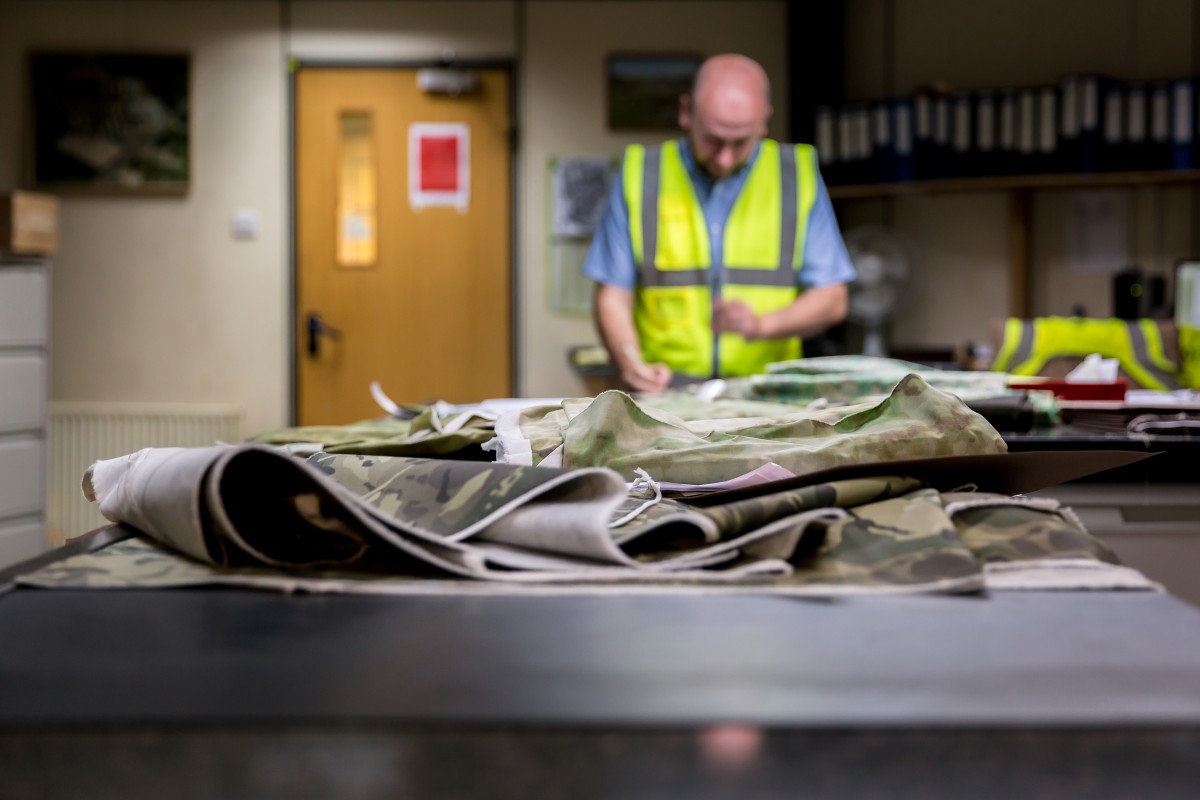
Innovation in material science and fabric engineering has positioned Carrington Textiles as a leading manufacturer of high-performance technical textiles.
Britain’s own worst customer
Government procurement policies is a topic that unites everyone named in this article, and one where the industry’s frustration perhaps runs deepest.
Steve said the Ministry of Defence predominantly buys based on price, “even if there’s a much greater total value to the economy to use a UK company,” pointing to the tax and employment that a domestic manufacturer generates and a lowest-price tender ignores.
But there’s a sharper edge to his argument too. As technical textiles increasingly incorporate embedded electronics and nanotechnology for defence applications, he said manufacturing those products overseas, “is clearly a security risk. We should be looking to do that ourselves and keep it here.” Steve drew a direct comparison to the US’ Berry Amendment, which requires the US military to buy domestically produced clothing and textiles, a protection that does not have an equivalent in the UK.
Paul sees the issue in similar terms, while recognising the complexity of public-sector procurement. “There is a real opportunity for UK government and defence procurement to place greater value on domestic manufacturing capability, particularly where resilience, innovation, security of supply and SME participation are important,” he said. “We would like to see more of that value return to the UK supply chain, and as an industry we continue to make that case constructively.”
The clearest comparison comes from Washington. Adam highlighted the Berry Amendment’s role in building a substantial US technical textiles industry supplying its own military, and to an EU-wide public procurement regulation due for publication in September, which will weigh quality and performance far more heavily than cost alone – something the UK has not committed to matching.
He’s also blunt about a missed opportunity: “COVID, very, very briefly, lifted the lid on technical textiles for government. The fact that they then went away and purchased from the Far East was massively disappointing.”
The consequence, as Adam described it, is that UK-purchased defence textiles increasingly aren’t UK-made at all: “Pretty much everything that our armed forces wear is made abroad,” he lamented.
From supplier to partner
Away from policy, the commercial relationship between technical textile manufacturers and their customers has changed markedly over the past decade. The industry’s real value lies not in what its products are, but in what they enable. As a result, technical textile manufacturers are being increasingly asked to solve engineering problems rather than produce materials to a specification.
Steve outlined how Arville’s customers increasingly want a single, capable partner rather than a transactional supplier. “The biggest play that we have is they want a one-stop-shop,” he said, “someone with the technical capability to keep them ahead of their competitors.”
That extends to the relationship itself: “It’s no longer a salesman talking to a buyer. Customers are now seeking a multi-level partnership.” He also pointed to a tangible shift toward onshoring, as customers actively try to de-risk overseas supply chains. “We’re noticing a lot of onshoring now coming back to the UK,” though he was careful to add that this doesn’t mean that customers will simply pay more.
At Carrington, the defining shift is sustainability, moving from what Paul calls a “nice to have” five or ten years ago to a core requirement today. Customers increasingly want greater transparency around fibre origin, manufacturing processes and the carbon footprint of finished products. Alongside that sits growing demand for garments that deliver more comfort, stretch and appearance, while still maintaining durability and performance. “Customers are rightly looking for products that deliver across a wider range of requirements, while remaining commercially competitive,” Paul said.
However, that sustainability picture is more complicated than it first appears. Paul frames Carrington’s own approach around durability and circularity. “We engineer products to last, first and foremost. And when they reach end of life, we strive to ensure they can be recycled back in a circular economy in some way,” he said. But UKFT is quick to point out that a fashion industry lens on sustainability doesn’t always map neatly onto technical textiles.
“If you take products like Kevlar and stab vests, which are all textiles, it is extremely difficult to think about recycling at the end of life,” the UKFT team explained. Tara added the underlying reason: “Performance is the priority, rather than designing for end of life.” Performance must come first, even when it sits awkwardly alongside sustainability goals.
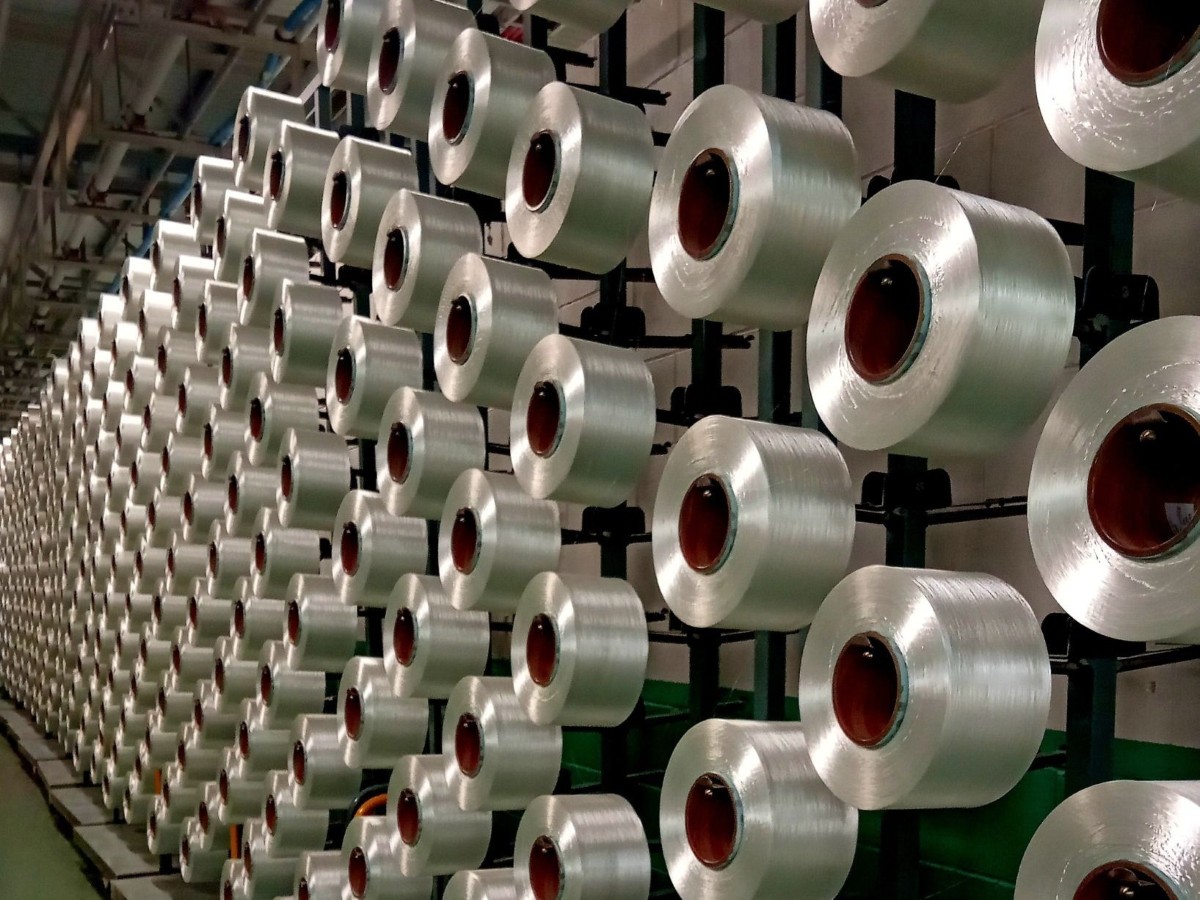
Technical textiles now account for the vast majority of Toray Textiles’ UK production, supplying advanced materials for a wide range of industries.
The textiles talent gap
Another pressing issue facing the UK technical textiles industry is skills and specifically, the age of the workforce.
At Arville, the picture five years ago was stark: an average workforce age of 56. Through a concerted apprenticeship effort, run in partnership with the Textile Centre of Excellence, that figure now stands at 43.
Steve is candid about why this matters beyond simple headcount: “The biggest threat to the industry is the failure to extract expert knowledge from people’s heads, and that knowledge is usually tacit. They can feel a problem – it isn’t something they can necessarily write down.”
Losing that generation without a deliberate handover plan means losing knowledge that can’t easily be rebuilt. Arville has also begun introducing digital shop floor technology, partly for efficiency, but partly, as Steve put it, because “younger people understand the digital element” and it helps make the work “more attractive.”
Carrington is wrestling with the same problem from a different angle. “This can be an older, traditional industry, with people who’ve worked here for 30 or 40 years,” said Justin Price, RTS Group’s Head of Global Brand and Communications. “They need to be replaced to keep the knowledge going – that’s what we’re continuously trying to do: get the next generation in to learn the technical side and keep it going.”
The company’s answer is a placement scheme launching this summer: five students rotating through R&D, the lab, manufacturing and marketing over 12 months. “We’ve got interns and students coming in to learn about every side of the factory,” Justin said.
Both he and Paul see the scheme as being about more than succession. As the industry becomes less commoditised and more technical, bringing in people who’ve never worked in textiles is one of the few ways to stress-test the business’s own assumptions.
Justin is confident the interest is there: “Young people want to come into this industry now. These are highly engineered, technical fabrics – not things from the past. They’re still evolving generation to generation, and that’s what keeps it cutting edge.”
UKFT carries the formal responsibility here: as the government-appointed sector skills body, it oversees 14 separate manufacturing apprenticeships, and helped establish the UK’s first undergraduate degree in textile sustainability and innovation at Leeds University three or four years ago, funding bursaries for its first three cohorts.
However, the deeper obstacle isn’t funding, it’s visibility. Many companies, Katie said, “see themselves as part of the end use supply chain, so they won’t necessarily see themselves as textile companies… when there’s medical, defence, aerospace, automotive, that’s what they see – they don’t see the textiles within.” The result, as she put it, is “a double-down challenge with attracting new talent” – an industry that’s hard to recruit into partly because most of the people in it don’t think of themselves as working in textiles.
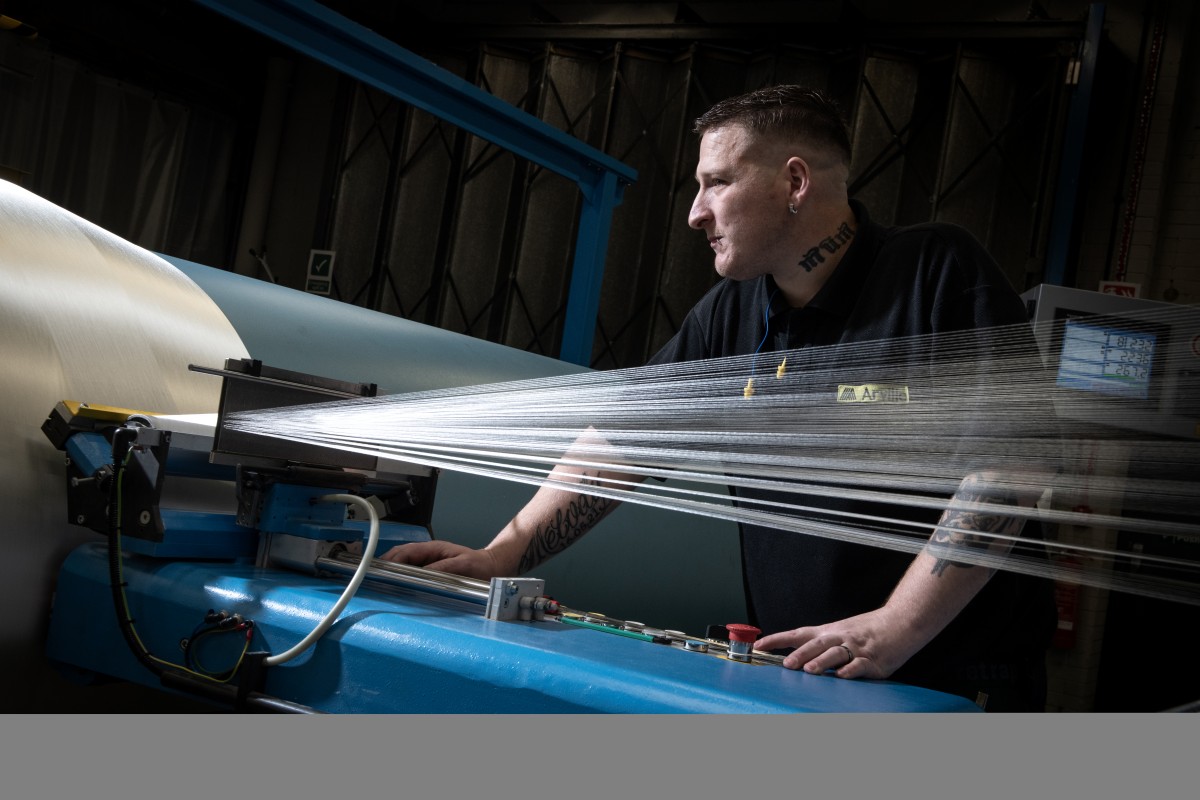
Arville develops highperformance technical textiles for demanding aerospace, defence, medical and industrial applications.
Staying competitive
Underneath the skills and procurement challenges sits a more familiar manufacturing problem: cost.
Paul is frank that the UK’s high standards around quality, compliance, sustainability and worker welfare are genuine strengths, but they come with a cost base that can be difficult to compare directly with manufacturers in Asia or Latin America operating under very different conditions.
“Customers are understandably under pressure to manage cost, and lower headline prices from other regions can be compelling,” he said. “The real challenge is ensuring that best value is recognised – encouraging procurement professionals to consider innovation, resilience, compliance, security of supply and longterm performance, rather than focusing on unit cost alone.”
Katie believes the UK shouldn’t strive to compete on price, and that its advantage lies elsewhere, predominantly in innovation. “We aren’t going to compete with the Far East on price, and we don’t need to,” she said. “But we can create new technologies, better and more productive ways of working and the next generations of products. That’s what we want to compete on rather than price and volume.”
Adam named three further pressures: rising energy costs, difficulty accessing R&D support, and a government Industrial Strategy built around eight named key sectors that inadvertently squeezes out companies that don’t sit neatly inside one of them, making it harder for parts of the technical textiles sector to access funding intended to support advanced manufacturing.
Nevertheless, Steve is careful to note that Far East competition isn’t insurmountable: “We’ve just won a significant contract where we were cheaper than a Chinese company,” he said, of a highly technical product line – something that would have been unthinkable a few years ago. “That may be an exception rather than the rule, but it’s good to see.” It’s proof, he argued, that targeted innovation, rather than trying to compete on volume, can still win.
An industry of the future, not the past
For an industry with a genuine list of structural problems – procurement policy stacked against it, an ageing workforce, a cost base under constant pressure – the tone across technical textiles is strikingly optimistic, and consistent in where that optimism comes from.
The UK will never compete with China, or some other locations, on volume (and often price), and nobody seems to want to. The shared bet is on innovation, speed and technical capability instead. “Textiles is not an industry of the past; it’s an industry of the future,” said Paul. “Really technical textiles is where material science, manufacturing and innovation intersect.”
Steve framed Arville’s growth in almost identical terms: “We’re combining 75 years of family heritage with technical excellence and the speed to become that fast end-to-end partner for customers,” – a company built on being fastest and best rather than cheapest.
His own summary of the industry, offered as the one thing he’d want readers to take away, is this: “Technical textiles is a high tech, export-driven sector built on innovation and engineering capability, and that’s what the UK was famous for and world leaders in.”
UKFT, perhaps inevitably, summed up the sector’s frustration and its self-image in a single phrase used repeatedly across the interview: an “enabling technology” – invisible by design, indispensable in practice, and still waiting for the recognition that comes with being seen.
That recognition may be closer than it’s been in decades. Between a geopolitical push toward domestic resilience, an EU procurement overhaul that finally weighs quality over cost, and a generation of manufacturers betting on innovation rather than volume, the conditions the industry has been asking for are starting to align. Whether Westminster follows is another matter.
Full circle
Which brings us back to a Devon industrial estate, and a parachute that carried a message across 140 million miles of space, made by a British company most of the country has never heard of, doing exactly what the rest of this industry has been doing for decades: extraordinary work, quietly and mostly unseen. The difference now is that the industry no longer seems content to stay that way.
Key takeaways:
- Hidden talent: Technical textiles have become one of the UK’s most innovative and strategically important manufacturing sectors.
- Setting high standards: Innovation and engineering expertise, rather than low-cost production, are driving the industry’s global competitiveness.
- New opportunities: Rising demand from defence, aerospace and healthcare is creating significant new growth opportunities for UK manufacturers.
- Support from the top: Industry leaders say government procurement must do more to support domestic manufacturing and supply chain resilience.
- Making the sector attractive: Addressing skills shortages and raising awareness will be critical to securing the sector’s long-term future.
Q&As
Technical textiles are engineered materials designed to deliver specific performance characteristics rather than primarily for appearance. They are used across sectors including aerospace, defence, automotive, healthcare, infrastructure and industrial applications. The article notes that everyday products can contain dozens of different technical textile components, from seatbelts and airbags to filtration and battery-related applications.
Technical textiles are presented as an increasingly important part of UK manufacturing, combining advanced materials science, fabric engineering and specialist manufacturing expertise. The sector had a reported UK value of £3.6bn in 2024, with more than 750 companies operating in the sector.
The article identifies several areas of growing demand, particularly defence, aerospace and healthcare. Other opportunities include automotive applications, where the sector is adapting to the shift towards electric vehicles, as well as industrial and specialist protective applications.
Manufacturers face pressure from high costs, international competition, skills shortages and procurement practices that can prioritise upfront price over quality, innovation and resilience. The article also highlights difficulties around research and development support and the visibility of technical textiles as a career option.
The article argues that the sector’s future lies in innovation, advanced engineering and specialist expertise rather than competing primarily on low cost. Greater recognition of technical textiles as strategically important, stronger domestic procurement and investment in skills and innovation could help UK manufacturers capture opportunities in areas such as defence, aerospace, healthcare and sustainable manufacturing.