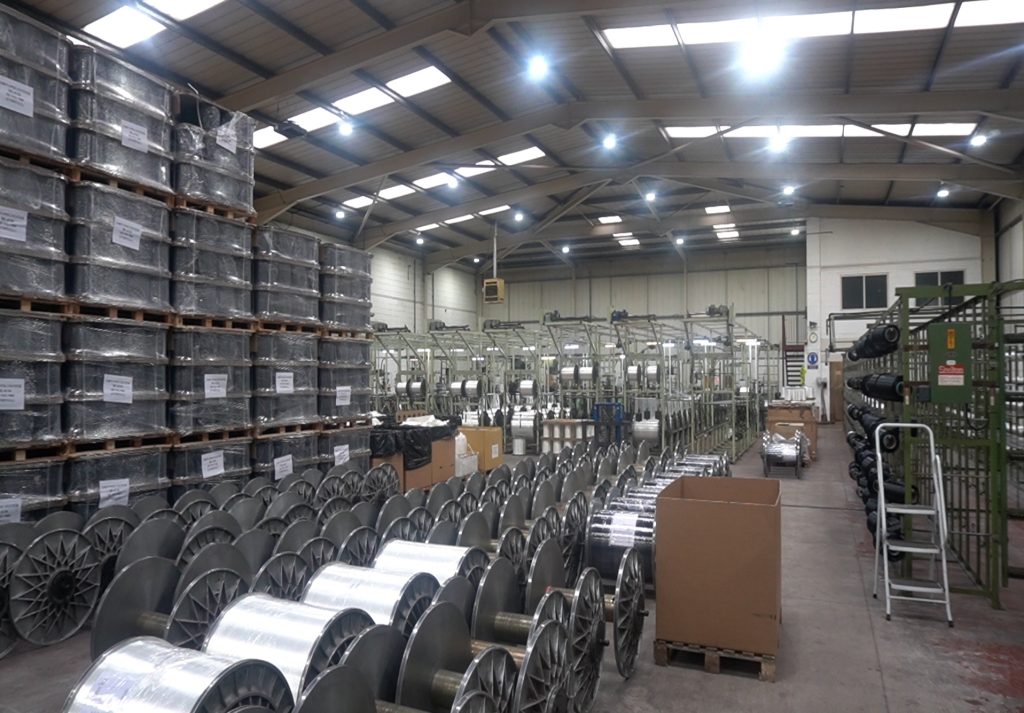
In Droylsden, just east of Manchester, high-performance textiles are being woven into some of the most demanding applications in the world. From aerospace to equipment supplied to the Great Britain Olympic Cycling Team, Wisla Narrow Fabrics has built a reputation as a specialist manufacturer operating at the cutting-edge of the narrow fabrics industry.
Key takeaways
- Specialise deeply, diversify broadly: Specialising in your field is the first step, then you can explore different markets
- Stay close to material science: Innovation often begins with fibres and yarns. Upstream awareness enables downstream differentiation
- Build supply chain resilience: Avoid single points of failure. Maintain disciplined stock management and multiple suppliers
- A willingness to learn outweighs experience: In an increasingly hard recruitment environment, good attitudes and impressive soft skills shouldn’t be underestimated
- Embrace continuous evolution: Technological shifts define competitive eras, make sure you’re not left behind
FAQs
- What makes Wisla a leader in innovation within the narrow fabrics industry?
- How does Wisla approach product development and customer collaboration?
- What role does technology play in Wisla’s manufacturing processes?
- Which industries benefit most from innovative textile solutions?
- How does Wisla sustain long-term innovation and competitiveness?
Founder Edward Kozaczek, or Eddie as he goes by, is proud of his legacy. I’m not just referring to the business that he and his wife, Ingrid, founded in 2004. He is also proud of his Polish routes. Indeed, the name Wisla is a reference to the families of both his parents, who lived in small villages on the banks of the Vistula river. In Polish, the river is called the Wisła.
His mother, Irena, was 14 years old in May 1942. She and her family were displaced by the Nazis and were sent to Germany to work as labourers on a farm. Her mother and sister were then sent back to Poland, to the concentration camp in Łódź.
Around a year later, her father was also taken away to work at the Westfalia Coal Mine. He wrote to her saying he was starving and losing weight, and if it hadn’t been for Irena somehow managing to steal provisions such as flour to send to him, he may well have died.
Irena worked alone at the farm until the end of the war, with no knowledge of her family’s welfare. In 1947, the allied authorities informed Polish people that their country had been devastated by the war, and that there was nothing to return home to. Irena decided to come to England, first living and working in Bolton. She continued to write regularly to her family, but received no reply. Until eventually, The Red Cross wrote to inform her that her family had survived the war.
Now, her son Eddie has a company that marked its 21st anniversary last year. This is a milestone that represents not only commercial longevity, but also the evolution of a sector that has undergone significant technological change, particularly from a materials perspective.
This has, and will continue to open up new markers for Wisla. I think this is another story that offers up valuable lessons for SME manufacturers around diversification, talent acquisition, sustainability pressures and shifting global supply chains.
From legacy to leverage
Wisla’s origins lie in deep sector knowledge, a lot of which starts with Eddie. He had already spent two decades immersed in the textiles industry – which he said he was led into largely by the North West’s heritage in this area and its famous old mills. From textiles machinery he went into the manufacturing of spindle tapes, the forerunner to narrow fabrics. He then spent around 20 years embedded in the development and evolution of narrow fabrics. Learning and experimenting with “the yarns and fabrics, and what you can do with them, all the while realising how technically sophisticated webbings can become,” as he put it.
Upon starting Wisla, the market base was mainly safety products. Narrow fabrics, which include webbings, tapes and elasticated textiles, are often unseen components within larger assemblies. They are, however, absolutely mission-critical, in fall arrest systems, load-bearing harnesses, cargo restraint systems, personal height safety – pretty much anything with a safety element to it.
The general product profile is still safety, but the markets are expanding. “We see opportunities,” said Eddie, “not product specific, but industry specific. The range was quite significant, from aerospace, aeronautical, mining, transport, height safety – and we saw significant potential for growth.”
And the industries keep expanding; materials handling, agri-ventilation systems, and as mentioned, the Great Britain Olympic Cycling Team is a customer, supplied with bespoke straps. Eddie then paused to look down at his wrist as he was going through the various markets: “Watch straps!” he exclaimed, as if he’d missed something glaringly obvious.
Material world
This diversification has been made possible by the incredible innovations that are happening from a materials perspective. “The concept of weaving had a major sea change back in the late 1960s-mid-1970s,” said Eddie. “Conventional weaving was replaced by needle loom weaving, or shuttleless weaving as it’s now known. “But it hasn’t really changed since then. You can spend money on a new loom that runs a little bit faster, but in terms of what they do, it’s much the same as it was 20 years ago.” He continued: “Where we differentiate now is the yarns that we weave the product from, and from the finishes – the dyes and chemicals – which are all becoming a lot more environmentally friendly.”
The level of sophistication in these materials is quite remarkable, and is an area of real excitement for Eddie and Wisla. There are fibres that are spun into yarns that, for instance, provide the same strength as steel. You can have the malleability of a textile webbing, but the strength of a steel rod – there is such a yarn that can be woven quite easily. It would appear that from the perspective of fibre, there’s not much that’s off the table. “There’s a lot of investment going on in developing new technical fibres,” said Eddie. “Flame resistance, anti-wicking, flame retardancy, high elongation, high strength-to-weight ratios – it’s a really exciting area.”
Wisla designs specifications around the properties of yarns to meet the needs of fabricators who themselves must differentiate in competitive markets. “That front end – yarn preparation and identification of yarns – is critical,” added Eddie. The companies that understand material science, even if they’re not polymer producers themselves, can create real technical advantage. High-performance fibres such as aramids, high-tenacity polyesters and specialist blends are enabling lighter, stronger and more durable textile components. This becomes particularly handy in industries like aerospace and transport, where strength-to-weight ratios all lead directly to fuel savings and carbon reduction.
Gifts from the east
Much of this fibre innovation is coming from the Far East, particularly from Japan. This obviously raises the question of supply. Like many UK manufacturers, Wisla experienced disruption triggered by the pandemic and subsequent geopolitical disruptions. “There’s still some volatility,” Eddie admitted. “Back in the COVID years, a lot of people started to look a bit closer to home for raw material supply.”
He went on: “We retain good levels of stock management to make sure that we don’t run out of raw materials, and we also have second lines of supply as and when necessary. We don’t have single points of failure.” The Red Sea disruptions and broader geopolitical instability have reinforced the importance of buffer strategies. “Supply lines coming in from the Far East are sometimes affected by geopolitical factors,” he said. “We always cater for additional lead times in that event. Things have eased now, but they can very rapidly change.”
‘The times they are changin’
There is recent change afoot at Wisla. In providing a shareholder exit for Ingrid and himself, Eddie will continue to work with the new father-son management team of David and Tom Judge. A new chapter in the company’s history was marked by new plans, which includes investment into new machinery. The innovations also continue, with research and development opportunities including trials of embossed PVC-coated webbings for a prospective US customer.
Recruitment is also an area of focus, as the company looks to grow. “We’re looking to recruit people based on their attitude rather than their experience,” said Tom. “This is an industry where you have to show a willingness to learn, because there’s so much to get your head around. “But we’ve got people that have worked with us for 20 years. If we put them with one of those guys for a couple of days they just need to have the willingness to learn.” But what does the new ownership mean for Eddie? “It’s freed up my time,” he said.
“The knowledge and experience – not just of myself but colleagues here – is going to enable me to consolidate what we’ve already got with existing clients and develop an expanding client base into newer markets requiring better finishes, newer specifications and higher spec materials.” A succession and ownership transition can often be fraught for SMEs, particularly those built around founder expertise, which Wisla undoubtedly is. But the transition appears to be focused on leveraging institutional knowledge while unlocking growth capacity.
A sector in quiet transformation
I was left surprised and slightly embarrassed when I was asked the question: “Have you ever been to a mill before?” Because my answer was, “No.” This is a modern-day mill, and the webbings that are produced end up in critical infrastructure, transport systems, safety equipment and high-performance sport, to name just a few applications.
The industry’s transformation through advanced fibres – the capabilities of which defy belief – reflects a frustration we hold of manufacturing more broadly. Why the hell don’t more people know about this? One incredible application where you’ll find Wisla’s narrow fabrics is in drogue refuelling, which allows aircraft to refuel mid-flight. Wisla provides a technically adept three millimetre webbing manufactured out of Dyneema. An almost shuttlecock-shaped mesh trails from the back of the aircraft and allows fuel to run through it – an application that took years to develop and refine. But it’s now the industry standard.
It’s innovations like this that really do make the future of narrow fabrics absolutely fascinating, and will continue to drive people like Eddie. He may not run the show anymore, but I don’t see him stepping away anytime soon. “We’ve gone through 20 years and some heartache from time to time,” he reflected. “But on the whole, it’s been a successful journey.”
For more articles like this, visit our Innovation channel