
For two decades, conversations about mobility have followed a familiar pattern. We look for the next big thing, whether it’s the cleanest engine, the smartest car or the fastest train, and we treat each as a panacea for all our transport ills.
Here, Andy Davis, Project Manager at C&W Business Solutions, part of the West Midlands Growth Company, explains why the future of connectivity is just that, a connected network of transport systems.
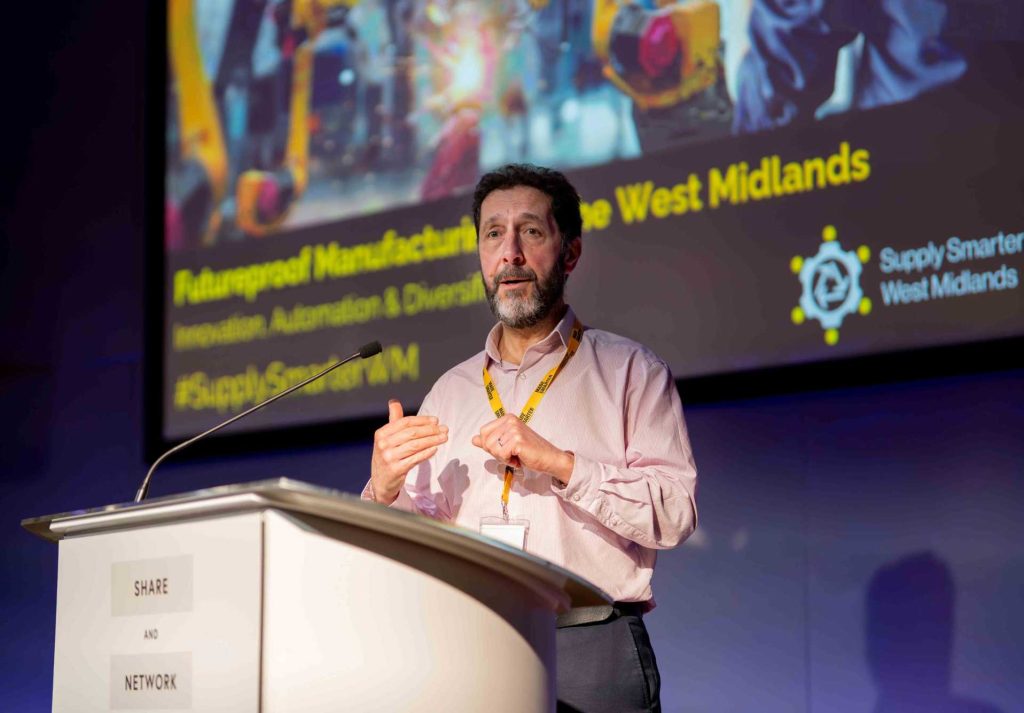
At the recent Supply Smarter conference, Futureproof Manufacturing for the West Midlands, every mind gathered in the room was clear about one thing; the vehicle centric view of mobility is starting to feel outdated. The more interesting question that the participants at the event raised was not “what’s the next vehicle?”, but rather “how do all these innovations work together?”
Steve Bowyer is Head of the West Midlands Investment Zone at the West Midlands Combined Authority and has nearly forty years’ experience in regional development and investment. He was one of the first speakers on the day at the conference and in his opinion, the region already has the optimum foundations in place.
“We’re already one of the strongest manufacturing ecosystems in Europe,” he explained, “but it’s about joined-up thinking.” In fact, the phrase ‘joined-up thinking’ came up repeatedly during the conference, and it’s probably one of the simplest ways of describing where mobility is heading.
In practical terms, it means treating mobility as a single, interconnected system rather than a collection of separate industries. For the sector, it means vehicle manufacturers, component suppliers, energy providers, infrastructure developers and digital technology firms designing solutions that are compatible from the outset, so charging networks, data platforms and transport systems all work together rather than in isolation.
For the region, it means aligning transport planning, skills development and industrial strategy so investment in manufacturing capability is supported by the right workforce, infrastructure and supply chains. This creates a connected ecosystem where innovation, production and deployment reinforce each other, supporting more resilient growth and making it easier to scale emerging technologies such as electrification, connected mobility and integrated transport networks.
Moving beyond silos
Just as joined up thinking was the theme of the day, the frustration of the day was how often these strategies are still developed in isolation. Transport plans are developed by one group, while skills are left with another, and manufacturing vision is with an entirely different group of people.
Steve challenged this idea directly in his presentation. “Often we’ll do a manufacturing strategy over here, a skills strategy over there,” he said. “But the question’s framed the wrong way. It’s about where we want to be in ten or twenty years’ time and building that system together.”
The idea of starting with the system, and not just the component, is what underpins Richard Parker, the Mayor of the West Midland’s connected city approach. It’s not about promoting one mode of transport, but rather making sure everything connects in a way that benefits businesses in the region and the people who need to get from A to B.
The LEV piece of the jigsaw
The conference was intended for manufacturing SMEs with ambition to diversify, explore digital transformation and automation, and embed resilience into their businesses to take advantage of opportunities in new and emerging industries. Those industries include aerospace, battery manufacturing, smart energy systems, Light Electric Vehicles (LEVs), modern methods of construction, and medical and health technology.
As a result, it’s little wonder that LEVs were a topic of conversation on the day. However, a valid point raised was that they normally get talked about as if they’re going to replace cars, while in reality their real strength is in the gaps, the short journeys and the awkward connections. They are there for the bits of the network that don’t quite join up.
But what was particularly interesting about the Supply Smarter event was how often conversation moved beyond transport altogether.
Nicola Small, one of the speakers on the day, is the Very Light Rail (VLR) Programme Director for Coventry City Council and Transport for West Midlands. She has worked in local government since 2003, with a focus on delivering sustainable transport projects.
Nicola made the point that electrification is already spilling into other sectors. “A lot of EV technology goes beyond automotive,” she said. “We’re seeing opportunities in areas like drones as well, it’s about diversifying your market.”
The real impact of electrification of the transport system is the way that it encourages technologies, supply chains and businesses to evolve together, to solve challenges before they become problems. A little like how the space programme of the 60s and 70s resulted in innovations which were not the primary purpose of the programme but have since become indispensable, such as memory foam, cordless power tools, freeze dried food, and ear thermometers.
And, as Nicola pointed out, there’s also a practical driver behind the push to innovate. “If you’re in a single market, you’re going to have a problem if that market goes down. So, it’s about export, and supply chain resilience.”
For more articles like this, visit our Innovation channel.

