
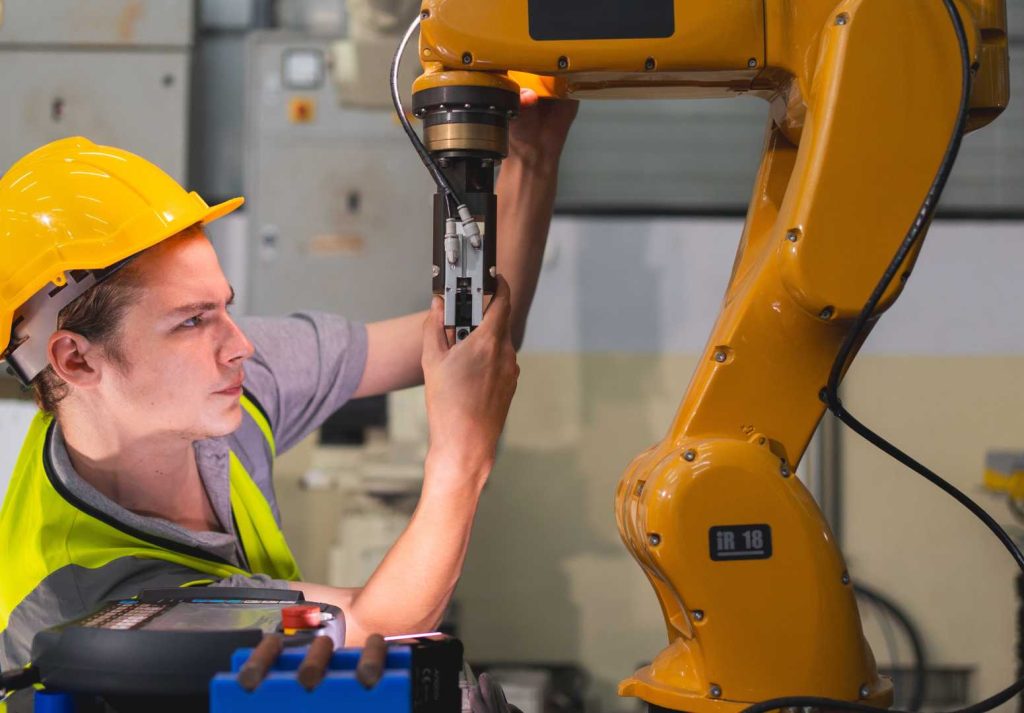
For UK manufacturers, 2026 isn’t just about adopting high-end technology, it’s about starting small, thinking globally and leaning into a network of expertise. Therefore, there is a definite automation adoption opportunity for the UK.
Key takeaways
- The UK has the lowest robot density in the G7, creating significant opportunities for manufacturers to improve productivity through automation.
- AI is transforming robotics in manufacturing, enabling smarter, more autonomous systems that are easier for non-specialists to deploy and manage.
- Cost, skills shortages and outdated perceptions remain the biggest barriers to robotics adoption, particularly for SMEs.
- Manufacturers should start with simple automation projects to build confidence, reduce risk and create momentum for wider deployment.
- Businesses that adopt robotics early and engage with the UK’s innovation ecosystem will be better positioned for long-term growth and international competitiveness.
FAQs
- Why is robotics adoption important for UK manufacturers?
- What are the main barriers to robotics adoption?
- How is AI changing industrial robotics?
- Should SMEs invest in robotics?
- Where should manufacturers begin with automation?
The role of robotics in manufacturing
As we’ll find out in the next feature, the country has been lagging behind the rest of the world for quite some time, so there’s certainly room for improvement and to make advancements in industrial robotic density.
As AI continues to thrive and is combined further with robotic technologies, new possibilities are opening up for businesses to move quickly. This short guide provides a blueprint for UK manufacturers to navigate the transition from traditional production to AI-integrated automation.
The convergence between AI and robotics is unlocking new possibilities for manufacturing.
The rise of autonomous and intelligent systems
There are currently autonomous systems that are acting increasingly independently of humans, as well as dexterous manipulation (robotic hands and grippers) which can work on complex objects and unsupervised learning, where robots are able to identify a pattern without guidance.
This is drastically changing industry and speeding up the time from deployment to results, as well as increasing human and robotic collaboration.
From large language models to physical AI
AI now spans the full spectrum of robotics, from development and testing through to deployment. Large language models have also grown in the last year when it comes to robotics. Their widespread use makes it easier for non-specialist users to train and configure robotic systems. This allows for a lower dependency on specialists and decreases barriers for implementation.
The sector is now moving towards the use of physical AI, meaning the use of systems that perceive reason and act in the physical world. Robots are now working independently and autonomously in the world around them, in a smarter way.
The manufacturing industry must throw out everything it thinks it knows about robots and make room for this new age.
Barriers to robotics adoption for SMEs
Barriers to robotics adoption in the UK are highly researched. Industrial robotic installations did reach a record high in 2023 which was driven largely by the automotive sector. However, in general, UK robot density stands at around 112 per 10,000 manufacturing workers which is the lowest in the G7. But why?
The top three barriers manufacturers face:
- Cost of integration: The cost of integrating a robot into a business is often more than purchasing one. Most SMEs won’t be developing their own technology and therefore will be purchasing off the shelf technology. Therefore, installation often creates a stumbling block for SMEs.
- Expertise gap: The UK has great system integrators, but unfortunately, not enough of them. Industry is calling for a strategic shift in public procurement to fuel robotics adoption. This move will help to build the industrial capacity and expertise our integration sector currently lacks.
- Incorrect perception: Businesses associate robots with large automotive style manufacturers and smaller businesses can’t always visualise how robotics would apply to them. To combat this idea, the UK government needs to look at the wider ecosystem. Perceptions of robotics and automation go beyond the company; it goes to the public, investors, policy makers and regulators. If the story out there is not a good one, then the UK is not going to realise the opportunity it has.
The business case for robotics adoption
Beyond simple efficiency, the integration of robotics addresses the most pressing structural challenges facing UK industry today, allowing businesses to solve them.
- Labour shortage: The UK manufacturing sector currently has around 58,000 vacancies in which robotics can offer a direct response. With the use of robotics and automation, businesses can maintain output and grow, but without being constrained by workforce availability. This allows the industry to plug skills gaps and be more competitive globally.
- Operational safety: Robotics remove humans from dull, dirty and, importantly, dangerous environments. According to the latest HSE data, manual handling and machinery contact are the leading causes of serious injury in UK manufacturing, accounting for up to 25% of all non-fatal accidents. By automating these high-risk tasks, businesses don’t just protect their workforce, they significantly reduce the downtime and insurance costs associated with workplace injuries.
- High output and lights out: For manufacturers, robotics is the key to continued growth. However, widespread adoption requires a stable market. By committing to innovative robotic solutions in public sectors like healthcare and defence, the government can stimulate the industrial capacity needed to make these technologies more accessible and affordable for every UK manufacturing business.
How manufacturers can start their automation journey
Struggling where to start? Small and simple. Manufacturing businesses often know they want to implement robotics and automation in their factories, but don’t know where or why.
Building confidence through early wins
Businesses should begin by looking to automate relatively straightforward processes, not complex ones. This will increase the chances of success and lay the foundations for future deployments by boosting internal confidence and creating a culture of acceptance. Many businesses that unsuccessfully deploy new technologies will be reluctant to repeat their mistakes, opting in the future for maintaining the status quo over investing in new and unproven technologies. In short, perceptions matter.
Leveraging technology hubs and test facilities
Right now, across the UK, technology hubs and test facilities for the manufacturing sector are popping up. A place where business owners can go and ask experts hundreds of questions about what robot is right for them, or what a new solution could look like. For them, this creates peace of mind and lowers the risk of investment.
These hubs connect manufacturers with proven off-the-shelf solutions. Manufacturers should ride the wave of these existing initiatives that are well-funded, tried and tested to help themselves on their adoption journeys. The UK ranks highly when it comes to robotic innovation. However, the perception is that only ground-breaking, frontier innovation will yield results, when in fact, off-the-shelf technologies can work just as well.
Preparing for growth through robotics and automation
The UK requires a robotics opportunities action plan that spans adoption, regulation, skills and investment at scale. This framework is needed for the UK to move from innovation to adoption as quickly as possible and reap the benefits of robotic adoption in industry.
Ultimately, manufacturing businesses need to be adopting now because waiting for the market to mature will allow competitors such as Germany and China to benefit from the UK’s hesitancy.
Thinking globally from day one
To attract serious growth-stage investment, UK robotics and manufacturing firms must prioritise international scale from the outset. Although the UK market is relatively small, the most successful companies are those that ‘think global’ early, using international demand to generate the high returns required to gain ROI and fuel long-term expansion.
Winning the race to automate
For manufacturers, the race to automate is already underway and victory belongs to those who act early. Success depends on integrating into the national network of robotics expertise, from transport and defence to digital infrastructure. Engaging with these ecosystems ensures businesses are at the forefront of new procurement opportunities and nationwide funding rolls-outs, allowing them to scale faster and more effectively.
Thanks to Rory Daniels, Head of Emerging Technology and Innovation, techUK.
Further reading
- International Federation of Robotics – World Robotics reports and insights
- techUK – Robotics and intelligent automation resources
- Made Smarter UK – Manufacturing technology adoption support
For more articles like this, visit our Automation channel.