

Digital transformation is redefining how manufacturers design, operate, and maintain complex facilities. Yet many initiatives falter because their data doesn’t fully reflect the physical world.
Grounding digital transformation in reality
Every manufacturer today is pursuing some form of digital transformation. From predictive maintenance to AI-driven optimization, nearly every initiative depends on data accuracy and accessibility.
But decades of modifications, undocumented upgrades, and legacy systems have left many industrial sites with incomplete records. Engineering teams often rely on as-designed drawings that represent only a fraction of what exists on the shop floor. The result is a “digital trust gap” — a disconnect between digital models and the physical environments where work actually happens.
Closing that gap requires a shift in perspective. Instead of treating as-designed data as the source of truth, manufacturers are turning to the as-built world—a living, continuously evolving representation of how a facility exists today. By grounding every initiative in verified as-built data, organizations can build digital systems that reflect reality, not assumption.
The as-built world: the missing layer of transformation
Facilities evolve constantly. Equipment moves, lines expand, and processes adapt to new demands. While design models define intent, the as-built environment reveals reality — a record of what truly exists.
Without visibility into this as-built layer, transformation remains abstract. Investments in automation or AI are only as reliable as the data that feeds them. Managing the as-built world means capturing and maintaining this dynamic layer of reality — giving engineers, operators, and decision-makers a shared, trustworthy baseline for every stage of the facility lifecycle.
Reality capture as the new baseline
Reality capture technologies such as terrestrial laser scanning (TLS), drone LiDAR, SLAM mobile scanning, and photogrammetry now allow manufacturers to digitize large environments with speed and precision.
This “reality data” becomes a complete, measurable, and visual record of existing conditions — a single version of the truth that unites disciplines. Instead of sending teams onsite for every inspection or verification, they can explore their facility virtually. For manufacturers managing multiple plants or remote sites, this shift isn’t just convenient—it’s transformative for safety, collaboration, and cost efficiency.
From digital models to visual twins
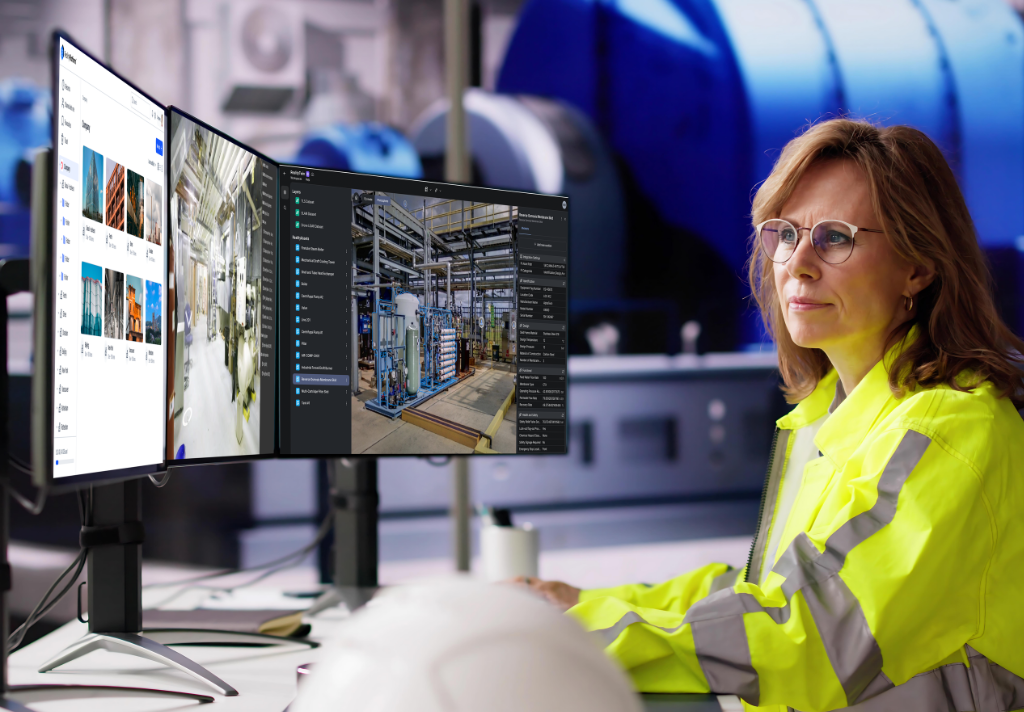
Traditional CAD and BIM models remain vital for design, but they were never built to capture operational complexity. A visual twin provides the missing spatial context — integrating scans, imagery, and CAD layers into one coherent view. It can also connect to maintenance or asset systems, enabling decisions based on verified context rather than static documents.
Visual twin platforms, such as Prevu3D RealityTwin, can support a wide range of use cases:
- Validation: Confirm site conditions before retrofits, installations, or shutdowns.
- Planning: Evaluate space constraints and visualize project impacts.
- Training and safety: Prepare teams virtually before entering hazardous areas.
- Maintenance: Identify equipment and isolation points directly within the 3D environment.
Rather than replacing existing systems, a visual twin enhances them by providing an intuitive, spatial interface for complex operational data.
Bridging engineering and operations
Engineering teams work from design intent; operations teams manage reality. When these worlds drift apart, inefficiencies compound — from installation errors to extended downtime.
A visual twin closes this gap by linking both perspectives. Engineers can validate that new layouts or retrofits fit existing conditions before work begins. Operations teams can visually locate assets, confirm isolation points, or brief contractors with accurate context. Health and safety leaders can assess risks virtually before anyone enters the site.
As these workflows mature, visual twins evolve from one-off projects into long-term operational assets—a shared reference point connecting design, maintenance, and decision-making.
Why the foundation matters
The industrial sector’s next wave of innovation—AI-driven insights, autonomous inspections, adaptive maintenance scheduling—depends on trustworthy spatial data. Algorithms can only optimize what they can accurately “see.” If facility information is fragmented or outdated, digital initiatives will inherit those blind spots.
According to Deloitte’s 2025 Smart Manufacturing Survey, 92% of manufacturers believe smart manufacturing will be the main driver of competitiveness over the next three years, yet most still report gaps in maintenance and materials management maturity. This reinforces a critical truth: digital performance gains depend on the accuracy and integrity of the underlying facility data.
By grounding transformation in verified as-built data, manufacturers create the foundation for digital continuity—ensuring that every technology layer, from sensors to simulation, is built on reliable context.
Building a reality-centric future
Managing reality data effectively requires more than capturing scans. It demands an integrated ecosystem where visual information can be ingested, organized, and connected to enterprise systems.
“A visual twin should make the as-built world accessible to everyone—not just engineers or CAD experts,” says Michel Besner, CEO of Prevu3D. “When every team, from maintenance to leadership, works from the same accurate view of reality, digital transformation stops being an IT initiative—it becomes how the company operates.”
Manufacturing’s digital future depends on that continuity between the physical and digital worlds. When every team operates from a shared, verified understanding of reality, transformation becomes measurable and enduring.
As-built data provides the missing layer that grounds strategy in fact—reducing uncertainty, strengthening collaboration, and creating the conditions for continuous improvement.
Interested in learning more about managing the as-built world?
Discover more insights on building a reliable digital foundation at prevu3d.com.
 Elle Magni, Content Marketing Manager, Prevu3D
Elle Magni develops content and brand strategies that make complex technology accessible. At Prevu3D, she leads storytelling around digital twins and the evolving connection between physical and digital worlds.
For more articles like this, visit our Digital Transformation channel.