



Tiberius Aerospace has moved its Invictus long-range precision strike system from early laboratory investigation into formal engineering test and evaluation (T&E), marking a significant step towards developing the system for field deployment.
Invictus is a tube-launched, multi-mission system designed to integrate with multiple platforms and operate across land and sea domains. Its architecture is intended to support launches from vertical launch systems and autonomous vehicles, providing greater flexibility in how long-range precision effects are delivered.
The programme follows the development of Tiberius Aerospace’s Sceptre ramjet munition, which the company launched in May 2025. The company recently announced that Sceptre had successfully achieved ramjet ignition during a live firing in the US. According to Tiberius, the development and testing undertaken through the Sceptre programme has accelerated Invictus from exploratory laboratory work into an engineering programme focused on validating propulsion, flight performance, guidance, platform integration and manufacturability.
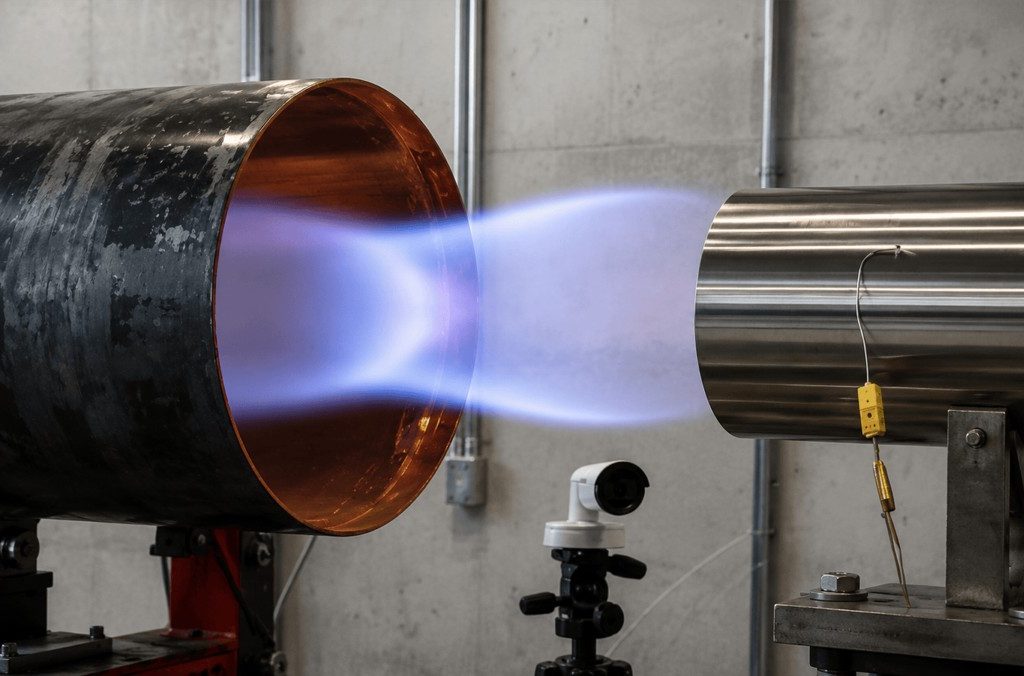
Direct-connect testing of the Invictus ramjet engine is already underway at Purdue University’s Zucrow Laboratories, where the company says the engine has demonstrated operability using Jet-A fuel across all conditions tested so far.
Designed for production at scale
Tiberius says the programme is being developed against growing demand in the US and allied countries for long-range precision strike capabilities, as governments seek to rebuild missile inventories and increase defence production capacity. The company claims the US Army used virtually all of its stockpile of ATACMS and Precision Strike Missiles during the five-month conflict with Iran, while missile inventories across Europe have also come under pressure. These challenges have increased calls for faster production and replenishment of precision weapons.
Invictus is intended to address both capability and manufacturing capacity, combining long-range precision with a modular architecture designed to support different missions and future upgrades.
The Invictus-200 variant will combine a ramjet with an integral booster to achieve speeds of up to Mach 3 and a range of up to 200km. Tiberius says it will offer targeting precision of 5.5m circular error probable (CEP), depending on the guidance configuration. The system will have a payload capacity of between 10kg and 15kg, while its modular, open architecture is intended to allow configurations to be adapted as operational requirements evolve.
“The move into formal engineering, testing and evaluation is a major step toward turning Invictus from a promising technology into a deployable capability,” said Chad Steelberg, founder and CEO of Tiberius Aerospace.
Steelberg said the company had designed Invictus and Sceptre to provide cost-effective lethality while also enabling high-volume production. He added that the company’s AI-powered GRAIL platform is being used to connect programme requirements with domestic and allied suppliers capable of manufacturing components and systems.
According to Tiberius, this approach is intended to support a broader and more resilient industrial base while reducing the need to replace entire weapon systems as requirements change. The company said Invictus will combine long-range precision, multi-domain flexibility, scalable production and an open architecture, with the aim of enabling continued adaptation throughout its service life.
For more articles like this, visit our Innovation channel