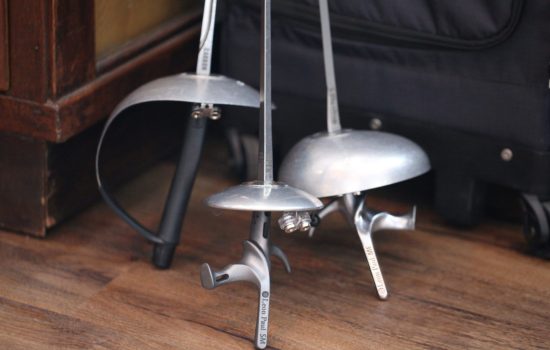


A century-old British manufacturer is proving that fencing isn’t just an Olympic sport steeped in tradition – it’s also a cutting-edge industry. Leon Paul, the London-based family firm behind generations of blades and masks, is blending heritage with innovation to grow on the global stage. The Manufacturer‘s Joe Bush went to find out more.
When I was approached about a site visit to a London-based fencing manufacturer, I naively assumed I would be perusing a variety of perimeter and border-based offerings to meet the needs of gardeners, security professionals and farmers nationwide.
Key takeaways
- Leon Paul combines tradition with innovation: The 102-year-old British fencing manufacturer blends century-old craftsmanship with modern digital design and manufacturing processes to produce high-quality fencing equipment.
- Digital transformation drives efficiency: Implementation of CAD design, software modelling, and Orderwise stock control has reduced order fulfilment from over six days to less than eight hours, while also streamlining warehouse training and operations.
-
Product longevity and customisation are market leaders: Leon Paul’s fencing blades are more durable than competitors’ (lasting up to one and a half years), and the company offers customisable weight and performance features to suit different fencing styles.
-
Sustainability and ethical practices: Leon Paul is the only net zero fencing company globally, using fully recycled or compostable packaging and actively reducing waste and transport inefficiencies.
-
Skills investment and adaptability ensure long-term growth: Instead of traditional apprenticeships, Leon Paul hires adaptable talent, pays above-market wages and encourages employee innovation, supporting both workforce development and global expansion.
FAQs
- How is Leon Paul innovating in fencing equipment manufacturing?
- What makes Leon Paul’s fencing blades different from competitors?
- How does Leon Paul promote sustainability in manufacturing?
- How does Leon Paul support its workforce and skills development?
However, the ‘fencing’ in question referred to the art of swordplay. An ancient discipline, originating from the battlefields of history, fencing has been an ever-present sport in the Olympics, dating back to the very first modern games in Athens in 1896 – one of only four other sports that can make that claim.
You may have caught a glimpse yourself during an Olympic year, when various sports which don’t usually get air time are thrust onto our screens. Despite being a tricky sport to follow, I did my best to get my head around some of fencing’s various nuances during a visit to Leon Paul, a traditional British engineering firm that has been manufacturing fencing equipment in the UK for over 100 years.
There are three types of fencing weapons, each with its own rules and target areas. The foil targets only the torso area of the body and points only count if landed with the tip of the blade. The epée can strike the entire body and whoever hits first wins. And finally, the sabre targets the waist up, including arms and head and hits can be made with the edge as well as the tip of the blade.
While watching some of the budding Olympians warm up in Leon Paul’s dedicated, and very impressive, training centre, I had to be careful not to get too carried away and remember that I was there to find out about the company’s manufacturing process; rather than indulge in a childhood fantasy by embracing my inner Erol Flynn (The Sea Hawk, The Adventures of Robin Hood, Captain Blood and all that)!
Thankfully, I was saved any embarrassment by the arrival of Leon Paul’s Commercial Director, James Fay, who kindly got my head back in the game and took me on a tour.
How Leon Paul blends century-old craftsmanship with modern manufacturing innovation
Leon Paul is a £10m business and its Hendon factory manufacturers blades as well as masks and protective clothing. Despite being 102 years old, operating within what is a fairly traditional environment, the company is going through a period of disruption.
The age demographic is changing, with the sport now appealing to a far younger age group, while also experiencing peaks and troughs in popularity depending on where you are in the world. James commented: “The sport is expanding in the US, China and Far East, and therefore that’s where we’re positioning our business to grow for the next 102 years.”

Unsurprisingly, fencing is a sport that is heavily regulated. However, Leon Paul has been diligently innovating its products where possible and streamlining its operations. The company has pivoted to different materials and manufacturing processes to enhance longevity and quality, while also increasing the ability for customers to adjust the performance of their own individual products.
“It’s not a one-size-fits-all sport,” continued James. “So, we’re continually looking to improve the service that we offer to our customers. While we’re a manufacturer, we are now predominantly a service business, and that’s why people buy from us. All of those elements culminated in us winning the King’s Award for Enterprise last year for innovation and development in sport.”
Commenting on the King’s Award, Barry Paul, grandson of company founder Leon, said: “Receiving the King’s Award is a proud day and back in 1921, I don’t think Leon, in his wildest dreams, would think that the company he founded would eventually be recognised by royalty 100 years later.”
The digital transformation driving faster, higher-quality fencing equipment production
Because everything at Leon Paul is manufactured by hand, James explained that it’s difficult to make wholesale changes to established processes. That being said, the company is constantly developing its understanding around the molecular behaviour of the materials and cloths used, and how it can provide benefit to the end users, and improve performance and accessibility within the sport.
“We’re on a digital transformation journey every day,” James added. “Most of our products are now CAD designed and we have a lot of software in place that enables us to model and better understand the model properties of steel, which in turn impacts our manufacturing processes. Within the warehouse, sales and anything that is customer facing, we’re totally digitised now. We’re always improving and we’re now into a marginal gains process.”
James added that Leon Paul’s USP is service, quality and brand. “Our current performance on providing a standard order shipped out of the warehouse is less than eight hours. A standard order from our biggest competitor is around eight and a half to nine days. And if you look on their website, at any point in time, a large amount of their product is not available, compared to just 11% on our own website. And that’s the difference.”
Much of that key differentiator is down to the company’s deployment of the Orderwise stock control and WMS software in 2017. On joining the business, James admitted that there wasn’t a barcode in sight within the warehouse, with the business still operating a paper-based order system. “We needed a means of understanding what was going on in our sales,” he added.
Orderwise was initially rolled out across finished goods, and once that was Paulsuccessful, was then extended further across the business. “As we cut our teeth in one area, we were able to learn problems, understand the issues, act on those learnings and then move onto the next stage,” he added.
This has enabled warehouse order output to reduce from six and a half days to less than eight hours. Additionally, the simplification of the system has significantly reduced employee training time; with Orderwise Leon Paul is able to have someone trained and picking in three hours, while traditionally this process would have taken six months. “We have a walking route in our warehouse,” added James. “The system tells the worker where to go, so as long as you understand your alphabet and you can count, the rest of it works very easily.”
However, it’s not only getting orders out of the door where Leon Paul has a cutting edge (excuse the pun). Some of the company’s competitors manufacturer blades very labour intensively. However, the industrial manner used by Leon Paul reduces cost, and maintains efficiency and consistency.
It also enables the company to add customisable elements to the end products. Traditionally, the company’s blades would have a standard form with the weight in a specific area, corresponding to the needs of the general market. However, the manufacturing process now deployed at Leon Paul enables weight to be shifted across the blade (more towards the tip for example) to incorporate different fencing styles.

“What we’ve built into our blades which wasn’t there before is longevity,” James continued. “A normal foil blade being used three times a week would typically last around five or six months. Ours will last up to a year and a half. Fencers will go through two of our blades a year, compared to six if they use a competitor blade.
“This enables us to offer a lot of economic benefits to fencers going forward. The price between our blades and our competitors is comparable but customers get three times the longevity with our products. “We’ve built our blades to accommodate people’s technique.
We’ve put quite a lot of molecular structure in our blades that enables it to recover if misused.”
And, the proof is in the pudding. Leon Paul used to have 15% of the sabre blade market. However, that has increased to 82% in the last three years, purely due to the longevity, consistency and performance that has been built in to the blades via new manufacturing processes.
Sustainable manufacturing and skills investment: Leon Paul’s strategy for long-term resilience
Like all manufacturers, Leon Paul has faced myriad challenges in recent years including supply chain disruption, the drive for sustainability and the battle for skills. Indeed, James admitted that he stopped counting the cost of Brexit three years ago. But, like all agile businesses, the company has adapted, found a way around the problem and looked closely at how to provide value to customers while maintaining costs.
“We’re all about customer service,” added James. “We ship globally, pick up all customer issues and costs, and we do all of that at point of sale, so the customer gets a smooth transition of delivery. We’re always looking at improving packaging, and reducing waste, cost and space – all the things that any ethical, responsible company would do on a daily basis.”
Indeed, Leon Paul is the only fencing company in the world that is net zero. All the company’s packaging is either fully recycled or compostable. The business is further investigating how it can innovate by reducing packaging still further, and minimising space when transporting its products so vans, boats and planes are not travelling unnecessarily.
Interestingly, Leon Paul takes a slightly different approach to the talent conundrum, as James explained: “Skills are a massive and ongoing issue but we don’t offer apprenticeships. However, if we think that someone has the adaptability, skill and aptitude for manufacturing, we’ll give them a job and we’ll train them. But we’ll pay them as if they’re doing their job properly, and that gets a lot of interest from an investment perspective. We’ll still send them to college, but we’ll pay them a proper wage.”
James added that the business is keen to look after the skills that it has within the business and so every employee at Leon Paul earns more than the market rate for the role they perform. That, in turn, helps to keep skills and knowledge in the business, which can then be passed on to the next generation of the workforce that come through.
Whether it’s facing down challenges or deploying new manufacturing processes within a traditional operation, it’s clear that Leon Paul holds the virtues of adaptability and agility very dear, as James explained: “It’s important that manufacturers don’t rest on their laurels. Just because a business has been doing something a certain way for 25 years, it doesn’t mean to say it’s the right way. There is always a better way to do something. We encourage a lot of employee participation. If someone has a good idea, we’ll let them run with it to see if it works. We’ll never fire anyone for trying.”
For more articles like this, visit our Innovation channel