

A UK-led space mission designed to advance ultra-secure communications has successfully launched into orbit, marking a significant step forward for quantum technology and cybersecurity.
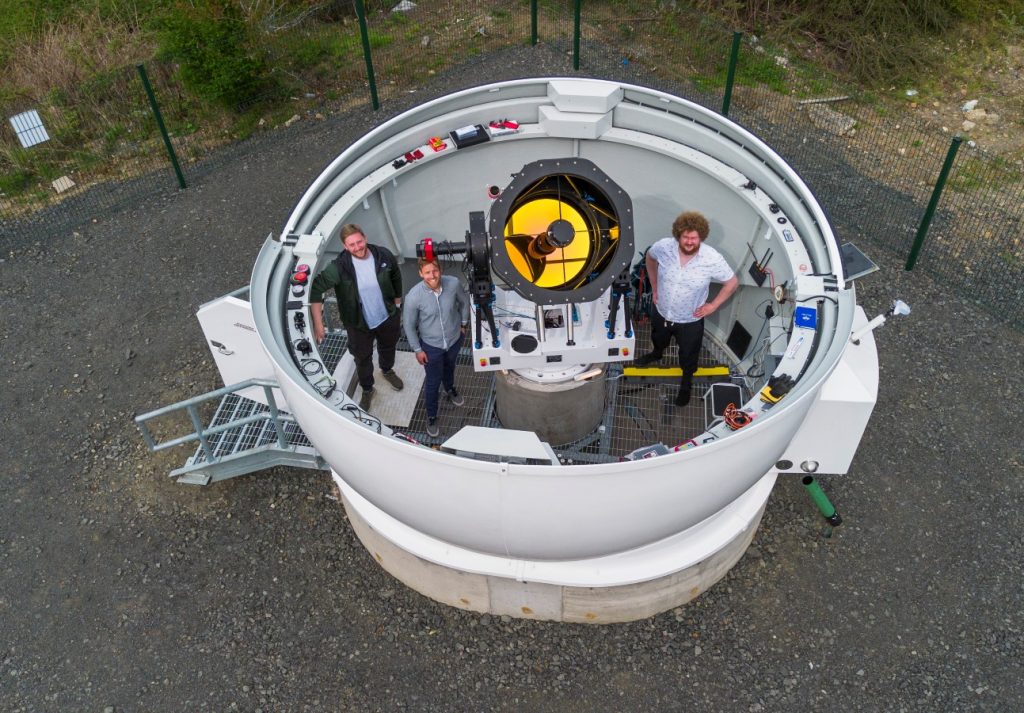
The “Satellite Platform for Optical Quantum Communications” (SPOQC), developed through a collaboration led by Heriot-Watt University, was launched aboard a SpaceX Transporter-16 rocket from California on 30 March. The CubeSat is now undergoing final commissioning before beginning quantum signal transmissions to a ground station in Edinburgh.
The mission brings together five UK research institutions alongside Science and Technology Facilities Council’s RAL Space, with the aim of strengthening the UK’s leadership in space-based quantum communications, an area seen as critical to countering future cybersecurity threats posed by quantum computing.
Quantum communication enables highly secure data transfer, where any attempt at interception can be immediately detected. While terrestrial fibre networks already support such capabilities, satellites are seen as essential to enabling secure communication over long distances and at a global scale.
Professor Gerald Buller, Director of the Integrated Quantum Networks (IQN) Hub, described the mission as “a vital enabler towards truly global quantum communication,” highlighting its role in integrating space-based systems with terrestrial networks.
The SPOQC satellite carries a dual quantum payload, allowing researchers to test two different communication approaches under varying conditions—an innovation expected to improve reliability and accelerate development.
Andy Vick, Disruptive Technology Programme Lead at STFC RAL Space, said the launch reflects the UK’s growing strength in the field.
“SPOQC is a big step for all the teams involved… one that we hope will pave the way for the UK’s national quantum network mission.”
– Andy Vick, Disruptive Technology Programme Lead at STFC RAL Space.
The mission follows the launch of another UK-supported quantum satellite, SpeQtre, in late 2025, signalling increasing momentum in the sector.
Full quantum communication experiments are expected to begin later this year, as researchers work towards building resilient, global quantum-secure networks capable of protecting digital infrastructure for decades to come.
For more articles like this, visit our Innovation channel