

As UK steel output falls to its lowest level since the 1930s and import dependency hits
record highs, the sector faces a fight for survival. Can the transition to ‘green steel’ be
delivered in time, and will government act to help forge a brighter future?
Jonny Williamson reports.
UK steel at a glance
- Directly contributes £1.7bn to the economy, plus £2.2bn in supply chains
- Employs 36,800 people directly, with wages 24% higher than the national average
- The UK government is the largest single buyer of steel in the country
- The UK has six main steel producers: British Steel, Liberty Steel, Marcegaglia, 7 Steel UK, Sheffield Forgemasters and Tata Steel
FAQs
- What are the challenges facing the steel industry?
- What percentage of UK steel demand is produced in this country?
- What has been described as a “a generational opportunity” for the UK steel sector?
- What is UK Steel’s Digital Catalogue?
- How much scrap steel does the UK produce every year?
“I’ve been Director General of UK Steel (trade association for the UK steel industry) for ten years, and I’ve never seen the sector in such poor health as it is now.” A sobering assessment from Gareth Stace, and one supported by the figures.
UK steel production fell to just 4 million tonnes in 2024, down from 7.6Mt in 2018 and a third of the 12Mt produced a decade ago. It’s the lowest output since the Great Depression, and a stark indicator of the pressure facing producers.
Equally worrying is the UK’s increasing dependency on imports. In 2020, UK made steel met around half of domestic demand. Today, it’s less than a third. Seventy per cent of steel used in the UK is now imported, up from 60% in 2023 and 55% the year before.
The biggest increase has come from non-EU sources, mainly India, Vietnam, China and Turkey, which benefit from lower energy costs, lighter environmental regulation and significant state subsidies.
“The UK supplies just 30% of its own steel demand – anyone can see that’s unsustainable,” Gareth told The Manufacturer. “Individually, the six steel producers here might be doing well, but as an industry, I think we have a big problem.”
Overcapacity, imports and energy prices
That “big problem” is a convergence of structural pressures, all forecast to intensify through 2025 and beyond. While not unique to the UK, the country is feeling the effects more acutely than most.
The first is global overcapacity. Simply put, mills worldwide are producing far more than demand requires, with no sign of output falling. Overcapacity is forecast to rise from 602Mt in 2024 to 721Mt in 2027 – five times total EU steel production. This glut in the international market has pushed prices down.
Chinese exports alone more than doubled between 2020 and 2024, reaching a record 118Mt last year – enough to meet UK demand 13 times over. For UK producers, that pain is compounded by a fresh wave of imports redirected from the US following President Trump’s increase in steel tariffs.
Second is uncompetitive energy prices, a long-standing thorn in the side of UK industry. Steelmaking is highly energy intensive, and UK producers pay up to 50% more for electricity than competitors in France and Germany – a disadvantage that deepens as the sector electrifies.
“As we transition fully to electric arc furnace (EAF) technology, price competitiveness will become even more central to our future,” added Gareth. UK Steel estimates the switch to EAF could double the sector’s electricity consumption.
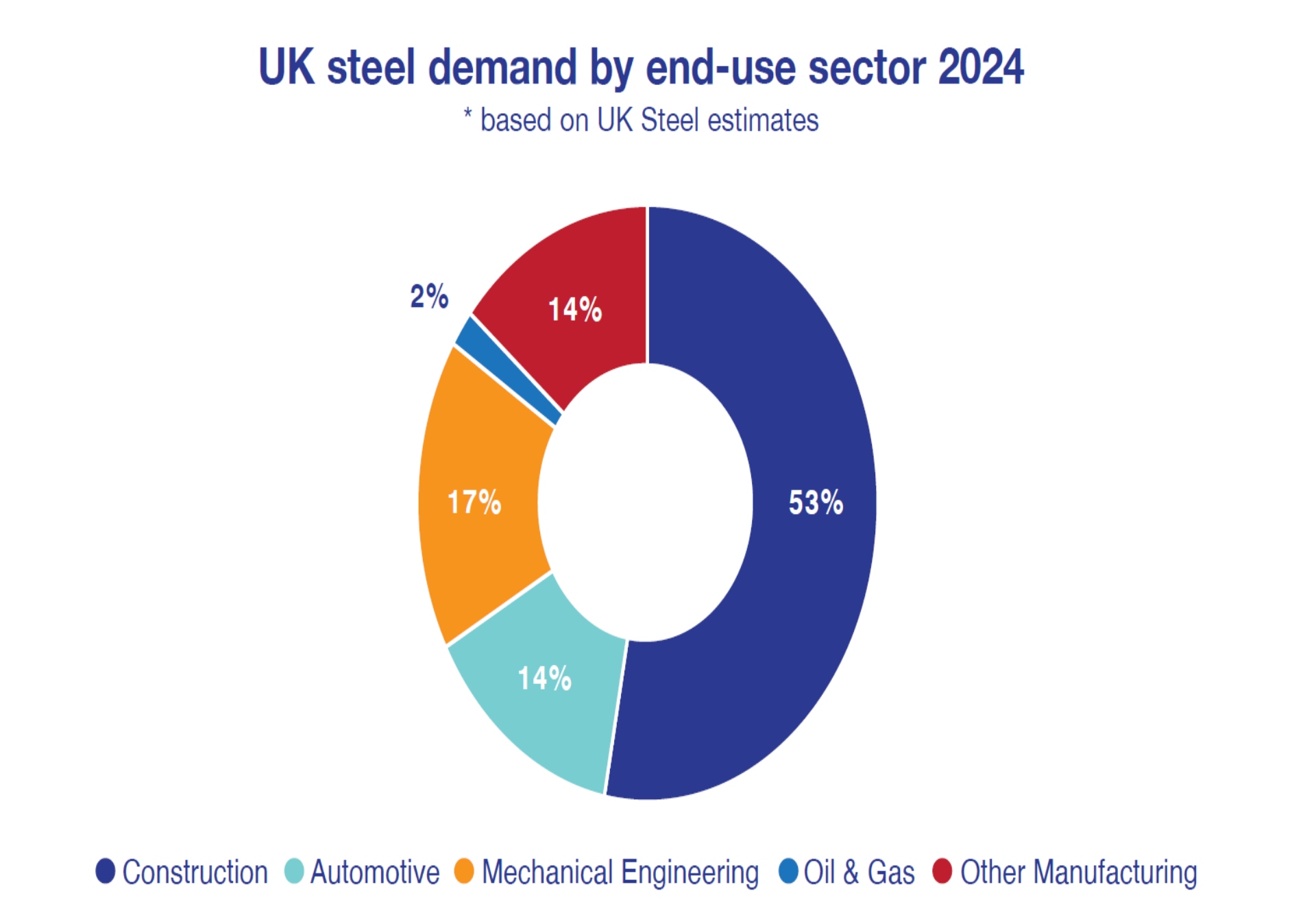
Third is weak domestic demand. Two-thirds of UK steel is consumed by just two sectors – construction (53%) and automotive (14%) – both facing headwinds. New vehicle production fell 12% in 1H 2025, while construction output remained flat.
“Fundamentally, the economic pie needs to get bigger, and it just isn’t,” Gareth warned. “What we need is sharper thinking and support from policymakers, and a greater focus on using the capability and capacity the UK already has.”
The most powerful lever for change
Public procurement is the most effective tool government has to support UK industry – using national investment to strengthen supply chains, build resilience and deliver maximum social, economic and environmental return.
Over the next decade, £4.3bn is expected to be spent on steel through public projects – a figure that doesn’t account for major initiatives like nuclear energy and hydrogen infrastructure, so the true total will be far higher.
Unlike the US or EU, the UK has yet to fully align procurement policy with national interests and local industry. From the US Inflation Reduction Act to the EU Green Deal, other nations now mandate or incentivise domestic content. The UK must follow suit.
Encouragingly, for the first time in years, there are signs of political appetite to act. Offshore wind offers a critical test. The first wave of UK investment relied too heavily on imported steel. That mistake can’t be repeated in the second, described as being “a generational opportunity” for the UK steel sector.
The UK’s offshore wind pipeline – targeting 50GW by 2030 and 100GW by 2050 – is the second largest in the world. Delivering it will require 1Mt of steel annually through to 2050, worth an estimated £21bn.
The bulk of this (89%) will be steel plate, used in high-volume components like towers and monopiles, alongside significant demand for rebar and tensioning strands. UK producers can already supply up to 13Mt (51%) of the 25Mt needed, including 45% of the plate. That could rise to 86% if proposed investments in steel casting and mills proceed.
Steel as a ‘strategic national asset’
Strengthening the supply of UK-made steel into the defence sector is another major opportunity. UK Steel has called for defence-grade steel capacity to be recognised as a ‘strategic national asset’ – something ministers are reportedly open to – and for the MoD to assess scaling up, reopening or adopting mothballed plants to meet emerging demand, including for new product lines.

Heathrow has committed
to prioritising UK-made steel in its
proposed £49bn expansion, including a
third runway and new terminal capacity.
Image courtesy of Heathrow Airports UK
The government’s Strategic Defence Review (SDR) – published in June 2025 – identified ways to expand industrial capacity, including steelmaking, to support the UK’s evolving military priorities. With an ambitious list of investments in defence infrastructure, procurement will be a key element of turning that strategy into action.
“Steel is not only integral to the construction of naval vessels and armoured vehicles but is also the foundation of essential defence infrastructure, from barracks and warehouses to shipyards and logistics hubs,” Gareth said.
“British steel should, wherever possible, be the default choice for projects of national importance. The Defence Secretary has made clear his desire for more domestic steel to be used across defence programmes, and this review marks a turning point in converting that commitment into policy.”
Much now rests on the forthcoming Defence Investment Plan, due in Autumn 2025, which must set out how government intends to deliver on its SDR ambitions. It will replace the Defence Equipment Plan 2022 – 2032 (issued under the Sunak government), and will be a litmus test of whether the government is serious about prioritising sovereign capability.
“The Steel Strategy (still in development after missing its planned spring 2025 publication) and the £2.5bn pledged via the National Wealth Fund, are essential tools for delivering that vision,” Gareth added. “They can help identify and close capability gaps, ensuring that the widest possible range of steel grades can be sourced from UK mills and furnaces to meet our national defence needs.”
Making UK-made steel visible
If the sector is to reverse its declining output and capitalise on the billions committed to national infrastructure and defence, then visibility of products, capabilities and supply chains is vital.
UK Steel’s new Digital Catalogue aims to close that information gap. Developed in close partnership with industry and backed by government, the catalogue lists more than 10,000 steel products manufactured in the UK – searchable by type, supplier and specification. It gives buyers – from government officials to engineers and architects – a clear view of what can be sourced domestically, removing a long standing barrier to local procurement.
The new digital platform is a key outcome of the government-backed Steel Procurement Taskforce, and is now embedded and linked in the revised guidance that stipulates public sector officials and their contractors must consult the catalogue before making buying decisions.
There’s now no reason for UK steel to be overlooked, Gareth added: “This catalogue is a one-stop-shop that takes away any uncertainty around what we do and don’t make in the UK. With national security concerns front and centre, we urge all public and private sector buyers to make full use of the catalogue to help ensure that economic value, jobs and supply chains are built here and not lost abroad.”
Green steel needs bold policy
The transition to electric arc furnaces – a cornerstone of the UK’s decarbonisation strategy – will define the industry’s immediate and long-term future. As the world’s first steel-producing nation to publish a net zero roadmap for its steel sector, back in 2022, the UK has a head start.
But that momentum will stall without energy and scrap reform. As noted, energy price disparity sees UK firms pay far more than competitors elsewhere, primarily due to significantly higher wholesale electricity prices.
The sites switching from blast furnaces to EAFs will see their power use almost quintuple. Hence why affordable energy is such a hot button issue. The recent shelving of plans to introduce zonal electricity pricing was welcomed. Because steelmaking is tied to specific legacy sites, UK Steel warned it would have unfairly penalised existing producers who couldn’t easily relocate.

Construction of the Sizewell C
nuclear power station in Suffolk will require
nearly 300,000 tonnes of steel, representing
a £700m opportunity for UK suppliers.
Image Courtesy of EDF/ Sizewell C
“Now the government must ensure the alternative, reformed national pricing supports rather than hinders industrial competitiveness,” Gareth said. As the UK scales up EAF production, access to scrap metal – the primary feedstock – will become vital. In this regard, the UK has a unique yet currently untapped advantage. The country produces more than 10Mt of scrap steel each year, 80% of which is exported to predominantly developing countries for processing and then shipped back.
This is an industrial own goal. “No country in the world has a higher scrap-to-steel ratio than the UK,” Gareth added. “Port Talbot, when its EAF comes online, will want pristine scrap, but a rebar manufacturer doesn’t need the same high grade – so they’re not fighting over it. That’s why we’re asking government to change the export rules, something we hope to see in the national Steel Strategy.”
Introducing a robust scrap strategy would future-proof the supply of a resource set to see rising global demand, lower costs, reduce reliance on imports, build new supply chains and create jobs – all aligned with the decarbonisation roadmap.
As the steel industry faces the need to redefine production and business models, reassess raw materials and supply chains, and make huge technology investments, all against a global backdrop of rising protectionism and excess stock, now is the time for a more assertive stance from government – on public procurement, import protections, energy reform, sector safeguards and the scrap market.
Whether this translates to a true turning point or a missed opportunity will be defined by the policy decisions made over the coming weeks and months.
Related content from The Manufacturer
British steel industry faces ‘existential threat’ from EU tariff hike – The Manufacturer
Ovako: A company on its mettle when it comes to sustainable steel – The Manufacturer
Visit our Leadership section for more articles like this one