

This article is a transcript from a podcast by Siemens.
For more than 30 years, I’ve supported leading manufacturers, large and small, helping them to become more productive, to drive down costs and to increase quality. This is achieved through the holistic application of digital technologies. At Siemens we call this Smart Manufacturing. My favourite work days are those where I get the opportunity to visit a factory and see manufacturing in action. When I get to talk to the people who make it happen, to understand their challenges and aspirations. To work with them to build a digital road map and explain how digital manufacturing technologies can be brought to bear to make this vision a reality.
My name is Ian Walls and I’m part of the team at Siemens Industry Software in the UK. This is the first in a short series of podcasts in which I will share some of my experiences and insights relating to Smart Manufacturing. Hopefully you’ll find these interesting and, more importantly, thought-provoking. Done well, digital manufacturing delivers enormous value. I would love to play a part in helping you and your organization on your own Smart Manufacturing journey.
Demystifying Smart Manufacturing
What is Smart Manufacturing? Smart Manufacturing is the in-silico planning and optimization of real-world manufacturing systems. That is, a digital twin of actual systems and processes is built before breaking ground on new greenfield factories or modifying existing production lines. Once in production, the digital twin of your factory and the manufacturing processes within it ensure the effective operation of your factory and leads to on-time delivery of high quality products at the lowest cost. Time, cost and quality have always been key business drivers and the objective of Smart Manufacturing is to deliver these, consistently.
A real-world impact: the digital design review
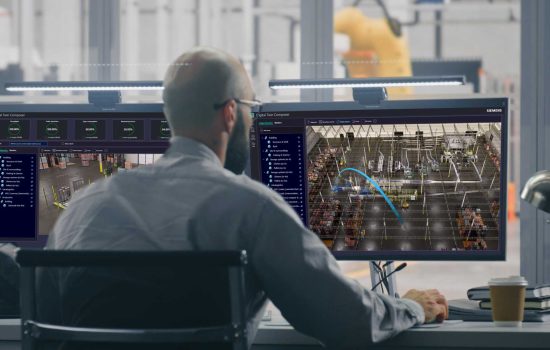
Consider the example of a family business in the Midlands that I recently worked with. Their process for introducing new products involved designing them using digital tools and then handing that design over to the production line, where one would be built. Only then did they uncover flaws with the design or the assembly process. Flaws such as inaccessible fasteners or poor workplace ergonomics. And then they would go back to the drawing board to iron out the design problems and try again. This process ultimately works, but it can take a long time, especially when you make your mistakes in metal. We introduced them to the concept of a digital design review. The different stakeholders including manufacturing engineers, industrial engineers, quality lead operators and so on gathered round conference room screen and built that first product digitally. Step by step. They were thus able to validate the build sequence, identify where fasteners could only be reached with torque tooling by damaging surrounding components. And in the process, also uncovered a design flaw with a piece of mould tooling. But crucially, this was identified before that tool was actually built, saving tens of thousands of pounds. The time invested in a digital design review, paid off many times over and resulted in a product that could be made right first time, every time, saving money and getting new products to market faster.
What problem does Smart Manufacturing solve?
To answer this it is necessary to look at the pressures on manufacturing companies today. Every manufacturer must respond to its own unique combination of factors relating to complexity in the product design, complexity in the manufacturing process or complexity in terms of increased quality product requirements. There’s also complexity due to external factors such as extended supply chains, with recent global events causing shortages of certain critical components. Historically, one of the ways to address complexity has been to simplify. My contention is that simplification is not the right response. Rather, we should embrace complexity. And use it to deliver competitive advantage. This desire to simplify can be seen in organizational structures that effectively create silos for various engineering and commercial domains. And so we will have, for example, product design in one silo, manufacturing engineering in another, perhaps quality assurance in a third and so on. The issue is not that digital technologies have not been deployed, rather that they too are siloed. There are different Systems Of Record, each with their own processes and workflows, adherents and data formats. This impairs the flow of information between departments and the issue is exacerbated when additional IT investments are made, as this often serves to deepen those silos, adding additional capabilities solely in the context of those domain systems.
Navigating silos and embracing complexity
The challenge then is how to break down the silo walls so that information can flow freely. We refer to this free flow of information as a Digital Thread that connects people and systems. It’s more than just a channel for data. That’s an important part of it, but equally it enables the interconnection of business processes. These run across departments and rely on common access to information covering all aspects of product design, simulation, tests, manufacturing, quality assurance and service. A Digital Thread removes much of the need for manual intervention, moving and checking data and all but eliminates errors associated with those data transfers.
At Siemens we think about manufacturing not as a discrete activity that occurs at a particular point after the design has been finalized. But rather as a continuous process that happens in parallel to other activities, that goes beyond the left-to-right or design-to-production flow of information. It’s about taking feedback from various points in that manufacturing planning and manufacturing execution. And acting on that information to further improve the process. We call this closed-loop manufacturing.
How then do we build a Digital Thread for manufacturing? For Siemens the answer lies in our Xelerator platform which accelerates the digital transformation of manufacturing by integrating Internet-of-Things enabled hardware, software and services. It offers interoperability, Digital twin technology for real time process optimization and scalability for businesses of all sizes. The platform fosters collaboration through a partner ecosystem and features a marketplace for discovering and deploying digital solutions. This empowers manufacturers to enhance efficiency, innovation and growth. It’s important to stress, however, that digital manufacturing is not just about technology. It’s also about the people and the business processes themselves.
A journey of transformation: the Congleton Facility’s digital transformation
This can be seen in action at Siemens’s electronics-drives manufacturing facility in Congleton in the UK. Over many years they have implemented digital manufacturing technologies and processes and are now reaping enormous benefits. Those benefits allow them to go from design to manufacturing, engineering into production and to look back into design. Closing this manufacturing loop reduces product lead times and new product introduction times and it drives productivity and agility. The journey started many years ago, implementing conventional lean manufacturing techniques. This led to significant improvements in productivity and reductions in lead time, but the Congleton team found that to go beyond this they needed to digitalize large parts of their engineering and execution processes. This was not done as a big bang, rather it was done incrementally over a number of years with each stage along the way delivering value to the business in a way that allowed them to justify continued investment.
Today, their journey is not at an end. In fact, digitalisation is not an end in itself. Rather, the manufacture of innovative high quality products at lower cost, making best use of your limited resources becomes your North star, guiding the business onwards. Digitalization is an enabler. My colleagues in the Congleton facility are justly proud of what they’ve achieved and are happy when they get an opportunity to share their experiences and host reference visits in which they can talk about their people and process aspects in particular. Over the course of the following episodes, I will cover the interrelated aspects of planning, executing, and optimising manufacturing. I look forward to welcoming you on the journey as we consider the core capabilities required to embody smart manufacturing beginning in Episode 2 with the domain of manufacturing engineering.
Our Smart Manufacturing journey continues
If you’d rather listen to my thoughts than read, check out my Podcast. In the meantime, if you wish to reach out to me and have a conversation about any of the topics I’ve discussed and how it might apply in your manufacturing context, I’d be delighted to speak to you. I can be reached by e-mail at [email protected]. I will leave you with a quote from the author William Gibson: The future is already here. It’s just not evenly distributed.
Until the next time, goodbye.

Ian Walls, Portfolio Development Executive, Digital Manufacturing Siemens Digital Industries Software.
Ian’s primary focus is the software portfolio supporting Digital Manufacturing. This encompasses manufacturing process planning; plant design, simulation and optimization; Part Manufacturing and CAM; and Additive Manufacturing; production scheduling; Manufacturing Execution; and Quality.
Ian has been with Siemens for over 30 years. In that time, he has been involved in sales; presales; services delivery; training; and support; for customers spanning a broad range of industries both in the UK and around the world.
For more articles like this, visit our Digital Transformation channel.