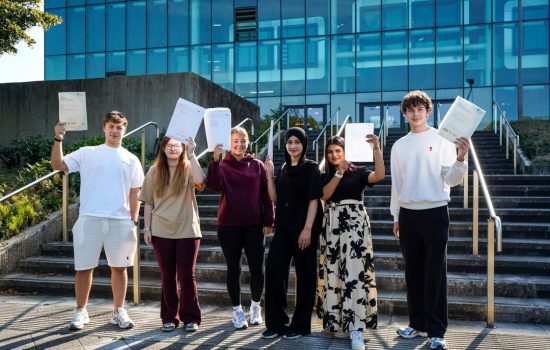
Thousands of young people all around the country will see the release of the 2026 A-levels, AS-levels and T-level results for England today (13 August), as well as results for other technical and vocational qualifications.
With the ongoing challenge around skills within manufacturing and engineering, businesses within the sector will be keeping a close eye on the results and what they may mean for the future of the sector.
The Royal Academy of Engineering has supported and advised on engineering education and training ever since it was founded 50 years ago. The UK engineering economy comprises around 685,000 engineering businesses (26% of UK business base) across all nations and regions, employs around 8.5 million people (more than a quarter of the UK workforce) and contributes 33% of the UK’s total economic output.
We welcome any increase in the number of young people choosing to study subjects, both academic and vocational, that support routes into engineering. But the truth is that the upward trends in these subjects over the last decade are not anywhere near enough to address the long-standing shortage of engineers and technicians.
Dr Ian Ritchey OBE FREng, Chair of the Royal Academy of Engineering Education and Skills Committee
Ahead of results day, Dr Ian Ritchey OBE FREng, Chair of the Royal Academy of Engineering Education and Skills Committee, commented: “This year’s results are likely to reinforce the need for more radical action to address the long-standing skills shortage and persistent skills gap in UK engineering.
“Of course, we welcome any increase in the number of young people choosing to study subjects, both academic and vocational, that support routes into engineering. But the truth is that the upward trends in these subjects over the last decade are not anywhere near enough to address the long-standing shortage of engineers and technicians. Latest estimates suggest we may need as many as 240,000 new engineers and technicians a year just to fill existing roles, as well as supporting essential infrastructure and decarbonisation projects.
“The solution is not a simple one but the Academy-led report, Engineers 2030, outlined some of the urgent actions required.
“We will certainly need to attract far greater numbers of women and others from groups currently underrepresented in engineering. This needs to be via both academic routes and better resourced technical education pathways nationally and regionally. The Academy works with schools, colleges and industry in regions around the UK to help give teachers the confidence to deliver engineering-based activities in the classroom and talk about engineering careers and pathways to their students.
“The new government’s intention to focus investment on high-quality technical education and practical routes into employment is most welcome, but to realise the benefits it must help improve access for more people by simplifying the complex landscape of education and training pathways and also help businesses, particularly small and medium enterprises, with the bureaucratic and financial hurdles they face to offering student placements and apprenticeships, which are vital to the success of vocational qualifications.”
Chief Executive of the Baker Dearing Educational Trust Kate Ambrosi, added: “On behalf of Baker Dearing, I would like to congratulate those young people receiving their results today.
“Thousands of students across our 44-strong programme of University Technical College secondary schools will today be receiving theirs, before they progress to ambitious destinations such as degree apprenticeships, technical university courses, and employment.
“Including UTC Portsmouth’s Miraaj Choudhury who is progressing to a degree apprenticeship with the UTC’s founding partner QinetiQ after his engineering T Level. Also Ben Brailey-Garrett from Doncaster UTC, who is in line for place on Amazon’s highly competitive Level 4 RME Mechatronics apprenticeship.
“Following the success of UTCs in progressing students to apprenticeships, Baker Dearing will in 2026-27 be piloting new apprenticeship provision with the generous support of The ERA Foundation, Ofsted ‘outstanding’ training provider The JCB Academy and involving several UTCs.
We are excited by the government’s announcement of new technical education routes for 14-year-olds. If this provision is of a high enough quality and properly involves employers, it should lead to similar destinations data to that of the UTC programme.
Kate Ambrosi, Chief Executive, Baker Dearing Educational Trust
“Due to their own efforts, as well as the high-quality technical education and employer connections their UTC has provided them with, very few UTC leavers will progress to no destination. Half of all UTCs had no NEETs in 2025 and a quarter have had no NEETs ever.
“We are excited by the government’s announcement of new technical education routes for 14-year-olds. If this provision is of a high enough quality and properly involves employers, it should lead to similar destinations data to that of the UTC programme.
“We are already delivering high-quality, employer-led technical education to more schools through our UTC Sleeve initiative, which implants a UTC-esque pathway within the school, to help students across the area.
“This is in parallel to our work designing an award for the Greater Manchester Baccalaureate, the PM’s own initiative which improves lines of sight between the classroom and workplace.
“We look forward to working closely with the government and devolved authorities to help more young people thrive in life and work through a UTC education.”
Paraic O’Lochlainn VP eMaint, a Fluke brand added: “The increase in the number of students taking T-Levels in manufacturing and engineering disciplines is very positive news for the sector. However, this only amounts to 0.8% of the total number of students in England and Wales studying T-Levels or A-Levels overall, reflecting how more technical careers are still the path less trodden.
“While schools are celebrated for students achieving Russell Group offers, the economy is short of the electricians, engineers and technicians needed to deliver its biggest growth ambitions – from renewables and data centres to a golden age revival of UK manufacturing. That is the supply-and-demand mismatch no one wants to confront.
“For years, young people were told that success meant university, a degree and an office job. Everything else was quietly branded second-best. Now we have over a million young people outside education or work, while industries like manufacturers offering paid training, progression and long-term demand can’t find enough people.
While schools are celebrated for students achieving Russell Group offers, the economy is short of the electricians, engineers and technicians needed to deliver its biggest growth ambitions… that is the supply-and-demand mismatch no one wants to confront.
Paraic O’Lochlainn VP eMaint, a Fluke brand
“That is not a lack of ambition. It is a failure of imagination from the system around them. We don’t just need more opportunities. We need to stop hiding the ones that already exist behind outdated assumptions about what a ‘good career’ looks like. Whilst university is a valuable route, it is not the only respectable one. For young people, manufacturing and the trades should not be a Plan B. They are a direct route into skill, income, purpose and the ‘first rung’ of the career ladder we keep claiming is missing.”
Becca Gooch, Head of Research at EngineeringUK, commented: “Congratulations to all students receiving their exam results today. STEM A levels are a key route into engineering and technology careers, so we are pleased to see an increase in entries for all relevant subjects.
“This includes maths (+3.9%) maintaining over 100,000 entries for the third year running, further maths (+8.5%), computing (+1.1%), design and technology (+2.8%), and physics (+1.9%). It is positive too to see an increase in entries across all of these subjects among girls. In particular, for both computing (+2.8%) and D&T (+3.6%), the increase overall was driven by girls. While the increases in maths (+2.9%), further maths (+6.4%) and physics (+0.4%) were lower than the overall increases in these entries, it is still a move in the right direction.
“T Levels continue to grow in number and popularity, and we’re pleased to see a 46% increase in engineering and technology entries – taking the total to 8,307 young people. The proportion of girls taking engineering and technology T Levels has increased slightly from 12% to 13%. Currently women make up just 17% of the engineering and technology workforce.
Currently women make up just 17% of the engineering and technology workforce. Addressing this gender imbalance would help the country meet its workforce needs as well as giving women a financial boost. It’s great to see positive movement, but there is still more to be done to increase the uptake of STEM subjects among girls.
Becca Gooch, Head of Research, EngineeringUK
“Addressing this gender imbalance would help the country meet its workforce needs as well as giving women a financial boost. It’s great to see positive movement, but there is still more to be done to increase the uptake of STEM subjects among girls. We’re delighted too that so many young people are opting to study engineering and technology at university level – it’s a great choice for them and welcome news for the sector. This year we have seen another large increase (+14%) to 34,100 in accepted applicants, compared to 30,020 in 2025, with a similar percentage increase for men and women.
“There’s huge growth across a range of industries and endless opportunities to make a real-world impact, from climate change to digital transformation. So, it’s an exciting time to be starting out on a career in engineering and technology. The upward trend in numbers suggests that efforts to attract more young people into engineering and technology are continuing to pay off. The skills they are developing are in high demand among UK employers, who are keen to welcome new talent into the workforce. These young people, and their peers on vocational and technical pathways, have the opportunity to enjoy sustained, rewarding and well-paid careers.”
For more articles like this, visit our Skills channel