


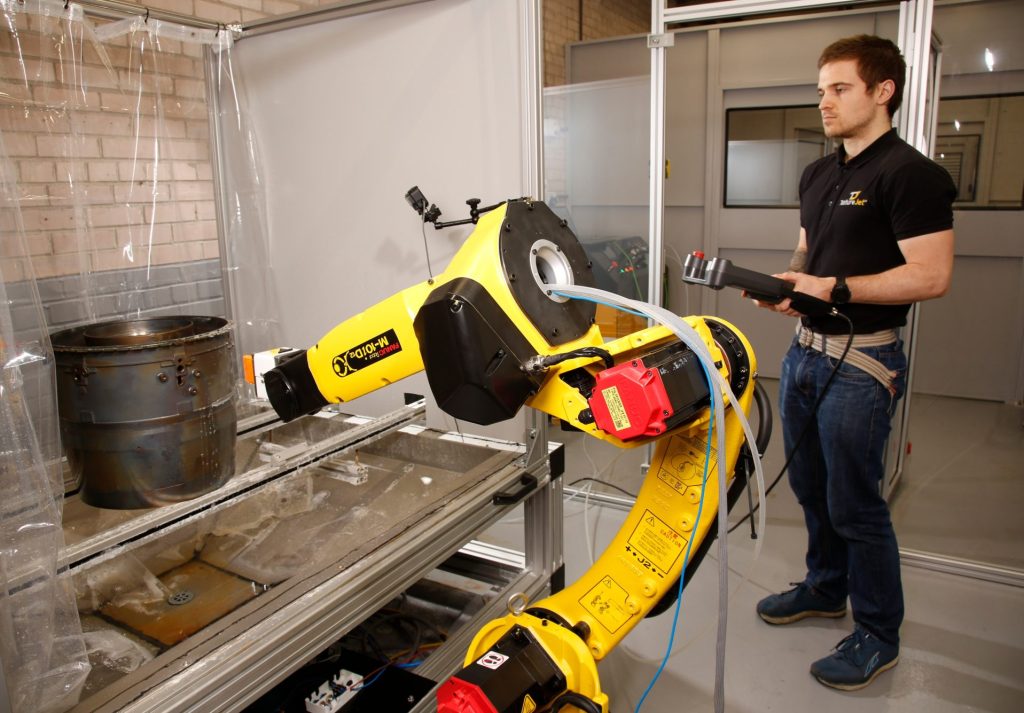
In precision manufacturing, the smallest details matter. Electrochemical jet machining now offers a cleaner, more precise alternative to traditional approaches, making this the time for change.
In precision manufacturing, the smallest details often determine the greatest outcomes. While component performance and in-service efficiency drive tighter tolerances and innovative material choices, one process is frequently underestimated: surface finishing. In particular, edge finishing – rounding, shaping, or breaking sharp edges – is a vital but overlooked stage that can make or break a component’s performance.
For industries such as aerospace, power generation and medical devices, the efficiency and reliability of a part may hinge on the quality of its edge. Untreated sharp edges can create a poor fit and stress concentrations that lead to cracking and eventual product failure. Yet despite these risks, edge finishing is still too often treated as a routine step, carried out with legacy methods that no longer align with the needs of modern, high-value manufacturing.
The hidden cost of edge finishing
Edge finishing is far from a minor detail in the production chain. For complex components with multiple features, it can account for as much as 30% of total part costs. That is a significant figure given that at this stage, the part has already absorbed substantial “value-add” in terms of operations and labour. Scrapping a component late in the process can therefore be disproportionately expensive.
The scale of the problem becomes clearer when looking at industry-wide data. In sectors such as German automotive and tooling, edge finishing–related rejects and rework account for up to 5% of overall manufacturing costs. That’s a vast financial burden borne from what might otherwise be considered a finishing detail.

The limits of legacy methods
Traditional edge finishing typically involves manual, or robotic, brushing. These processes are labour-intensive, inconsistent, and in some cases introduce stress and damage to delicate components.
Manual deburring is slow and operator dependent. Automated brushing improves efficiency but remains limited in precision and repeatability. Neither method offers the control or quality assurance increasingly demanded by safety-critical industries.
Researching new solutions
A recent research project has shed light on a new, smarter alternative that has been developed in the UK. Using Electrochemical Jet Machining (ECJM), researchers assessed the repeatability and precision of edge break treatments on nickel superalloy components.
The findings were striking:
- 4× more precise than manual brush deburring
- Nearly 2× more precise than automated brushing systems
- Consistent results meeting aerospace tolerance requirements
For manufacturers, this translates into higher yields, reduced rework, and greater confidence that the part will perform as intended in service. At scale, these benefits translate into lower costs and stronger supply chain resilience.
Just as significant is the environmental and operational impact. ECJM uses a pH-neutral, saline-based electrolyte eliminating the need for harsh acids, airborne particles, or specialist PPE. In other words, it addresses the juxtaposition in modern manufacturing of providing increased performance whilst satisfying the need for safer, cleaner manufacturing.
However, ECJM does more than provide a cleaner route to edge finishing. It offers manufacturers the ability to consolidate multiple surface processes – edge shaping, surface preparation, part marking – into one smart, automated solution.

A leader’s perspective
Jonathan Mitchell-Smith, CEO and founder of TextureJet, believes the industry is on the cusp of a transformation.
“Surface processing has often been overlooked, yet it is central to product integrity, safety and sustainability,” he explains. “We’re now seeing a shift towards smarter, cleaner technologies that not only improve component performance but also reduce environmental impact. This is not just an incremental improvement – it’s a rethinking of how we add value in manufacturing.”
By positioning surface processing as both a technical and strategic priority, Mitchell-Smith argues that manufacturers can unlock new efficiency gains while meeting the rising demands of regulators and customers alike.
Looking ahead
Surface finishing has long been treated as an afterthought in component design and manufacture. Yet as the demands on high-value industries increase, its importance is coming into sharper focus.
The research shows that smarter, cleaner, and more consistent alternatives are already emerging. For manufacturers, the question is no longer if these methods will become standard practice, but how quickly they can be integrated to deliver competitive advantage.
Surface processing may once have been the quiet end of the production line, but it is now central to the future of precision engineering. Those who embrace innovation in this space will be better equipped to meet the twin challenges of performance and sustainability that define modern manufacturing.
 Jonathon Mitchell-Smith, CEO and Founder, TextureJet
Jonathon has guided TextureJet from university spinout to thriving business. With a strong background in engineering, he transforms advanced manufacturing technologies into innovative solutions for customers.
Connect on LinkedIn: https://www.linkedin.com/in/jonathon-mitchell-smith-292ab092/
For more articles like this, visit our Leadership channel.

