
As digital technologies proliferate throughout the manufacturing industry, a significant workforce shift is needed to ensure that organisations are getting the most from their investments. Dr Awinder Kaur of Warwick Manufacturing Group (WMG), University of Warwick, believes the key lies in what she calls the ‘hybrid manufacturer’, professionals who have both deep technical expertise and the digital prowess needed to drive the next generation of industrial transformation. The Manufacturer’s James Devonshire sat down with Awinder to find out more.
AI, automation and other connected factory solutions are reshaping manufacturing. But the challenge now isn’t adoption. It’s developing a workforce with the skills to use these disruptive technologies to their fullest.
As a result, manufacturers are beginning to recognise the need for a new type of employee, one who combines deep technical expertise with a broad understanding of digital technologies, data and business strategy.
For Dr Awinder Kaur, Associate Professor in Data Science and AI, and Head of Digital Technologies and Machine Intelligence Education Group at WMG, that evolution represents one of the most significant workforce shifts manufacturing has experienced in decades.
“It’s something I’ve seen first-hand through delivering leadership training in digital transformation with organisations and my work with manufacturers at WMG,” Awinder explained. “The biggest challenges were not purely engineering or technology problems, rather they required people who could connect engineering, business strategy, digital technologies and people.”
It is a philosophy she describes as “digital skills stacking”, developing complementary skills that allow professionals to work confidently across disciplines while maintaining expertise in their own specialism. For manufacturers operating increasingly connected factories, those combinations are becoming invaluable.
“The competitive advantage comes from combining skills, not simply accumulating experience in only one area,” Awinder said.
As manufacturers grapple with skills shortages, accelerate AI adoption and attempt to improve productivity in an increasingly competitive global marketplace, developing these hybrid capabilities may prove just as important as investing in the next generation of technology.
The emergence of the hybrid manufacturer
Traditionally, manufacturing has been built around specialist expertise. Mechanical engineers solved mechanical problems. Production managers focused on operations. Quality teams ensured products met specification. IT departments managed digital infrastructure. Each function operated largely within its own discipline. Digital transformation has fundamentally changed that model.
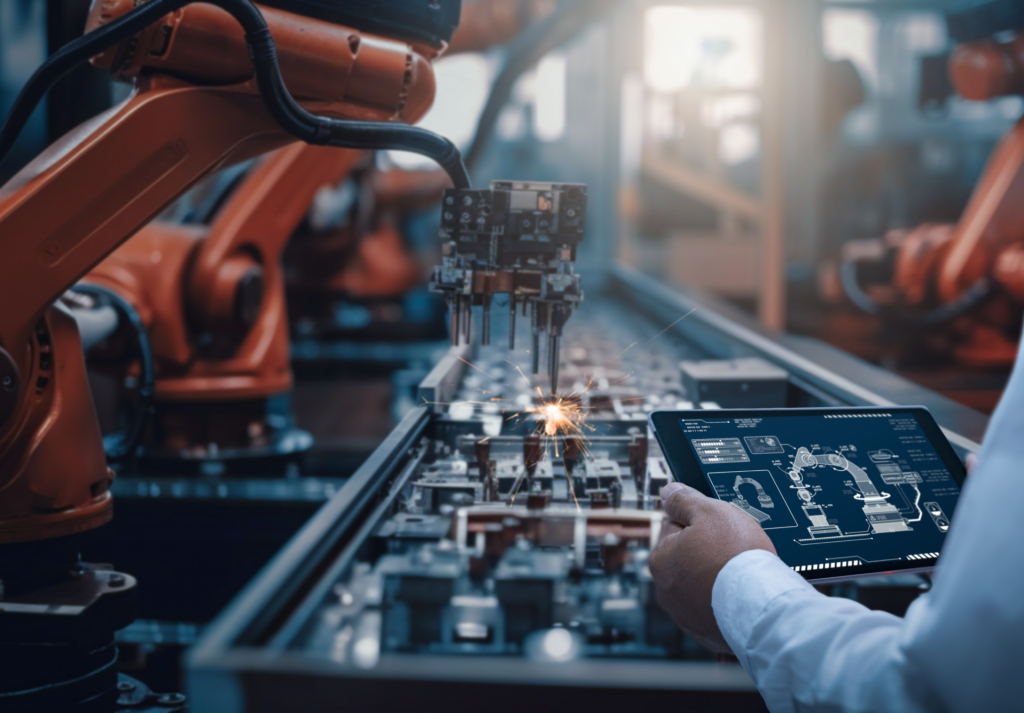
Today’s production environments are built around connected systems that generate vast amounts of operational data. Equipment is monitored continuously through sensors, production performance is visualised through live dashboards, quality inspection increasingly incorporates AI-powered computer vision, while supply chains rely on predictive analytics and digital twins to optimise inventory and logistics. In this environment, no department operates in isolation.
Instead, engineers are expected to understand the data generated by the machines they maintain. Production managers need sufficient digital knowledge to interpret operational dashboards and identify opportunities for improvement. Quality engineers increasingly work alongside AI-assisted inspection technologies, while supply chain professionals are using predictive modelling to make faster, more informed decisions. This convergence of engineering and digital capability is where Awinder’s ‘hybrid manufacturer’ comes in.
“A hybrid manufacturer isn’t an expert in everything; that is a common misconception,” she said. “They have deep expertise in their own discipline, but enough understanding of digital technologies to collaborate effectively and make informed decisions.”
Rather than expecting every engineer to become a data scientist or every production manager to become an AI developer, manufacturers should instead focus on building enough digital capability across the workforce to improve collaboration and decision-making.
“Manufacturing expertise plus digital capability results in greater value,” Awinder explained.
It also reflects the reality that many of today’s manufacturing challenges no longer fit neatly within a single department. Implementing predictive maintenance, for example, requires engineering expertise, sensor technology, AI models, cyber security protections and business leadership working together. Introducing AI-assisted quality inspection similarly requires collaboration between production teams, quality engineers, software specialists and operational leadership.
The organisations most likely to succeed are therefore those capable of breaking down traditional organisational silos and encouraging collaboration across multiple disciplines.
Manufacturing jobs aren’t disappearing, they’re evolving
Few developments have generated as much debate as AI’s potential impact on employment. Predictions that automation will replace workers have dominated headlines for years, fuelling understandable concern across manufacturing.
However, Awinder has a different take. Rather than eliminating jobs, she believes AI will fundamentally redefine them. Technology, she argued, should be viewed as an enabler rather than a replacement for human expertise. Maintenance engineering offers perhaps the clearest example.
Historically, maintenance teams responded when equipment failed. Planned maintenance schedules reduced risk, but interventions largely remained reactive. Today, connected assets continuously generate operational data via sensors embedded throughout manufacturing equipment. Combined with predictive analytics and AI, that data enables engineers to identify potential failures long before production is disrupted. The bottom line is rather than replacing maintenance engineers, digital technology is enhancing their ability to make better decisions.
Awinder explained how a similar transformation is taking place within quality management. Where inspections once relied primarily on manual visual assessment, manufacturers are increasingly combining experienced quality engineers with AI-assisted computer vision capable of identifying defects in real time. Production management has evolved in much the same way, according to Awinder.
“Where previously production managers focused on managing people and scheduling, it’s now increasingly about managing connected operations using live operational dashboards to inform decisions,” she said.
But whether it’s maintenance, quality, production or another area of manufacturing, the digital shift being witnessed can only happen with a solid data foundation in place.
Data before AI
Whether discussing predictive maintenance, digital twins, cyber security or workforce development, Awinder emphasised that while AI is an important driver of digital transformation, highquality data is the foundation on which its success depends. It is a distinction often overlooked amid the current enthusiasm surrounding AI in manufacturing.
Faced with mounting pressure to adopt AI, many manufacturers have focused their attention on identifying use cases for the technology. Yet, according to Awinder, too many are attempting to deploy AI before establishing the robust data foundations needed to support it.
“Organisations often want to begin with AI. But my advice is always start with your data,” Awinder said.
“Technology is only as good as the information it receives, and without good data, AI produces poor recommendations, automation becomes unreliable and decision-making suffers.”
The future of manufacturing isn’t about having the most advanced technology. It’s about having people who know how to use that technology effectively.
AI is not a magic solution… technology alone does not transform any organisation. For that reason, data literacy is becoming one of manufacturing’s most valuable workforce capabilities.
Dr Awinder Kaur, Associate Professor in Data Science and AI and Head of the Digital Technologies and Machine Intelligence Education Group, WMG, University of Warwick
 The future of manufacturing isn’t about having the most advanced technology. It’s about having people who know how to use that technology effectively.
As generative AI has become increasingly accessible, businesses of all sizes have felt pressure to demonstrate they are embracing the technology. For many SMEs in particular, the conversation has quickly shifted from whether to adopt AI to how quickly it can be implemented.
However, Awinder believes organisations risk treating AI as a destination rather than a tool. Instead of asking which AI platform they should purchase, manufacturers should first ask a far more fundamental question: what problem are they trying to solve?
If production inefficiencies stem from inconsistent processes, disconnected systems or poor-quality operational data, simply introducing AI is unlikely to resolve the underlying issue. In some cases, it may even amplify existing problems.
“AI is not a magic solution,” Awinder said. “Technology alone does not transform any organisation.” For that reason, she believes data literacy is becoming one of manufacturing’s most valuable workforce capabilities.
Data literacy extends well beyond collecting information from machines or dashboards. It involves understanding where data originates, assessing its quality, interpreting its meaning and recognising when results should be questioned.
As manufacturing environments become increasingly connected, employees across every department, not just data analysts, will need the confidence to work with information effectively. That represents a significant cultural shift for an industry where data has historically been viewed as the responsibility of specialist teams rather than the wider workforce.
Cyber security must become part of manufacturing culture
The same principle applies to cyber security. As operational technology becomes increasingly integrated with enterprise systems, cloud platforms and AI applications, cyber resilience has moved from being a technical consideration to a fundamental business requirement. For manufacturers, the consequences of a successful cyber attack extend far beyond the loss of data.
Production can grind to a halt, supply chains can be disrupted, customers affected and reputations damaged… often simultaneously. Yet Awinder believes many organisations continue to approach cyber security too narrowly.
“Cyber security isn’t just the responsibility of IT,” she said. “Everyone plays a role; operators, engineers, managers and senior leaders.”
Importantly, many cyber risks originate not from sophisticated technical attacks but from human behaviour. Whether employees unknowingly expose sensitive information, fall victim to phishing attacks or use unsecured AI platforms with confidential company data, awareness across the workforce has become just as important as technical security controls.
Awinder highlighted the growing concern around employees entering proprietary business information into publicly available large language models without fully understanding how that information may subsequently be used. As AI becomes increasingly embedded within manufacturing workflows, organisations will need to establish clear governance alongside technical implementation.
“Cyber security and AI go hand-inhand,” she said. “You can’t do one without another.”
Embedding cyber security from the outset, rather than treating it as an afterthought, therefore becomes essential to building trust in digital transformation.
Closing the digital skills gap
The evolution of manufacturing roles presents employers with another pressing challenge. Who possesses these hybrid skills? According to Awinder, the answer is not enough people.
“The real shortage isn’t AI specialists,” she said. “It’s people who can bridge engineering and digital technologies.”
Those individuals require a combination of capabilities that have not traditionally been taught together. Data literacy, cyber security awareness, AI implementation, systems thinking, digital leadership and change management all complement core manufacturing expertise, yet few professionals have developed all of them throughout their careers.
It’s a reality that begs the question: should businesses recruit entirely new talent, or invest in developing the people they already employ? Awinder believes the answer lies firmly in workforce development.
“I would prioritise developing existing employees,” she said. “Existing staff already understand manufacturing processes, products, customers and organisational culture. Those aspects are extremely valuable.”
Experienced engineers understand why production processes evolve in particular ways. Maintenance teams possess years of practical knowledge about equipment performance. Production managers understand customer expectations, operational constraints and organisational culture.
Decades of manufacturing experience cannot be taught, but digital skills often can be. But that’s not to say recruitment has no role to play. Fresh perspectives remain valuable, particularly when organisations require specialist expertise or new thinking.
Manufacturers that successfully combine experienced operational staff with targeted digital upskilling are likely to develop more resilient workforces than those relying solely on external recruitment.
Building the workforce of the future
Manufacturing has continually reinvented itself throughout history. Mechanisation transformed production during the Industrial Revolution. Electrification reshaped factories during the 20th century. Automation accelerated productivity in the decades that followed.
Today’s digital revolution represents the next chapter in that evolution. Yet unlike previous technological shifts, competitive advantage is unlikely to belong simply to those organisations with the largest technology budgets or the most sophisticated AI platforms. Instead, it will belong to manufacturers capable of developing workforces that combine engineering excellence with digital confidence, curiosity and adaptability.
The factory of the future will undoubtedly contain more connected systems, more intelligent automation and more AI than ever before. But those technologies will only deliver their full potential if the people using them possess the skills to interpret the data, question the outputs, collaborate across disciplines and continue learning as technology evolves.
Awinder also believes the organisations achieving the greatest success are those treating digital transformation as a business strategy rather than an IT initiative. Technology implementation, she argues, is ultimately a leadership challenge.
“Successful transformation depends on leaders who understand the business implications of technology, ask the right questions and create a culture that is conducive to their people delivering successful projects,” Awinder said.
“The future of manufacturing isn’t about having the most advanced technology,” she concluded. “It’s about having people who know how to use that technology effectively.” In the race towards smarter factories, that may prove to be the industry’s most important investment of all.
Q&As
- What is a “hybrid manufacturer”?: A hybrid manufacturer combines deep expertise in a traditional manufacturing discipline with a strong understanding of digital technologies, data and business strategy. They don’t need to be experts in everything, but they need enough digital knowledge to collaborate effectively and make informed decisions.
- Is AI going to replace manufacturing jobs?: AI is more likely to change and enhance manufacturing roles than eliminate them. Technologies such as predictive maintenance, AI-powered quality inspection and live operational dashboards allow employees to make faster, better-informed decisions while retaining the value of human expertise.
- Why is data so important before implementing AI?: High-quality data is the foundation of successful AI. Manufacturers should identify the business problem they want to solve and ensure their data is accurate, accessible and reliable before investing in AI. Poor data can lead to unreliable automation and poor decision-making.
- Why does cyber security need to involve the whole workforce?: As factories become increasingly connected, cyber security is no longer just an IT responsibility. Operators, engineers, managers and leaders all have a role to play. Employee awareness is particularly important as risks such as phishing and sharing confidential information with public AI tools increase.
- How can manufacturers close the digital skills gap?: Developing existing employees should be a priority. Experienced manufacturing staff already understand processes, products, customers and organisational culture. By adding digital skills such as data literacy, AI, cyber security and systems thinking, businesses can create the hybrid workforce needed for future manufacturing.
For more articles like this, visit our Skills channel