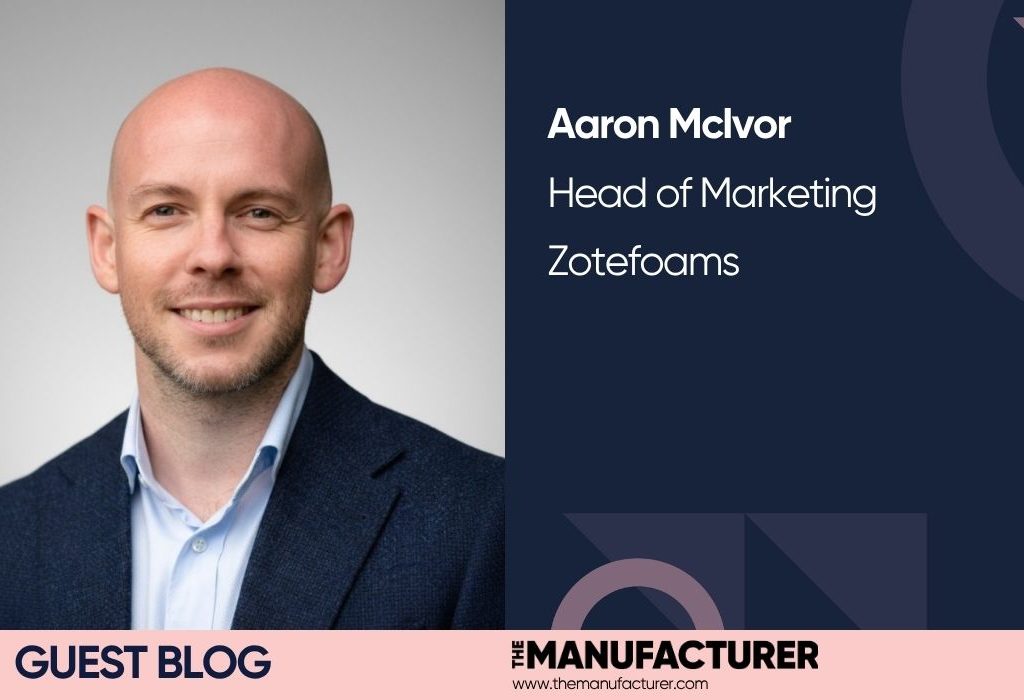
In this guest blog post for The Manufacturer, Zotefoams‘ Aaron McIvor argues that supply chain resilience begins long before procurement teams place an order. He explores why material specification has become a critical factor in reducing risk across aerospace, automotive and medical manufacturing, and explains how early design decisions can strengthen resilience, improve manufacturability and help manufacturers navigate an increasingly volatile global supply chain.
For much of the past few years, the supply chain resilience debate has focused on logistics – from shipping costs, congested ports, and shifting energy prices to supplier concentration, digital visibility and exposure to geopolitical disruption.
This emphasis is understandable amid a persistently volatile business landscape, with the World Economic Forum’s Global Risks Report 2026 seeing 57% of respondents anticipate a ‘turbulent’ or ‘stormy’ outlook over the next ten years.
But if disruption is becoming a long-term operating condition, resilience is more than merely a sourcing or logistics issue. By the time procurement teams try to secure supply, many of the most important dependencies have already been designed into the product.
From supply chain disruption to operational resilience
Join manufacturing leaders at the Manufacturing Supply Chain & Inventory Forum on 24 September 2026 at The Eastside Rooms, Birmingham, to benchmark with peers, share practical solutions and gain actionable strategies for improving supply chain performance, inventory management and operational resilience. No sales pitches—just real-world insight from those tackling the same challenges as you.

The matter of material specification
In high-performance manufacturing, a material is rarely chosen on availability alone. It may need to meet strict requirements around durability, weight, hygiene, fire performance, compression behaviour or long-life reliability. If that material later becomes constrained, inconsistent or commercially unviable, finding an alternative can mean reopening design, validation, customer approval or qualification work.
At that point, procurement is dealing with a risk created early in the design process – which is why resilience needs to start at specification, with designers, engineers, procurement and quality teams involved before dependency is locked into the product.
In aerospace, consistency is capacity
The aerospace sector puts forward a strong case as to why material specification and resilience are increasingly difficult to separate.
Today, global aircraft demand remains strong, but production systems remain under strain. IATA figures point to delivery shortfalls of at least 5,300 aircraft and an order backlog surpassing 17,000 aircraft, equivalent to almost 12 years of current production capacity.
In that environment, mitigating potential manufacturing complications is paramount. And while cabin, interior and environmental control components may appear small compared with the main airframe, they sit within systems governed by strict requirements around weight, durability, fire performance and long-life behaviour. If components vary from batch to batch, they become harder to convert, inspect, qualify and substitute. For aerospace manufacturers already managing constrained capacity and long backlogs, inconsistency becomes a supply chain resilience issue because it slows throughput and reduces room to manoeuvre when disruption occurs.
In aerospace, a large part of resilience is therefore confidence that the specified material will behave predictably when it is made, converted and installed. Lightweight, fire-retardant foam materials such as ZOTEK® F become useful in this context for more than just their material properties, as aerospace applications depend on consistency, convertibility and qualification confidence.
EV resilience is becoming a pack-level problem
The automotive sector faces a different version of the same challenge as it navigates electrification, cost pressures and uncertain demand.
The electric vehicle supply chain remains highly concentrated. The IEA’s IEA’s Global EV Outlook 2026 notes that China is set to remain the largest producer of batteries and battery materials to 2035 under stated policies. Meanwhile, outside China, much of the battery cell manufacturing in Europe and the US is still led by companies headquartered in Asia.
That makes resilience a design and production issue – not just a sourcing issue. Manufacturers cannot control every pressure in cell supply, but they can reduce avoidable risk inside the pack.
Spacing, cushioning and compression control help keep cells and modules correctly positioned over the life of the vehicle. If those materials behave inconsistently, the result can be tolerance issues, assembly variation, rework or delay.
For EV manufacturers scaling battery production, materials used in compression pads, cell dividers, seals and gaskets need to deliver resilient compression performance, predictable behaviour and consistent manufacturability. ZOTEK® Tis a good example of how a foam can be designed with these requirements in mind, helping designers and engineers manage tolerances and assembly consistency at scale.
Medical manufacturing leaves little room for uncertainty
Medical manufacturing also depends on components that support consistent performance, durability and safety. Compounding this, the OECD has highlighted supply chain risks across medicines and medical devices, including manufacturing issues, regulatory barriers and unexpected demand. For manufacturers, these pressures make material decisions especially important because the scope for late-stage substitution is often limited.
A component used in patient positioning, orthopaedic supports, wearable devices or protective medical packaging may need to meet stringent expectations for comfort, hygiene, skin contact, durability and repeatable performance. Changing the material can affect the finished product, the validation pathway and customer confidence.
As such, procurement resilience in medical manufacturing inseparable from specification. A supplier may be able to offer a nominally similar material, but similarity on paper is not the same as equivalent behaviour in use.
For designers and engineers, the task is to specify around the real application requirement. Plastazote and Evazote, for example, are used in medical applications including orthotics, prosthetics, surgical positioning and diagnostic supports. In these settings, the relevant issue is not simply comfort or cushioning. Predictable performance, hygiene, skin contact and validation are all critical to the finished application.
Repeatability is a resilience issue
Across aerospace, automotive and medical manufacturing, the common thread is that materials are expected to do quiet but critical jobs reliably.
They may be required to reduce weight, maintain spacing, cushion impact, support insulation, improve comfort or protect sensitive components. In each case, the value lies in whether the material can be delivered and perform predictably through manufacturing, conversion and service life.
That is where specification becomes a resilience issue. Designers and engineers understand performance requirements. Quality teams understand validation and variation. Procurement teams understand supplier exposure, cost and availability. Commercial teams understand the customer promise. When these functions work together earlier, they can make more informed trade-offs before risk is locked in.
That means asking practical questions before a material is specified:
- Are we choosing this material because it is technically right, or because it is familiar?
- Are we defining the performance outcome we need, or repeating a density, thickness or grade from a previous programme?
- Do we understand how the material behaves after conversion?
- Can it be produced consistently at the volume required?
- What would happen if the chosen material became constrained?
Designing out dependency
Supply chain resilience will always require better sourcing, stronger supplier relationships and more responsive logistics. But manufacturers should also look further upstream.
The most resilient manufacturers be those that also understand where product decisions create dependency, and where better specification can reduce it before disruption occurs. That starts when designers, engineers, procurement and quality teams work together to decide what a product will rely on for the next five, 10 or 20 years.
In volatile markets, the purchase order is too late to discover that a material choice has locked in risk. Specification is where resilience begins.
For more articles like this, visit our Supply Chain channel