
Founded in the late 90s by automotive veteran Gerald Bloom, Big Bear Plastic Products has grown into a heavy-gauge thermoforming powerhouse. Now led by his daughter, Emma Hockley, the Droitwich-based manufacturer combines some of the largest vacuum forming capabilities in Europe based around hard-won resilience forged through COVID, supply-chain disruption and rapid, unplanned growth. The Manufacturer caught up with Emma to find out more about the company’s journey.
Big Bear Plastics is one of those manufacturers we just love writing about; a family affair with a unique backstory, and a company that has shown the agility, flexibility and determination to thrive under pressure. It’s also a manufacturer whose products you probably encounter every single day, but completely take for granted. Big Bear’s primary business is heavy-gauge plastic thermoforming, producing caravan bumper panels, roofs for diggers and tractors, agricultural panels, highly technical lightweight aircraft seats and even garden ponds.
Key takeaways
- Resilient leadership under pressure: Emma Hockley stepped into the Managing Director role at the start of COVID-19, navigating uncertainty, imposter syndrome, and rapid change to successfully lead the business forward.
- Rapid growth through crisis: A competitor’s factory fire led to Big Bear doubling in size almost overnight, forcing the company to quickly adapt operations, invest in machinery, and restructure production.
- Specialist expertise in large-scale thermoforming: Big Bear has carved out a strong niche in heavy-gauge vacuum forming, producing large, complex components across industries like automotive, agriculture, and aerospace.
- Innovation driven by materials and partnerships: Developments like Bearex highlight the company’s focus on lighter, stronger, and more cost-effective materials, supported by close collaboration with suppliers.
- People and culture as a competitive advantage: A loyal, experienced workforce and a people-first approach—rooted in the founder’s values—continue to underpin the company’s success and long-term growth ambitions.
FAQs
- 1. What does Big Bear Plastics specialise in?
- 2. Who leads the company today?
- 3. What makes Big Bear Plastics unique?
- 4. How did the company handle recent challenges?
- 5. What are the company’s future plans?
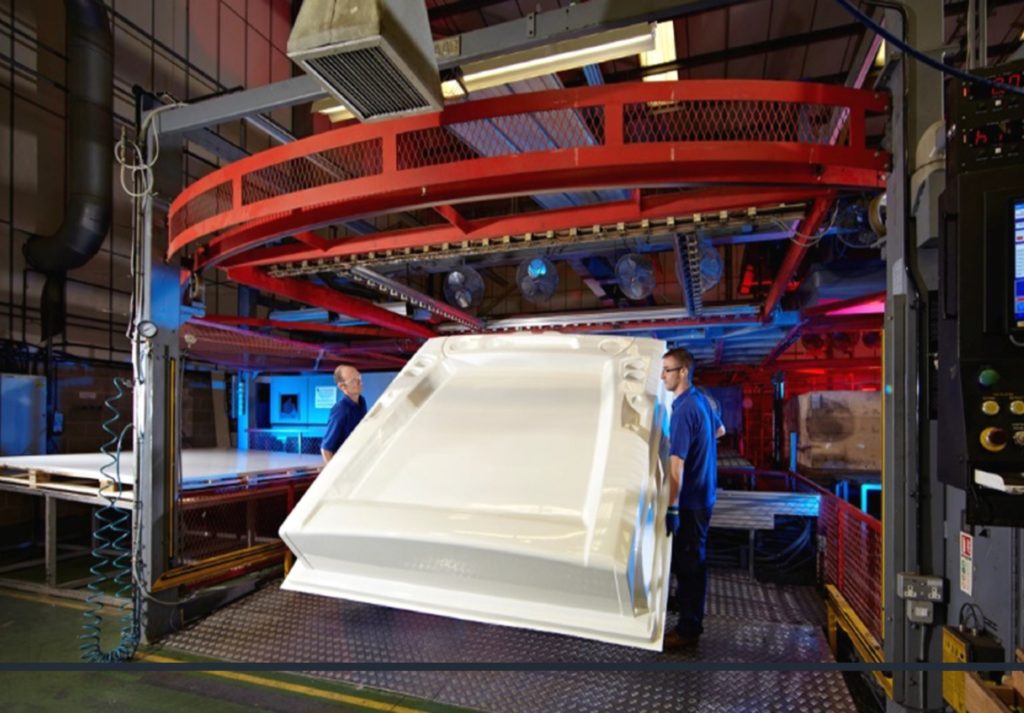
The heavy-gauge vacuum forming process involves heating a piece of plastic sheet (1mm thickness and above), applying it to an aluminium mould tool to get the desired shape, before it is trimmed on the company’s CNC machines. The business can also perform compression moulding, which is used primarily for lightweight interior trim parts, such as headliners, which involves composite materials which are compressed and then trimmed using water jets. At this stage in the company’s evolution, the primary focus is on vacuum forming technology, and Big Bear can mould parts up to 3.5m x 2.5m on its five large machines.
However, compression moulding is an emerging technology and is an area where Big Bear has targeted expansion in the future. “We like to bring innovation to our customers,” said Emma. “And for that, we like to work hard with our supplier partners around the use of materials. The technology of vacuum forming evolves as materials develop and that’s where innovation is really shining through. “This is leading to an emergence of new products which have lighter weight, better impact and UV resistance, and increased stability. And, of course, keeping an eye on cost is something that’s always important to our customers. “We tend to focus on larger products and that’s probably our USP, and where we really live up to our name. Big Bear means big products, big service, big quality and big quantity.”
We’ve got ourselves in a really strong position – operationally we’re better than we’ve ever been. We’re delivering good product for our customers, on time, and we’re getting great feedback. We’re really keen to innovate, create prototype parts and then move them on to production manufacture which will help us build on a very firm foundation. I’m really confident that we can build on that and continue to grow the business – as best we can in a challenging environment!
Emma Hockley, Managing Director, Big Bear Plastics
 We’ve got ourselves in a really strong position – operationally we’re better than we’ve ever been. We’re delivering good product for our customers, on time, and we’re getting great feedback. We’re really keen to innovate, create prototype parts and then move them on to production manufacture which will help us build on a very firm foundation. I’m really confident that we can build on that and continue to grow the business – as best we can in a challenging environment!
An example of this innovation in action can be seen in the company’s Bearex material, used as a lighter weight, more cost-effective alternative to ABS, for exterior panels which require excellent impact strength. For example, a particularly successful implementation of Bearex has been in the caravan industry, where it has been used for front and rear caravan bumpers, eliminating warranty claims due to cracks, breakages and stone chip damage; Bearex is shatterproof and crackproof, even at low temperatures, so is ideally suited for this type of application.
Growth journey – no teddy bears’ picnic
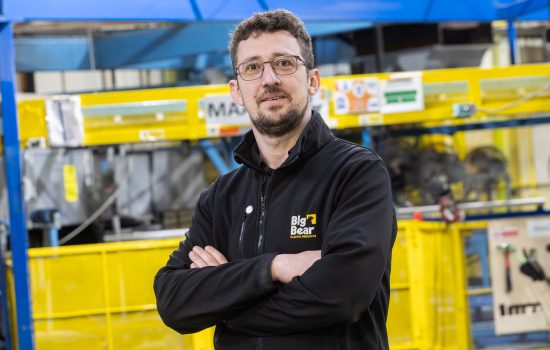
The journey so far for both Big Bear as a business and Emma as an individual, has certainly come with its own challenges. Emma came into the business with no manufacturing experience, having spent much of the previous decade at Harrods, as Buyer for the Perfumery & Cosmetics department, and then heading up marketing for the Beauty division. Not only that, but she took over the reigns as Managing Director at Big Bear in March 2020, right at the start of the COVID-19 pandemic. “I had to get to grips with the business pretty quickly with a very limited team,” Emma added. “Not coming from a manufacturing background has been challenging and joining the company as the owner’s daughter meant I certainly had a bad case of imposter syndrome in those early years.
“However, I have a great team who support me and share the vision for the company’s success. Even though we had a lot of people on furlough during COVID we still kept going and were even able to pivot to make products for the NHS. So, I’m really proud of everything that we’ve done.” That resilience of the Big Bear business was evident as the company began to emerge from the pandemic. Just as customers began to return and the business seemed to be emerging from the trials and tribulations of COVID, there was a devastating fire at one of Big Bear’s largest competitors.
Thankfully no one was seriously hurt, but it sent the whole supply chain into chaos. Big Bear were called upon to assist, which resulted in the company receiving a lot of new business. But equally, it put huge pressure on operations, processes and people as Emma explained. “We essentially doubled the size of the company overnight. And when you take on that volume of new, unplanned work – much of which involved very large components – suffice to say it was a very challenging time! ”
Big Bear took on fire damaged tools which then had to be modified to fit its machines. CNC jigs had to be built, tools had to be stored and those extra components had to be incorporated into the production plan for trimming, moulding, assembly etc. This resulted in a reorganisation of the factory into different production cells, with a dedicated manager for each area. There was also huge investment in new machinery that came about as a result of the increased demand.
All the while customers were continuing to build their machines. “Our customers were building up a backlog. So not only did we have to jump on a moving train in terms of catching up with their production, we also had to fill a huge backlog of parts. So the strain on us was immense,” added Emma. However, with the company in the strong position it is today, Emma was keen to stress that this period of disruption proved a real catalyst for change in the business; the driver behind Big Bear being able to take that next leap forward.
“It was a real sink or swim moment, but the fact we’re still here – and stronger than ever – proves that it worked. “We really had to lean on our reputation that we had built up over the previous years of delivering good service and quality product. We had quite a lot of difficult conversations but, by the end of that summer, we were back delivering on time and in full, and we’ve maintained and improved on that position ever since.”
Current trends
Like many manufacturers, Emma explained that sustainability has become more important to Big Bear’s customers, and likewise it has also become more integral within the business. We hear much in the wider media around plastics and its use, but most of the materials Big Bear work with are recyclable and its cut offs are returned to the supplier, where they are reground and made into products such as garden ponds etc. However, a product that would be installed on an aircraft for example, has to meet certain flammability requirements, with very precise specifications, so would almost certainly need a virgin sheet.
“We are very mindful of our footprint and what we’re doing,” said Emma. “So, we use recycled materials in our processes wherever we can. We are delighted that we have recently achieved our ISO14001 certification, which represents a real achievement and commitment to our sustainability goals.” As an SME and a local employer, Big Bear certainly hasn’t been immune from market pressures over the last few years and Emma was less than complimentary of the government’s perceived support for the sector outlined in last year’s Industrial Strategy.
“It currently feels like the situation is being made harder for SMEs, rather than easier. We have all felt the impact of taxes, the National Insurance rise and The Employment Rights Bill. In my experience, employers like us value our people above anything, and we look after them well – but this bill seems to assume that we don’t. “It’s frustrating; trying to employ people and bring innovation into a business can be difficult when it feels like that’s not valued. I’m sure everyone shares the concerns about the lack of support for British manufacturing at government level. I know there’s a level of competition, but generally speaking we’re an industry that tries to support each other. We all believe in British manufacturing and want it to succeed so it would be nice to have some recognition and some support.”
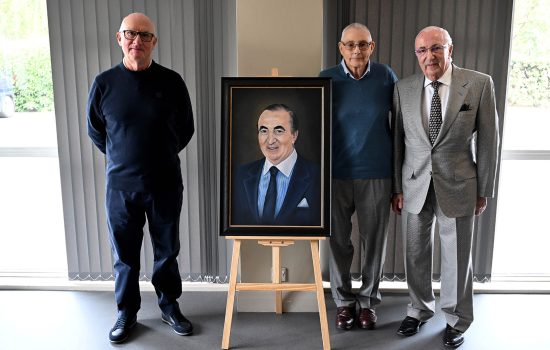
For Emma, the key factor that sets the business apart today is its people. She freely admits the difficulties in joining the business as someone with no experience, which meant she really had to lean and rely on the people around her. The result is that Big Bear is awash with people who are supportive, positive and not afraid to challenge the status quo. “This can make a massive difference to having people who always tell you how things can’t be done,” she added. “For me, our people are the most important part of the business, and it’s really important to me to treat them with respect. We are lucky enough to have some colleagues around us who have worked for my father for over 30 years, which is testament to how he treats people. And that’s always something that I’ve learned from him.”
Future plans
Far from being discouraged by the challenges associated with the rapid rise of the business after the pandemic, Emma’s mantra for Big Bear moving forward remains focused on growth and will be looking to increase the volume of work the company is doing. “We’ve got ourselves in a really strong position – operationally we’re better than we’ve ever been. We’re delivering good product for our customers, on time, and we’re getting great feedback,” she continued. Part of those future plans will be working even closer with the company’s supply chain partners, crucially around new material coming into the market with some amazing innovations available already.
“We’re really keen to innovate, create prototype parts and then move them on to production manufacture which will help us build on a very firm foundation. I’m really confident that we can build on that and continue to grow the business – as best we can in a challenging environment!” As Big Bear Plastics looks to the future, the business stands as a compelling example of how resilience, innovation and people-first leadership can drive long-term success.
From navigating a global pandemic to absorbing unprecedented demand and reshaping its operations, the company has repeatedly proven its ability to adapt and thrive. With investment in new technologies, a clear sustainability roadmap and a strong appetite for material-led innovation, Big Bear is well positioned for its next phase of growth.
For more stories like this visit our Leadership channel