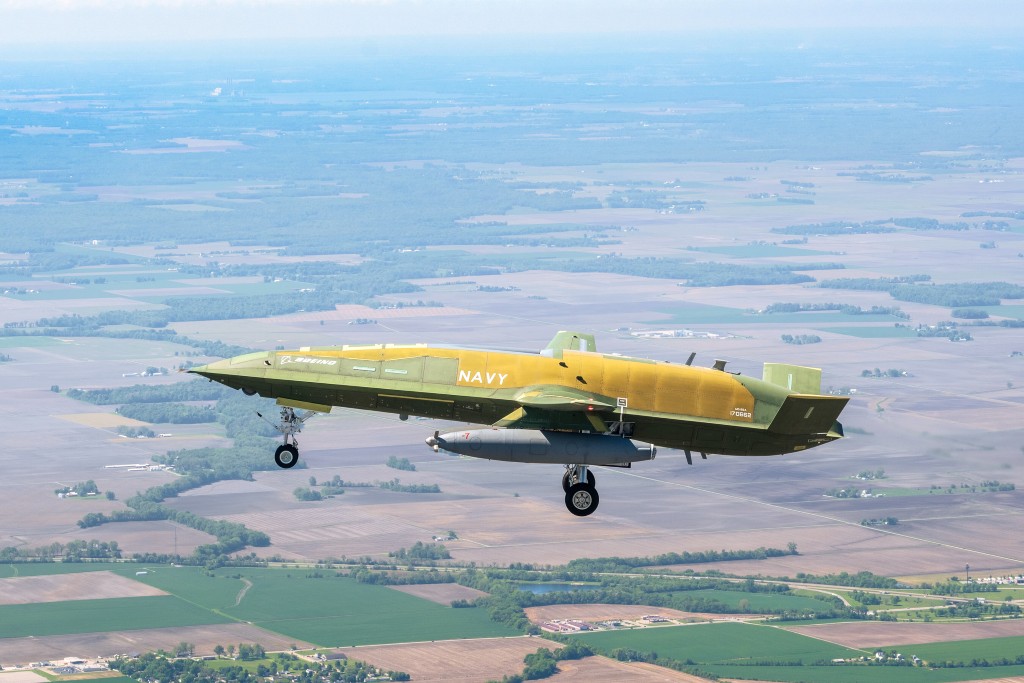
Boeing and the United States Navy have successfully completed the first test flight of an operational MQ-25A Stingray, marking a major step forward in the development of carrier-based autonomous aviation.
The milestone flight, which lasted approximately two hours, saw the unmanned aircraft autonomously taxi, take off, navigate a pre-determined mission, and land, while responding to commands from the Unmanned Carrier Aviation Mission Control System MD-5 Ground Control Station. The operation was conducted from MidAmerica St. Louis Airport, where the programme is based.
According to Boeing, the flight validated the aircraft’s flight controls, navigation systems and its ability to safely integrate with ground-based command systems. Personnel from both Boeing and the Navy monitored the mission in real time, issuing commands and assessing performance throughout.
Dan Gillian, vice president and general manager of Boeing Air Dominance, described the test as a key step in maturing the programme, noting that the MQ-25A represents “the most complex autonomous system ever developed for the carrier environment”.
Additional detail from Rolls-Royce confirms the aircraft is powered by a single AE 3007N engine, part of its established AE engine family. The high-bypass-ratio engine is designed for low fuel consumption, supporting the long-endurance missions required for both aerial refuelling and intelligence, surveillance and reconnaissance (ISR) operations.
Rear Admiral Tony Rossi, who oversees the Program Executive Office for Unmanned Aviation and Strike Weapons, said the flight represents a critical step towards delivering a carrier-based aerial refuelling capability that will extend the operational reach of naval aircraft.
The MQ-25A Stingray is intended to enable manned-unmanned teaming on aircraft carriers, with its refuelling role expected to significantly extend the strike range of the carrier air wing. This will allow Boeing F/A-18 Super Hornet aircraft currently tasked with refuelling to return to their primary role as multi-role strike fighters, while also enabling carrier strike groups to operate further from potential threats.
The platform’s engine integration was also validated during the test flight, demonstrating seamless interaction between propulsion, flight systems and the MD-5 ground control station. Rolls-Royce said it expects to deliver additional AE 3007N engines in 2026 to support production spares, with the overall programme of record covering 76 MQ-25A aircraft.
The aircraft flown is the first of four Engineering Development Models to be delivered under an $805m engineering and manufacturing development contract. Boeing says further test flights will continue at MidAmerica before transitioning to Naval Air Station Patuxent River, where the aircraft will undergo preparations for carrier qualification.
Troy Rutherford, vice president of the Boeing MQ-25 programme, said the successful flight highlights the role of “disciplined teamwork and rigorous testing” in advancing autonomous aviation, adding that the programme is helping to redefine the future of naval operations.
Interested in receiving the latest North American manufacturing news in your inbox each week?
Sign up to The Manufacturer Digital Briefing – North American Edition