
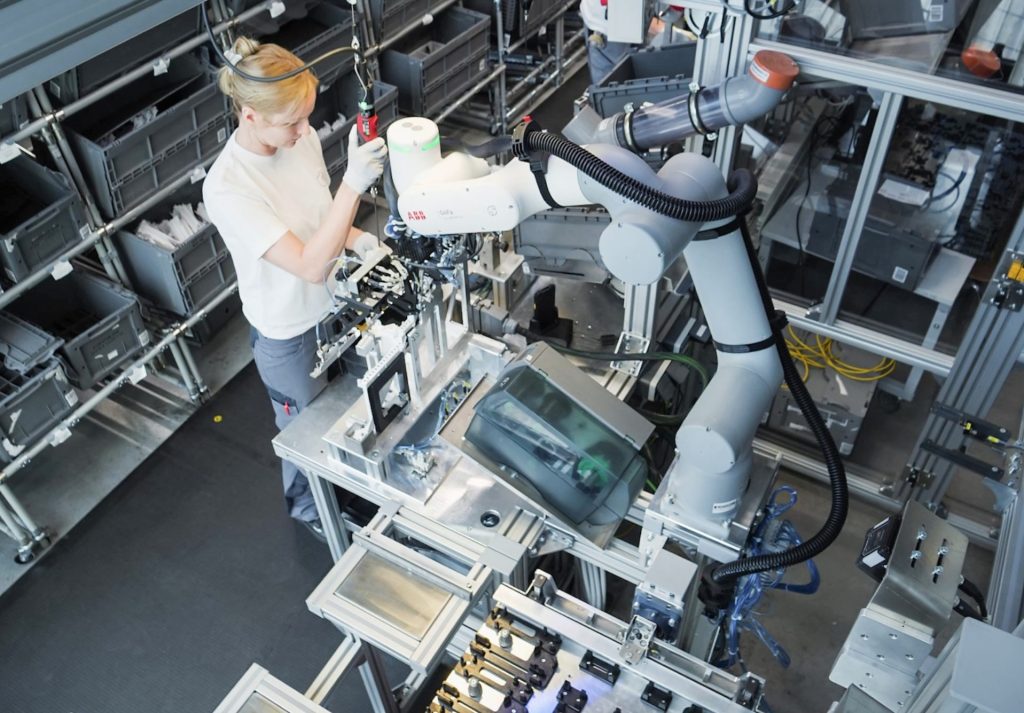
Collaborative robots, or cobots, have quietly moved from the fringes of industrial automation into the mainstream. Once a niche technology accounting for just two per cent of robot installations in 2015, cobots now represent more than one in every ten industrial robots deployed globally.
Late last year, Andrea Cassoni, Global Head of Cobots Distribution and Ecosystem at ABB Robotics, spoke to The Manufacturer about how this shift marks a fundamental change in how manufacturers approach flexibility, safety and collaboration.
Read the full article here: From niche to mainstream: how cobots are reshaping modern manufacturing
Cobots’ early appeal lay in their ability to work safely alongside humans without the need for cages or barriers. While safety remains a defining feature, their role has expanded far beyond this initial promise. Today, cobots are used across a wide range of applications, from machine tending and material handling to palletising and even welding — tasks once considered unsuitable for collaborative robots. Their growing presence in automotive manufacturing outside China underlines how closely cobots and traditional industrial robots are now converging.
Crucially, cobots are not replacing traditional automation but complementing it. Industrial robots continue to dominate high-volume, heavy-duty and highly standardised production. Cobots, by contrast, excel in environments that demand flexibility, smaller footprints and faster deployment. Their ease of programming and redeployment makes them especially valuable for high-mix, low-volume production and for manufacturers with limited in-house automation expertise.
The next phase of cobot evolution is being driven by artificial intelligence and advanced vision systems. These technologies are enabling greater autonomy, allowing cobots to adapt to changes in their environment, optimise performance and even reprogram themselves. As Cassoni notes, cobots are evolving into “autonomous and versatile teammates” that can keep pace with increasingly dynamic factory environments.
However, technology alone is not enough. Successful automation depends on strong ecosystems that bring together robots, software, hardware and experienced system integrators. Poor process mapping, unrealistic expectations or working with inexperienced partners can undermine even the most promising cobot deployment. Careful planning and the right support network remain essential.
Looking ahead, the future for cobots is bright. As manufacturers pursue more agile, human-centric and AI-enabled automation strategies, cobots will play a pivotal role. For those willing to invest thoughtfully — and partner wisely — collaborative robots offer not just efficiency gains, but a transformative new way of working on the factory floor.
For more articles like this, visit our Automation channel