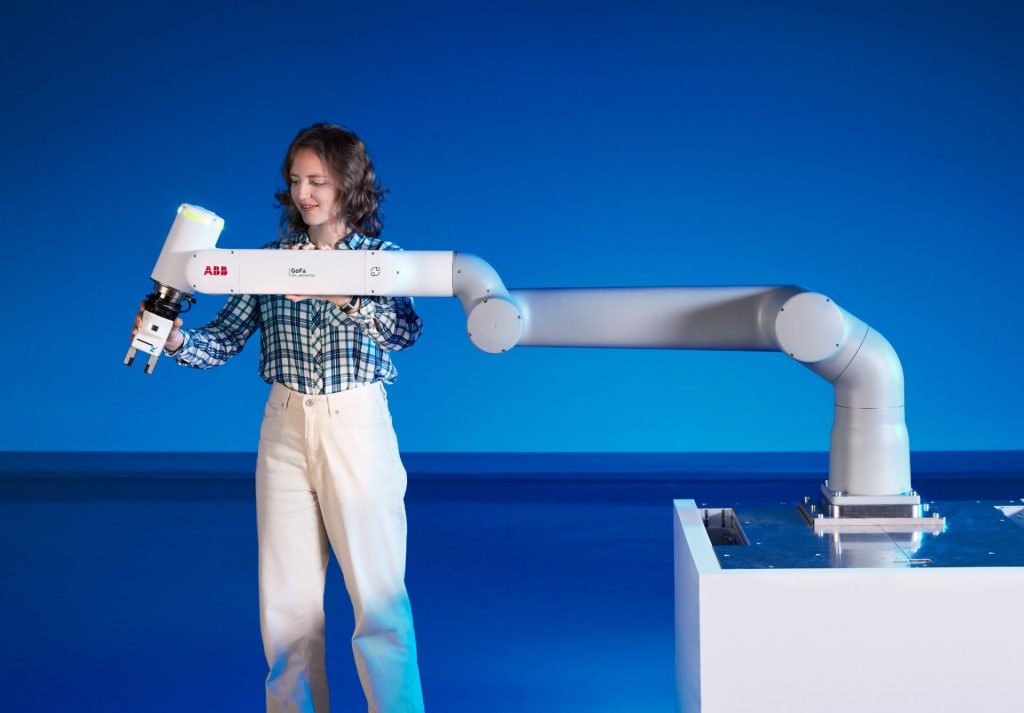
Here at The Manufacturer, we often comment on the importance of collaboration in modern industrial operations, and it’s just as true in the world of automation. Andrea Cassoni, Global Head of Cobots Distribution and Ecosystem, ABB Robotics, looks at the rise of the collaborative robot – or cobot – and how it is influencing the manufacturing sector.
Over the past decade cobots have transformed from a niche innovation into a central pillar of industrial automation. Once representing just two per cent of industrial robot shipments in 2015, cobots now account for more than ten per cent.
This means at least one in every ten robots installed today is a cobot. And while growth has slowed compared to the most optimistic early forecasts, the trajectory remains strong, with projected growth rates significantly higher than the industrial robot market as a whole.
Key takeaways
-
Cobots have moved from niche to mainstream, now accounting for over ten per cent of all industrial robot installations and growing far faster than traditional robotics.
-
Cobots complement – not replace – industrial robots, excelling in flexible, collaborative, and high-mix environments while traditional robots remain dominant in heavy-duty, high-volume production.
-
AI and vision technologies are accelerating cobot autonomy, enabling capabilities like integrated vision, autonomous reprogramming and performance optimisation.
-
Strong partner ecosystems are essential, as successful deployments rely on seamless integration between robots, software, hardware and expert system integrators.
-
Manufacturers must avoid common pitfalls, such as poor process mapping or choosing inexperienced partners; careful planning and the right support network are key to long-term automation success.
FAQs
- What is a cobot and how does it differ from a traditional industrial robot?
- Why are cobots growing so quickly in manufacturing?
- Can cobots replace traditional robots?
- How is AI influencing the future of cobots?
- What should manufacturers consider before deploying cobots?
Andrea highlighted that cobots are no longer experimental tools; they are maturing into mainstream automation assets, offering manufacturers flexibility, safety and accessibility that traditional industrial robots cannot always match. As industries embrace AI and pursue more adaptable forms of automation, cobots are poised for an even brighter future.
“Cobots have moved from the margins of industrial automation to playing a key role, and are now reshaping how manufacturers think about flexibility, safety and collaboration,” said Andrea.
From niche to mainstream: how cobots differ from traditional automation
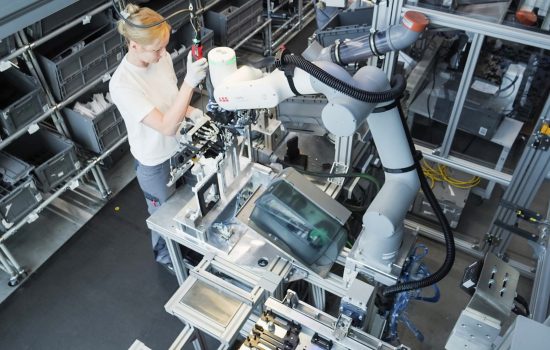
When cobots first entered the market, their appeal was closely tied to safety. Their ability to work alongside humans without cages or barriers was revolutionary. Over time, however, their role has expanded dramatically.

Today, cobots are applied in nearly every industrial domain – even in areas once thought unsuitable, such as welding. Their versatility has made them indispensable in sectors like lab automation, where close human-robot interaction is essential, as well as in more traditional robotic tasks like material handling, machine tending, pickand- place and palletising.
Outside China, automotive manufacturing remains the largest deployment sector for cobots, further evidence that collaborative and industrial robots are increasingly converging in application and relevance.
Cobots vs traditional automation: complementary strengths
Cobots are not here to replace traditional robots but to complement them. Each technology has its strengths, and successful automation strategies often involve both. Andrea underlined some of the key benefits of cobot deployment.
Advantages of cobots include:
- Ease of use: Cobots typically feature simpler interfaces and programming methods, making them more accessible for non-experts.
- Smaller footprint and weight: Their compact size and lightweight design reduce installation complexity and cost, often eliminating the need for heavy infrastructure reinforcement. For example, BMW Group’s plant in Steyr, Austria, has deployed an ABB GoFa cobot which moves connecting rods from one conveyor belt to another. This takes up minimal space while offering the flexibility to be easily reprogrammed to handle other components.
- Faster deployment and redeployment: Cobots can be moved between tasks more easily, supporting flexible, low-volume or high-mix production environments. Mesekon Oy, a Finnish welding manufacturer, has deployed the GoFa collaborative robot to perform intricate and precise 3D welding tasks, such as precise 90 degree saddle joints in shield piping, resulting in a 40% productivity increase.
- Built-in safety features: Force and power limiting functions make cobots uniquely suited for close human collaboration.
On the other hand, industrial robots excel in environments requiring:
- High-volume, standardised production with minimal variation.
- Very high payload capacity, far beyond the limits of current cobots.
- Ultra-rigid, long-duration operations, where durability is paramount.
That said, durability concerns around cobots are slowly dissipating and those that still persist are often more about the manufacturer than the technology itself. High-quality cobots, such as those built to the same standards as traditional robots, deliver equivalent long-term reliability.
Manufacturers should therefore evaluate suppliers carefully and consider credentials when assessing potential solutions.
AI and the evolution toward autonomy
One of the most exciting frontiers for cobots – and robotics more broadly – is the integration of artificial intelligence. Andrea emphasised ABB’s vision of “autonomous and versatile robotics”, where robots increasingly operate without constant human input and can quickly adapt to new tasks or workflows.
Cobots, often favoured by universities and start-ups, are close to the epicentre of this innovation. Their accessibility makes them a natural testbed for AI-driven advances such as:
- Integrated vision systems, enabling robots to pick parts without precise placement or navigate around unexpected obstacles.
- Autonomous reprogramming, where robots adjust their behaviour based on changes in the environment.
- Optimised performance through AI, improving cycle times, reducing energy consumption and enhancing flexibility.
These developments will benefit both cobots and industrial robots, but cobots may gain a first-mover advantage thanks to their adaptability and strong connection to innovation ecosystems. Andrea continued: “With AI and vision technology, cobots are evolving into autonomous and versatile teammates that adapt as quickly as the factories they serve.”
The importance of ecosystems in automation
Robotics is not just about machines – it’s about the ecosystem surrounding them. Successful deployments depend on seamless integration between robots, hardware, software and human operators.
ABB has invested heavily in creating a robust partner ecosystem, validating thirdparty products and ensuring they work flawlessly with ABB’s cobots and robots. By simplifying integration and reducing the need for custom programming, such ecosystems save time, reduce costs and ultimately improve the user experience.
Beyond suppliers, the broader robotics ecosystem includes manufacturers, system integrators and service providers. A strong, reliable network of partners is often the difference between a smooth deployment and a costly misstep.
Common pitfalls and how to avoid them
Despite the promise of cobots, manufacturers often stumble during deployment. A recurring mistake is underestimating the importance of choosing the right partner. Most manufacturers are experts in their product, not in robotics. As such, they need support from system integrators and technology providers who understand both the application and the process flow surrounding the robotic cell.
Other pitfalls include failing to account for process steps before and after automation, or assuming robots will ‘fix’ flawed workflows. While modern technologies like vision systems and AI make processes more forgiving, a solid foundation remains essential.
Tips for successful automation deployment
To maximise the chances of success, Andrea recommends:
- Select the right partner: Work with experienced integrators and manufacturers who can guide design, installation and optimisation.
- Understand process flow: Ensure that automation fits into the broader production environment, from inputs to outputs.
- Leverage modern technologies: Use AI, vision and smart software to increase flexibility and reduce reliance on rigid processes.
- Plan for support: Once robots are deployed, reliable service and spare parts availability are critical to maintaining uptime and peace of mind.

Why ecosystems matter
With more than 50 years of robotics experience, ABB brings not only advanced technology but also deep application knowledge and a global support network. Its portfolio spans digital offerings including RobotStudio, AppStudio and other software products as part of the portfolio. This standardisation simplifies programming, integration and scaling across different automation types. “Choosing the right partner is the single most important step in making automation a success,” Andrea added.
ABB also leverages its global network of system integrators, ensuring localised expertise and support. From initial consultation to long-term service, ABB provides manufacturers with the confidence that their automation investments are backed by proven competence, robust technology and reliable after-sales support.
Conclusion: a bright future for cobots
While cobots will not replace traditional robots, they are unlocking new possibilities in environments where agility, ease of use and human interaction are critical.
As AI and advanced vision systems accelerate the trend toward autonomy, cobots will continue to play a pivotal role in the future of manufacturing. For companies willing to embrace them — supported by strong ecosystems and the right partners— the promise of cobots is nothing short of transformative.
Visit the ABB cobot webpage where you can learn more about the portfolio.
For more articles like this, visit our Automation channel