
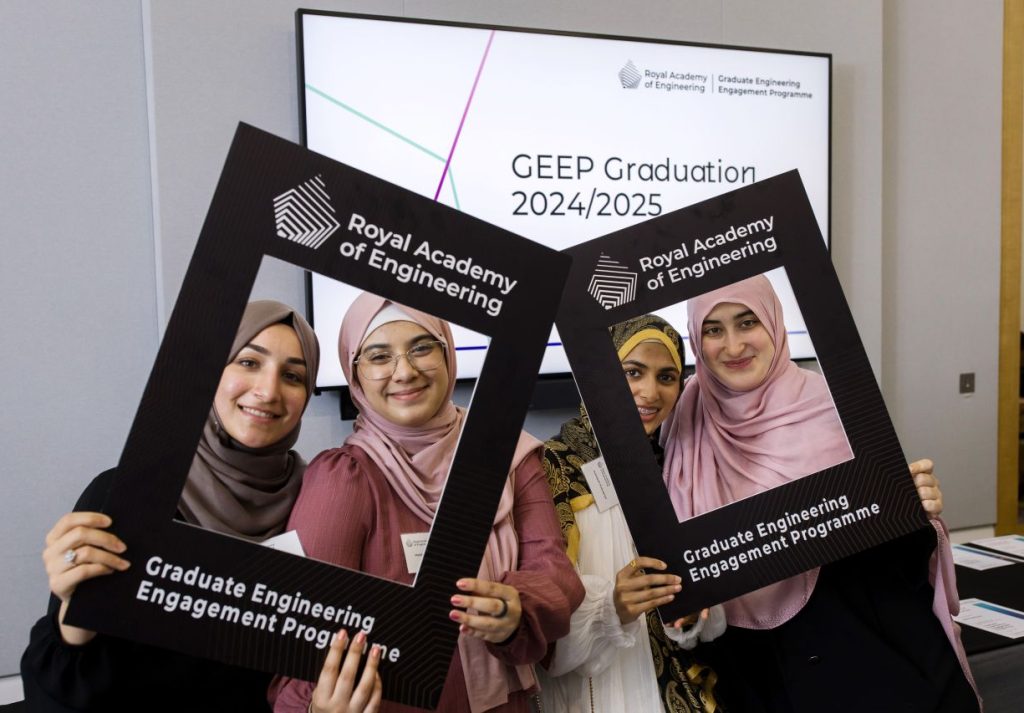
The Royal Academy of Engineering will celebrate ten years of its Graduate Engineering Engagement Programme (GEEP) today. But while the initiative has opened pathways for underrepresented groups, recent figures show Black (11.1%) and Asian (11.0%) engineering graduates remain more than twice as likely to face unemployment as their white peers (4.8%).
World-leading materials engineer and incoming chair of the Academy’s Equity, Diversity and Inclusion committee Professor Rachel Oliver FREng will open the event, speaking about the challenges remaining and progress made over the past decade and why the engineering profession still needs programmes like GEEP.
In the mid-2010s, analysis of HESA graduate destination surveys found that just 52% of Asian students and 46% of Black students were in full-time jobs within six months of leaving university, compared with 71% of white engineering graduates. When gender, age, class of degree and type of institution were taken into account, Black and Asian graduates were more than twice as likely to be unemployed as their white counterparts. Employers were visiting the same, limited number of ‘milk round’ universities to recruit engineering graduates.
GEEP was launched in 2015 to try to redress the balance, and over the past decade has supported more than 2000 students, worked with more than 50 engineering company partners and more than 70 universities to empower underrepresented engineering undergraduates or recent graduates in their transition from education to employment. At the same time, it has been supporting the engineering industry to attract a diversified talent pool and build an inclusive culture in which diverse talent can thrive. The programme is funded by the Department for Science, Innovation and Technology.
In her keynote address, Professor Rachel Oliver will celebrate the achievements of GEEP and issue a challenge to the audience of over 200 GEEP alumni and business leaders who have supported the programme: “There are GEEP alumni who have achieved fantastic success in their careers and many business leaders who can testify to the benefits of building a diverse and inclusive workforce” she says. “But GEEP is a drop in the ocean when we look at the bigger picture, where discrepancies continue, particularly for racially minoritised engineers.
“To really turn the dial, the entire engineering ecosystem needs to re-evaluate and improve the way it leads progress towards increased diversity and do so with the same skill, determination and engineering habits of mind it applies to technical projects. When it started, GEEP addressed a perceived deficit in student skills but adapted to address some of the systematic issues disadvantaging minoritised engineers. Now companies, universities, and professional engineering institutions need to join in with a fresh ‘engineering’ approach.”
For more articles like this, visit our People & Skills channel