
The market for wheel alignment systems is strong, and continues to grow, according to Straightset, the independent garage equipment experts. And the company subsequently saw an opportunity to acquire Supertracker in 2022, a trusted manufacturer of laser wheel alignment systems. From that point, there has been a period of learning, gradual innovation, constant training and an ingrained culture of product knowledge, right through the business. Tom St John, Multimedia Editor of The Manufacturer, went to learn more.
Key takeaways
- Green lasers are better than red – who knew? Red has just always been synonymous with the colour of lasers
- Before any improvements were made on the wheel alignment systems, time was taken to understand the product
- Knowledge is power. Right the way through the business, people are trained to have knowledge of the systems to be able to answer customer queries
- Every decision taken at Supertracker is a direct consequence of customer engagement and feedback
FAQs
- What are laser wheel alignment systems?
- How long have lasers been used in wheel alignment systems?
- Why did Straightset take over Supertracker?
- What are the benefits of using a green laser?
Straightset is a family run business that was formed in 1987 and currently employs over 90 people. The company acquired Supertracker three years ago, but Supertracker still operates as its own business. The teams meet every week to discuss strategies and ideas to develop the product. The product in question is laser wheel alignment systems, which do what they say on the tin – they utilise laser technology to measure and adjust the angles of wheels to ensure they’re aligned correctly.
Supertracker manufactures from its facility in Worksop, technically Nottinghamshire, but close to South Yorkshire. The factory has a studio where people are shown how to use the equipment, and existing engineers are able to access continuous training. Which as you’ll find out, is an essential part of the company’s goals. There is also a fabrication workshop on-site where all the systems and other garage equipment is manufactured, with the company aiming to keep as much production as it can in-house.
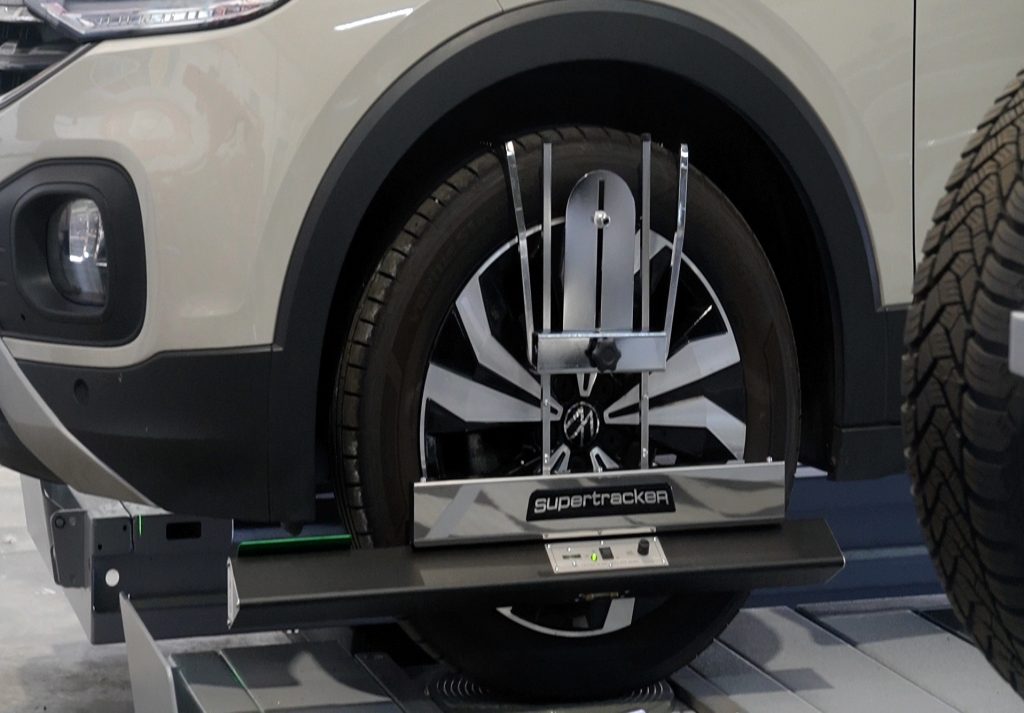
As you might expect, it’s not a one-solution-fits-all arrangement and there are different systems for different vehicles. The size of the wheel hanger, which as its name suggests, is fitted and hangs on the wheel of a vehicle, determines what tyre size it’ll work up to. There are hangers for any standard vehicle, and different hangers can be added and removed. Low spoiler hangers, for instance, are used for lower vehicles. Supertracker has off road hangers, used more on 4x4s for example.
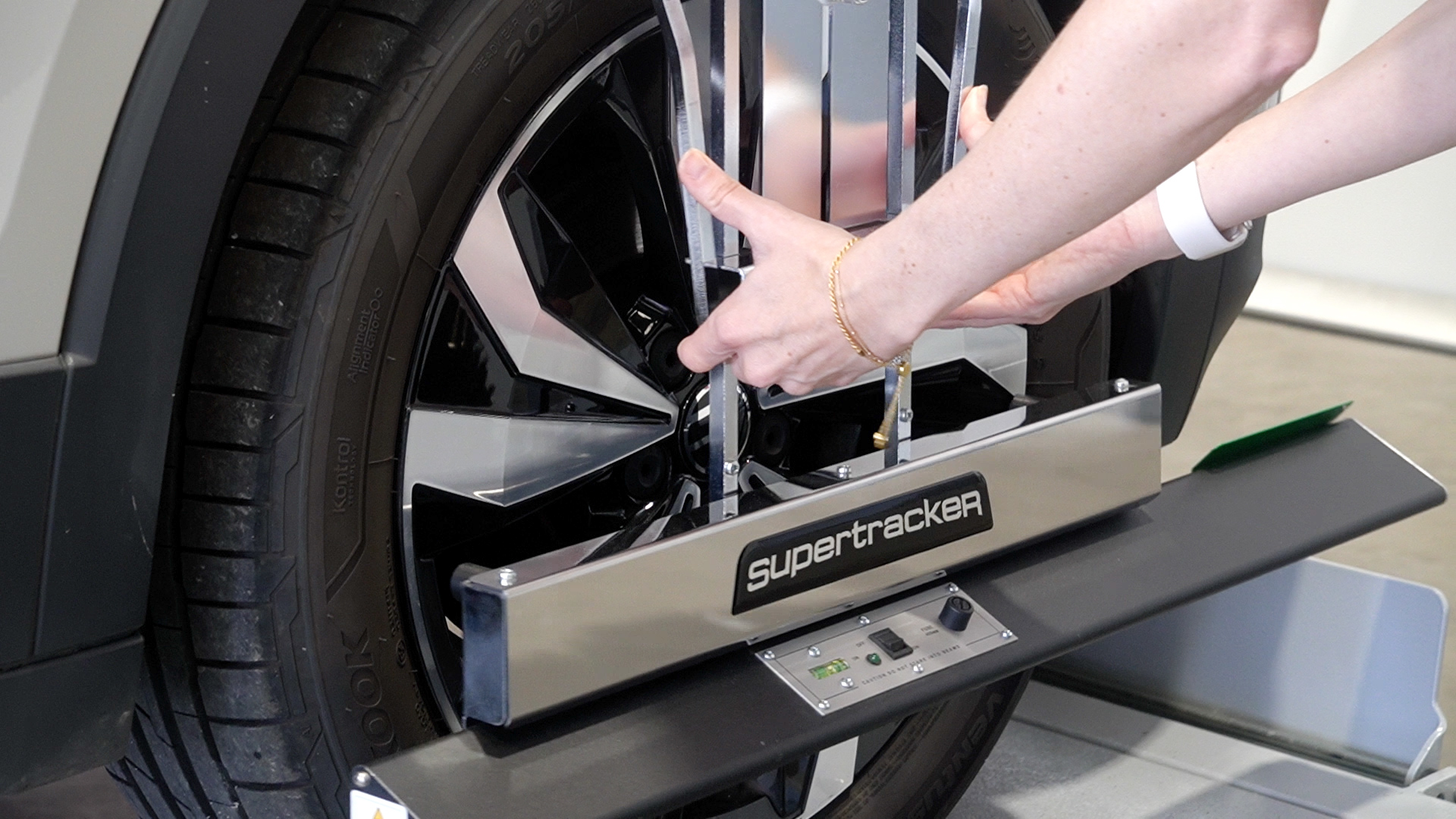
There are also systems used specifically for commercial vehicles. These can be used on trailers, trucks or HGVs. And tracking gauge systems, like the STR1500, are generally used by bus companies. Stagecoach, for instance, is a key Supertracker customer. The hangers are placed on to the side of the wheel with relative ease. While having the illusion of looking heavy, the stainless steel and chrome-plated steel structure is portable, which is of course handy for moving around garages. Pride is also taken in how easy the systems are to fit. To the point where even I was trusted to do my own wheel alignment using one of the hangers
From string to CCD
You can find ‘how to’ wheel alignment videos on YouTube – presumably for the DIY enthusiasts among us, or perhaps the hobbyists that don’t have a couple of thousand pounds to spend. This method uses string, which is tied between two jack stands (or any stable objects) on each side of the car. This would have been the process in garages 40 years ago.
Since that time however, the laser has been a common tool in wheel alignment systems – it’s far from the new age method I’d assumed it was. Julia Blake, Marketing Director at Supertracker, met me on-site to show me around. She explained: “Obviously, it’s still down to the judgment of the technician. There’s a calculation to be done with a laser. It gives you a reading, but it’s as accurate as your eye can read.”
The higher end of the market offers CCD wheel alignment, which is a computerised system. This has an in-built database which includes the make and model, and will tell the operator what the alignment reading should be. As the user makes changes, the screens make adjustments accordingly.
“The technology moves on,” said Julia. “But we believe there’s always a place for lasers. The laser wheel alignment systems are still our most popular product.” The technology for the CCD systems comes from a relationship with an Italian technology company, but everything is assembled in Worksop. Once the measuring head technology is installed, the PC, monitor, cabinets and hanging system is put together.
A super opportunity
Supertracker went into administration three years ago, with the company, at that time, based in Southampton. “At the time – and still now – we felt wheel alignment is a big growth sector,” said Julia. “The rise of electric vehicles, and the batteries that are associated with them, have obviously made cars heavier. Therefore, the importance of wheel alignment is heightened as it is key to reduce tyre wear and ensure handling and safety.”
Despite the company’s issues at the time, the Supertracker brand was strong and synonymous with wheel alignment. Straightset saw a market opportunity. The acquisition made sense for a number of reasons; crucially, the business already had the expertise. “We were used to fabricating equipment,” said Julia. “Because of that, and even despite the fact it was our first time manufacturing a final piece of equipment, the task wasn’t as daunting.”
Supertracker was moved up from Southampton to its new home in Worksop. “Initially, we just wanted to learn about the products and understand how they were built,” said Julia. “We spent a long time understanding which suppliers Supertracker was using and how it was manufactured.
“To be honest, we hardly changed anything because the product was so great – it was very robust and well trusted. We wanted to maintain its position in the market. We’ve been on exhibition stands where people have come and told us that they’ve had one of our machines for 25 years.”

Of course, in the spirit of continuous improvement, the company wanted to make changes at some point. “But we wanted to do that slowly and thoughtfully,” explained Julia, “ and in a way that was going to be advantageous to the customer.” After that familiarity and knowledge was established, an aftercare service was set up. Contracts were taken on, but ones that already had Supertracker machines in the marketplace.
“Again, the transition wasn’t hard,” said Julia. “They were doing wheel alignment calibrations anyway; it was merely a case of setting them up with calibration rigs.” The ground work had been done, so Supertracker could then start thinking about how to evolve the systems.
Red light, green light
That evolution has taken place within the last three years. There has been a number of product innovations, which Julia insisted have only come about following customer feedback. We’re not making aesthetic changes for the sake of it,” she said. “Ours actually have a purpose.” The latest customer specification was around size, as space is obviously a problem in garages.
As such, Supertracker engineers are currently working on making the systems more compact, in order to avoid bulk. The very first innovation however, was with the laser system itself. “The first element that we changed was moving from a red to a green laser,” said Julia. “We know from other sectors such as construction and medical that people are using green lasers to find level lines because it’s more visible to the human eye than red.”
She continued, “We never understood why that hadn’t evolved naturally into our market. Why has it inherently always been red; has red always been thought of as better? After really looking at the situation we realised we needed to change. It wasn’t an easy task, because we were trying to find the right reflective green for the laser.”
Julia explained that Supertracker needed to use green on green, because if you use any other colour, it takes the energy out of the laser. If the colour is like-for-like, it shows up more. The team were able to find the right formula, and the system now comes with a paired custom-matched green reflective scale. “In bright sunlight, a green laser opens up the market to allow a wheel alignment system that can be used at roadsides or race tracks. And on the flip side, it shows up better in a darker garage environment,” said Julia.
Imbedding digital
The wheel alignment systems, particularly the CCD systems with their in-built databases and measuring head technology, are digitally mature products by nature. Supertracker is also striving to make the customer experience easier and more seamless through its in-house customer portal, which was newly launched around the time of my visit. “We put QR stickers on any equipment that we sell,” explained Julia.
“You can take a photo of that QR code, and it will give you all the equipment history of that piece of machinery.” She continued: “It will also provide you with certifications, service history and any quotes that are outstanding and need to be approved on the machine.” This also allows for a daily system whereby technicians are able to perform checks on equipment. This means that systems can be regularly inspected to ensure they’re performing optimally, before they’re used on a customer’s vehicle.
The Worksop workshop
“Recruitment is not an easy task,” said Julia. Unsurprising to hear, and a view shared by most SME manufacturers. The strategy of the business is to recruit people for longevity, which adds an extra layer of difficulty, I presumed, given that talent retention is a tricky piece of the recruitment puzzle. “We’ve got a product that we’re so invested in,” explained Julia. “We want people who are really going to get under the skin of the product and take time to understand it. We don’t want to train an individual, only to see them leave. So, for us it’s about finding the right person.”
Worksop is close to the industrial heartland of Sheffield, which does help matters for Supertracker. The company has also retained the knowledge and experience of the people that were brought over during the acquisition. Julia added: “We’ve got our own fabrication department here in Worksop, which has been in operation for around 40 years, so we’ve always had a lot of in-house talent.

“Any recruitment drive that we’ve had has been with a view to continuing that heritage. The training process gradually introduces people to the product – and not just for the engineers that are building the machines – but right through our entire business.”
This means that people, engineers or office staff, can understand any customer query, and can hold a conversation about the functions of a machine or understand the diagnosis of a potential fault. The ability to do this comes from the training studio at the facility. An actual garage workshop where people can spend time understanding, as Julia put it: “The nuts and bolts of how equipment works.”
And training sounds like it’s continuous too. This isn’t just for new starters, it can be used at any time to refresh and hone expertise. “We’ll bring people in for training on a regular basis,” said Julia. “This includes training on the actual manufacturing of the product. Groups of engineers are trained on various different topics with a view to continuously improving.” She added: “The training centre is vital for all of us. Everyone can come and anyone who is unsure of something can be shown. Training has been our biggest priority for this year. We want any member of staff to have a real knowledge of what we’re making.”
When everything aligns
This is what true product innovation should be about, in my opinion. Not only innovations in design and manufacturing, informed by what the customer asks for, but on a more basic level, around what your people think of the product? There is an ingrained pride and knowledge right through the business of the wheel alignment systems that are being manufactured. The mindset is that if the people making and selling the product aren’t passionate about it, then why should the customer buy it?
The approach here is absolutely focussed on customer need. Which of course, every business would claim to do, or at least strive for. My trip to Worksop gave me a clear window into what that actually looks like. From the switch to green lasers from red, to the redesign of smaller, sleeker and wall-mounted hangers which take up less garage space – and through to the slow, steady but continuous training and knowledge of the systems – everything about the systems, process and people is aligned.
For more stories like this visit our Innovation channel