

Midlands presswork specialist HT Brigham is repositioning its Coleshill operation for long-term growth, blending heritage engineering with modern manufacturing systems as it targets higher-value, mission-critical markets.
Founded in 1947, the company has evolved from a single-machine workshop into a supplier of complex progression presswork, multi-stage transfer pressings and assemblies. Today, it delivers components in volumes ranging from tens of thousands to many millions, serving Tier 1 automotive suppliers, industrial OEMs and an expanding aerospace customer base.
Chief executive Doug Allen says the company’s core proposition has remained consistent despite major changes in technology and markets. HT Brigham, he explains, specialises in making parts that “just work”, allowing customers to build production lines around them with confidence.
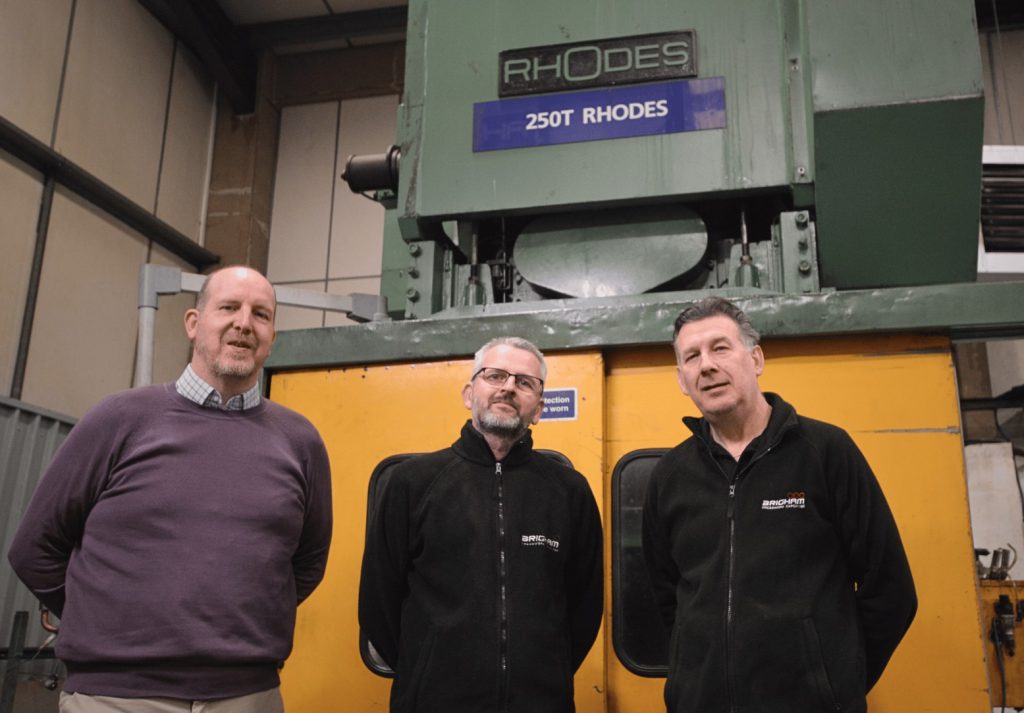
Recent capital investment has focused on reinforcing that reliability while creating headroom for future demand. A central project has been the strategic refurbishment of a 250-ton Rhodes progression press, upgrading controls, guarding and monitoring systems while retaining a machine operators trust.
Rather than wholesale replacement, Allen describes the approach as combining proven assets with modern capability. The aim, he says, is to build resilience through robust equipment, disciplined processes and a workforce that understands both legacy and new technologies.
That philosophy is formalised through the Brigham Operating System (BOS), an internal framework that brings together maintenance, quality, training and performance measurement. The system prioritises workforce capability, reflecting a belief that sustainable performance follows when people are equipped with the right tools, standards and environment.
HT Brigham’s strategic direction is underlined by its renewed AS9100 certification, held alongside ISO 9001, ISO 14001 and IATF 16949. The aerospace accreditation positions the company for more complex, tightly regulated work, where traceability and process discipline are non-negotiable.
Allen, whose background includes senior roles at Moog, UTC Aerospace Systems and Goodrich, says AS9100 is not a marketing badge but a structural commitment. The refurbished Rhodes press is expected to play a key role, supporting high-volume output while maintaining the tight tolerances aerospace customers demand.
Alongside equipment and quality systems, people development remains a major focus. HT Brigham is working with Birmingham City University through a Knowledge Transfer Partnership (KTP) centred on new product development and embedding innovation into the business. The collaboration spans engineering, digital design and market understanding, including projects linked to sister business Brigham Watch Company.
Allen says such partnerships help bring new thinking into the factory while offering graduates and young engineers experience in a live manufacturing environment. The broader goal is to create clear career pathways across engineering, tooling, data and sustainability disciplines.
Despite its expansion into new sectors, HT Brigham continues to trade on the values of its family-business roots: accessibility, responsiveness and close collaboration with customers. The company positions itself as a problem-solving partner rather than a transactional supplier.
Looking ahead, Allen is clear about the challenge facing UK manufacturers. Long-term survival, he argues, depends on sustained investment in internal capability rather than waiting for external solutions.
At Coleshill, that strategy is already taking shape. The presses keep running, new certifications are in place, and the next generation of engineers is being brought through—quietly reinforcing the supply chains that underpin modern industry.
For more articles like this, visit our Leadership channel