
Electric vehicles rely on power electronics to convert battery energy into power for the motor. At the heart of this are semiconductor switches, devices that turn current on and off very quickly. How that switching is controlled has a direct impact on efficiency, reliability and performance.
A key part of this control is the ‘gate driver’, which determines how fast a switch turns on and off. Switch too fast, and there is a risk of damaging voltage spikes. Switch too slowly, and it will result in waste energy as heat. Choosing the right behaviour is a balancing act.
Q&A
- Why is power conversion efficiency so important in electric vehicles?: Every electric vehicle relies on power electronics to convert energy from the battery into power for the motor. Even small improvements in how efficiently this conversion happens can reduce energy losses, lower cooling requirements and potentially increase vehicle range. Because these systems switch electrical currents thousands of times per second, optimising that process can have a significant impact on overall vehicle performance.
- What is the biggest challenge with conventional gate driver technology?: Traditional gate drivers rely on a fixed resistor to control how quickly semiconductor switches turn on and off. Engineers have to strike a compromise: switching too quickly can create damaging voltage spikes, while switching too slowly wastes energy as heat. The difficulty is that no single setting performs optimally across the wide range of temperatures, voltages and currents experienced in real-world driving.
- How does the EleVait project offer a different approach?: Rather than using multiple switching configurations or complex feedback systems, the University of Bristol’s Electrical Energy Management Research Group developed a simpler three-step switching method that operates using a single fixed pattern. Once configured, it works much like a conventional gate driver but delivers improved performance across the inverter’s full operating range without requiring constant adjustment.
- What were the key findings from the research?: Testing showed that the new approach reduced voltage overshoot compared with fast conventional switching, improving safety margins. It also cut switching losses by more than 20% compared with more conservative settings while maintaining the same voltage limits. Importantly, these benefits were achieved consistently across the full current range without changing operating settings.
- What could this mean for the future of electric vehicles?: The research demonstrates that manufacturers don’t necessarily need highly complex control systems to achieve meaningful efficiency gains. A practical, easy-to-implement solution could improve energy efficiency, reduce cooling demands and support longer driving ranges while being easier for industry to adopt. As EV technology continues to evolve, this balance between performance and practicality could play an important role in next-generation electric powertrains.
The trade-off that engineers face
In conventional designs, this balance is set using a gate resistor with a fixed resistance value. This is simple and robust, but also a double compromise: First, a small resistor value that switches efficiently risks causing voltage spikes, and a large value that avoids spikes wastes battery energy.
Second, the system behaves differently at different operating points, so if it works well at high current and low temperature, it may be inefficient or risky at low currents or high temperatures. The result is that the balance is pushed in favour of inefficiency over most of the operating range, to avoid voltage spikes in a small subset of this range.
Through extensive testing of a commercial vehicle inverter, across temperatures from –40°C to +140°C, currents from –400 A to +400 A, and voltages up to 900V, the Advanced Propulsion Centre UK has seen this trade-off clearly. No single conventional setting works well everywhere.
Advanced solutions
Gate driver manufacturers and research groups have proposed advanced solutions that involve multiple gate resistors and changing which one is used as the vehicle’s operating conditions change. This can be difficult to implement in practice, since it requires a number of measurements to be fed back to the gate driver, and that gate driver needs to know exactly which resistor to choose, and what to do in the case of a fault.
An alternative that has not made it into vehicles yet is ‘active’ gate driving. This aims to dynamically shape switching behaviour. In research, these approaches are often quite complex, changing the rate of switching dynamically during each event, and also relying on feedback and multiple tuned settings for different conditions. In the laboratory, these have been shown to perform very well, but at the cost of added system complexity.
A middle ground
Funded by the Department for Business and Trade and administered by the Advanced Propulsion Centre UK (APC) project EleVait (Electric Vehicle Advanced Inverter Technology) explores a simpler alternative.
Instead of switching between many configurations or relying on feedback, project partner Bristol University’s Electrical Energy Management Research Group developed a single, fixed switching pattern that works across the full current operating range of the inverter. It builds on conventional gate driving, but adds a small amount of timing control, just enough to improve performance without requiring system-level changes.
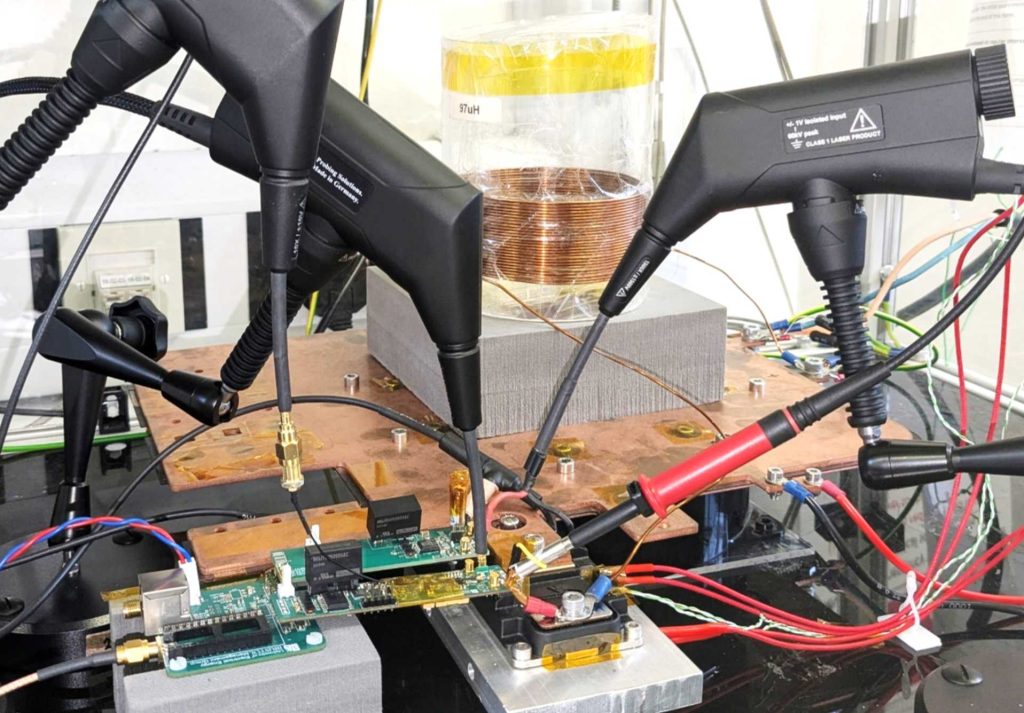
The approach uses a three-step switching sequence, delivered by a custom-built driver capable of very fast, high-current pulses. While the hardware is capable, the way it is used is intentionally straightforward: once configured, it operates open loop, much like a standard driver.
The findings
The approach was evaluated using both standard pulsed current tests and a faster method that creates pulses of increasing current up to the maximum power converter rating. This multi-pulse test allowed the assessment of performance across the full current cycle.
Compared to a very fast conventional setting, the new approach reduced voltage overshoot, improving safety margins. Compared to a more conservative setting, it reduced switching losses by over 20% for the same voltage limits.
Importantly, this performance improvement held across the full current range, without needing to change settings.
Why this matters
For electric vehicles, improvements in switching efficiency translate into reduced energy loss, lower cooling requirements and potentially longer driving range. Just as importantly, solutions that are simple to implement are more likely to be adopted.
This work suggests there is useful space between fully fixed and fully adaptive approaches: a modest increase in driver sophistication can deliver consistent benefits without the overhead of feedback control or multiple configurations.
Working with industry
Project EleVait enabled a set of world-class industry and academic partners to develop key inverter concepts and technologies that will enhance the attributes of JLR electrified vehicles from 2028. The inverter will be optimised for new JLR electric-first architectures and will improve the commercial success of both JLR and the associated UK supply chain.
Looking ahead
As electric vehicle systems continue to evolve, there is a growing need for solutions that are not only effective, but also practical to deploy. By simplifying how switching behaviour is controlled, without reverting to the compromises of conventional approaches, this work offers one possible path forward. The Advanced Propulsion Centre UK is now exploring the temperature and voltage ranges to find a gate driving method that extends to the entire operating range.
For more articles like this, visit our Innovation channel