

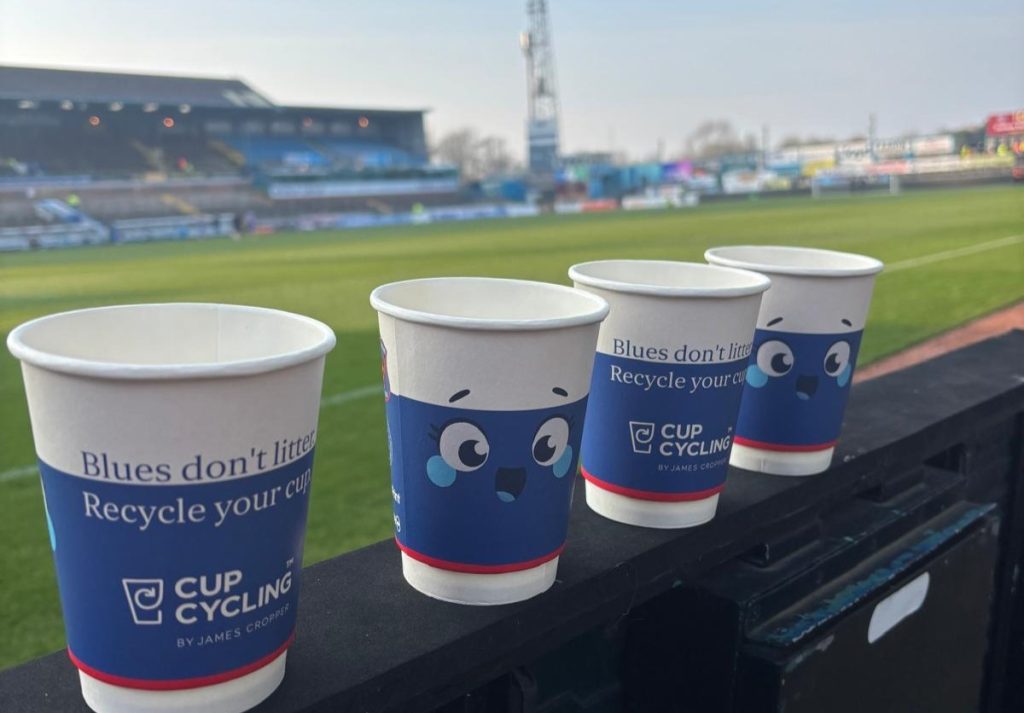
British papermaker James Cropper is supporting a new collaborative initiative with Little Coffee Cup and Carlisle United Football Club to demonstrate how used coffee cups can be collected, recycled and reintroduced into the paper supply chain through a coordinated, real-world system.
The project builds on the launch of Little Coffee Cup’s Big Surprise, a children’s book produced using paper made from recycled coffee cups via James Cropper’s CupCycling™ process. It now extends beyond the book into a live environment, with cup collection and recycling activities taking place at Carlisle United’s Brunton Park stadium.
Over the next four home fixtures, used cups will be collected and stored within the stadium, supported by North West Recycling (NWR) in partnership with Little Coffee Cup author Hayley Slack. The pilot aims to connect consumer behaviour with circular infrastructure, while raising awareness of recycling practices among fans.
A network of partners has been brought together to enable a closed-loop system. co-cr8 has supplied branded collection bins for use around the stadium, while CupPrint has produced a bespoke batch of PE-lined paper cups used during matches. These are distributed by John Watt and Son, Carlisle United’s catering and beverage partner. NWR will oversee the collection and baling of used cups, tracking volumes throughout the season to assess participation and recovery rates.
Once collected, the cups will be transported by co-cr8 into the recycling stream, where James Cropper will process the material using its CupCycling™ technology. The recovered fibre will then be used to manufacture paper for future Little Coffee Cup products, creating a continuous material loop.
CupCycling™ is designed to recover fibre from PE-lined paper cups, which are traditionally difficult to recycle. While the facility has the capacity to process up to 700 million cups annually, current volumes sit at around 58 million, highlighting the gap between available recycling infrastructure and consumer participation.
Hayley Slack said the initiative demonstrates how coordinated action across supply chains, supported by community engagement, can improve material recovery. “By linking storytelling with infrastructure and local partnerships, the project illustrates how circularity can be embedded not only in products, but in the systems that support them,” she said.
Stephanie Walker, head of technical at James Cropper, added that regional partnerships are key to advancing circular economy principles.
“By combining local expertise, venue-based collection and specialist recycling capability, the project provides a tangible example of how materials can be captured, processed and reintroduced into manufacturing cycles within a defined geographic ecosystem.”
– Stephanie Walker, head of technical at James Cropper
As pressure grows to address the environmental impact of single-use materials, the initiative offers a practical example of how circular systems can be deployed in everyday settings, bringing together industry, infrastructure and community participation in a live environment.
For more articles like this, visit our Sustainability channel