In this exclusive op-ed for The Manufacturer, MISUMI Americas’ Dave Evans examines why record levels of investment and a resurgent PMI are masking a more complex reality for U.S. manufacturing, arguing that the industry’s biggest challenge is no longer capital or demand, but whether it can build the skilled workforce needed to sustain long-term growth.
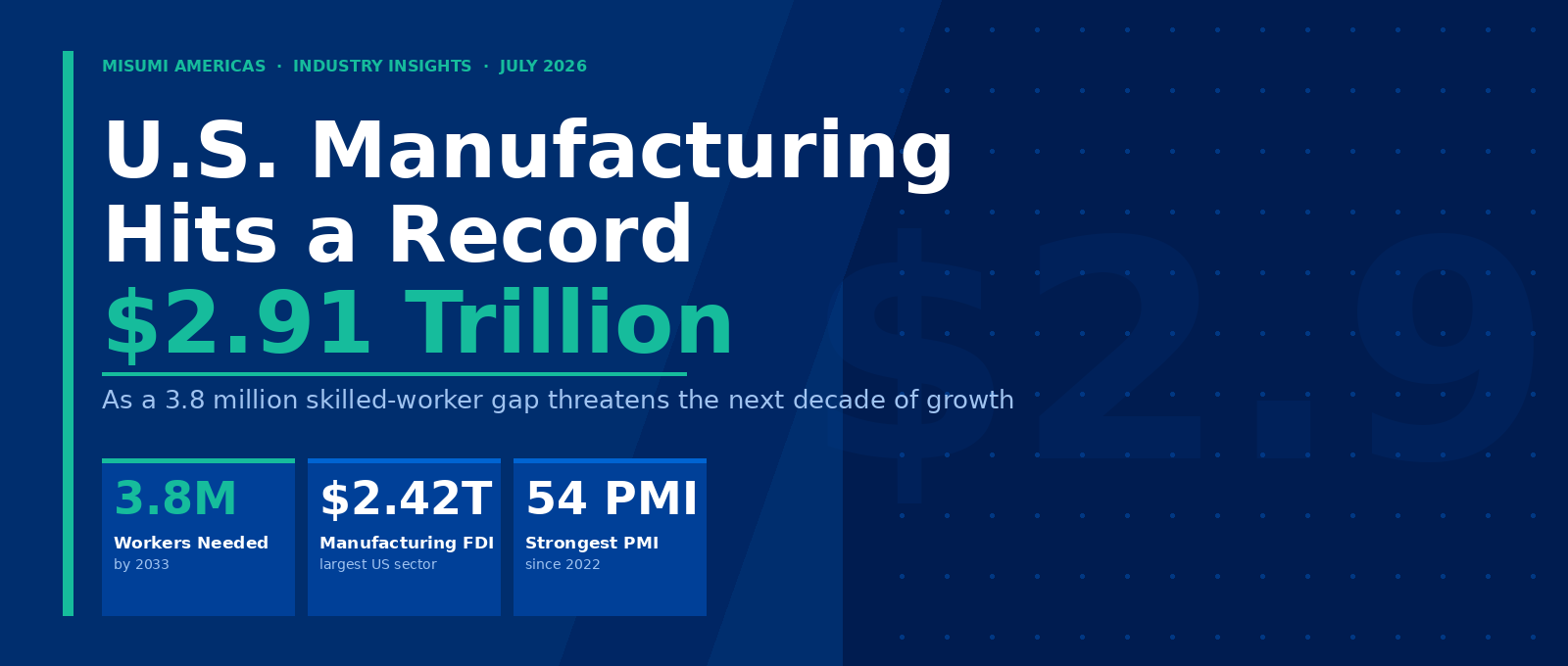
The headline numbers from May look strong. U.S. manufacturing value added reached $2.91tn in 2024, a record in nominal terms. Factory construction spending, even after moderating from its 2024 peak, remains more than double pre-pandemic levels.
And yet output stalled in May, breaking a four-month run of gains. That tension, where strong signals sit alongside a stumble in actual production, is worth paying attention to, because it reflects something real about where American manufacturing stands right now.
Growth is real. It’s also uneven. The investment story of the past three years has been concentrated. Nearly 88% of reshoring announcements in 2024 were in high or medium-high technology industries, fueled in part by the CHIPS Act and the Inflation Reduction Act. That’s a remarkable shift in the composition of American manufacturing, and it’s genuine.
But flagship investments don’t move the whole base. Smaller and mid-tier manufacturers serving broader industrial markets are navigating a different environment. Tariffs and input cost volatility have made long-range planning harder. Geopolitical uncertainty is forcing sourcing decisions that once optimized purely for cost to now factor in reliability and redundancy. Lead time assumptions that held for years are being revisited from scratch.
The result is a bifurcated landscape. There’s a tier of high-visibility, heavily capitalized projects moving forward with confidence, and a broader industrial base that is more cautious—responsive to each new data point rather than committing to the cycle ahead.
The constraint that capital can’t solve
What’s striking, given the scale of investment, is where manufacturers say the pressure is actually coming from. In survey after survey, attracting and retaining talent ranks as the top business challenge—ahead of supply chain disruption, input costs, and demand uncertainty. There are roughly 409,000 open manufacturing positions in the U.S. right now. The longer-range picture is starker. The industry is projected to need 3.8 million new workers by 2033, and without meaningful intervention, nearly half of those roles could go unfilled.
Some of that demand is net new, i.e., facilities being built or expanded. But the majority, around 2.8 million, is estimated to come from retirements. The industry is trying to grow and to replace itself at the same time. The advanced skills that the new generation of factories will require take years to develop. Institutional knowledge lives only in people’s heads, and if those people leave the workforce without being able to pass it on, it’s lost.
See what’s next for American manufacturing
Join thousands of manufacturing leaders at Smart Manufacturing Week U.S. in Detroit, April 19–22, 2027, and discover the technologies, ideas and connections shaping the future of industry. Register your interest today ⬇️

Why automation investment keeps moving
This is part of why investment in automation and operational efficiency hasn’t slowed despite economic uncertainty; if anything, the uncertainty has reinforced it. When labor is scarce and input costs are volatile, technology that reduces variability and dependence on headcount becomes a hedge as much as a productivity tool. Foreign direct investment in U.S. manufacturing stood at $2.42tn at the end of 2024, more than 42% of all FDI into the country. Japan alone holds an $819bn position—more than any other country invests in any single U.S. industry. Investors making commitments at that scale are looking through the current cycle. Their calculus isn’t about this quarter’s PMI; it’s about whether the U.S. can run these facilities at full capacity over the next two decades.
The operational pressure on the ground aligns with that longer view. Doing more with the workforce you have and building the systems to onboard the workforce you’ll need, is the same problem approached from two different directions.
What the rest of 2026 will likely show
May’s PMI (Purchasing Managers’ Index) came in at 54, the strongest reading since 2022, with new orders, production, and backlogs expanding together for the first time in roughly four years. June eased slightly to 53.3, marking six consecutive months of expansion, though production growth slowed. That gap between the headline number and the sentiment underneath it is telling: the demand environment is real, but manufacturers on the ground are still navigating enough uncertainty that confidence hasn’t fully caught up with the data. Converting demand signals into sustained output growth depends on execution capacity, and execution capacity comes back to people.
The remainder of 2026 will probably look a lot like the pattern we’ve seen this spring: moments of acceleration followed by friction, with the strongest performance in sectors where workforce and automation infrastructure are furthest along. The macro data will be worth watching, but the more telling signal will be whether the pipeline of skilled workers is moving fast enough to match the pipeline of new facilities coming online.
The investment is there. The orders are there. The open question, for this year and the better part of the decade, is whether the workforce can keep pace with both.
About the author
 Dave Evans is the President and CEO of MISUMI Americas and Co-Founder of Fictiv, a global supply chain and manufacturing company for custom mechanical products. Dave is a regular contributor for Fast Company and Forbes, has been featured on NBC News, Nasdaq, TechCrunch, and Discovery, and was named to Forbes 30 Under 30. Dave was the first hire at Ford’s Silicon Valley Innovation Lab and graduated from Stanford University with a B.S. in Mechanical Engineering. Dave is a father, a husband, a builder, and a creator.
Never miss a North American manufacturing story
Sign up for our free weekly North American Manufacturing Digital Briefing to receive the latest industry news, insights and analysis direct to your inbox every Monday.