


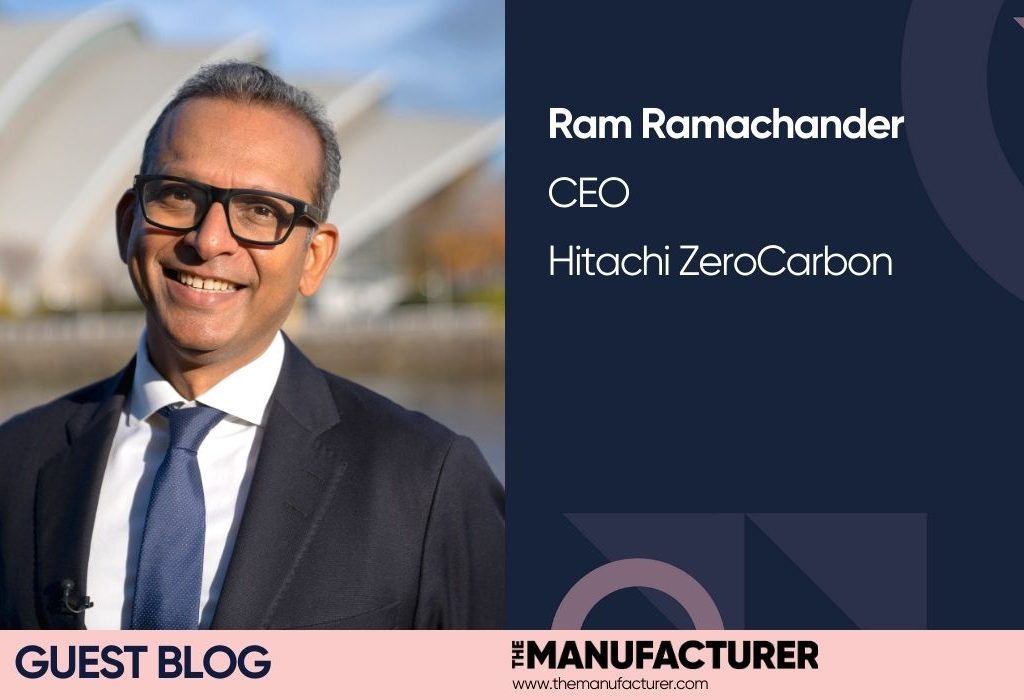
The world is abuzz with AI’s transformative power, but a recent warning from Google’s CEO resonated widely: don’t blindly trust AI. While the public discourse often centres on consumer applications or even health advice, this counsel is exponentially more true for critical industries. For us, AI isn’t just about convenience or entertainment; it’s about the very infrastructure that underpins our lives, our economies, and our safety. Ram Ramachander, Chief Growth Officer (CGO) for Hitachi EMEA and Chief Executive Officer of Hitachi ZeroCarbon explains more.
In the fast-paced world of Silicon Valley, the mantra of ‘move fast and break things’ has long been celebrated. It fosters rapid innovation, certainly. But in manufacturing and critical infrastructure, this ethos is not just irresponsible; it’s frankly dangerous. We are not building apps where a glitch is a minor inconvenience. We are building the physical world – factories, energy grids, rail networks – where an error can lead to catastrophic financial losses, environmental damage, or, in the gravest cases, the loss of human life. Precision, reliability and safety aren’t optional extras; they are non-negotiable fundamentals.
The future of AI in manufacturing isn’t about blind trust or reckless experimentation. It’s about intelligent, disciplined application, augmenting human expertise, not replacing it and securing a competitive future for UK manufacturers by building AI infrastructure that is as robust and reliable as the products they produce. This demands strong partnerships that blend cutting-edge AI with deep operational wisdom.
Ram Ramachander, Chief Growth Officer (CGO), Hitachi EMEA and Chief Executive Officer, Hitachi ZeroCarbon
Yet, we cannot afford to stand still. Global competition demands that UK manufacturers harness the power of AI to drive efficiency, innovation and competitiveness. The question isn’t if we adopt AI, but how we adopt it responsibly, embedding trust and robustness from the outset. We need to move fast, yes, but we can’t break anything.
This is where my experience at the intersection of technology, energy and industry comes into sharp focus. At Hitachi, we stand at a unique confluence. For over a century, our engineering DNA – deeply rooted in a Japanese ‘zero-failure mindset’ – has driven us to build and operate critical infrastructure. We are a global manufacturer, building everything from trains to power grids, and a solutions provider deploying advanced digital technologies. We genuinely ‘eat our own cooking’. This dual heritage gives us a distinct perspective: we understand the agility of the tech world, but we also live by the unwavering rigour of engineering.
We see our role as the essential human interpreter, bridging these two worlds. We combine software’s forward-thinking potential with the precise, reliable demands of the physical world. This means embracing advanced AI, but only through a lens of meticulous validation, stringent governance and an absolute commitment to safety. We don’t just develop these systems; we deploy and test them within our own complex industrial operations, proving their real-world value and resilience.
So, how can manufacturers, especially those with established ‘brownfield’ operations, adopt AI today without compromising their core principles?
- Start with outcomes, not hype: Don’t chase the latest AI trend. Instead, pinpoint concrete, measurable challenges: reduced downtime, improved quality, faster throughput, enhanced safety. Let these business problems guide your AI pilots.
- Build a unified data foundation: The true power of industrial AI lies in its ability to connect and contextualise data across your entire operation – from PLM and MES to SCADA and ERP. You don’t need to rip out existing systems. A flexible, vendor-agnostic data layer, like Hitachi’s Lumada platform, acts as the nervous system, normalising disparate information and making it AI-ready. This accelerates deployment from months to weeks.
- Co-create with your experts: AI is a powerful tool, but it’s not a magic wand. The most impactful solutions emerge from deep collaboration between AI specialists and your domain experts – the engineers, the technicians, the operators who understand your processes intimately. Co-creation with customers and partners is a core part of Hitachi’s business philosophy, especially in digital transformation and AI deployment. There are so many factors to consider – and the right solutions for your business need to be tailored to answer your own challenges.
- Design for efficiency and governance from day one: Industrial AI can be compute-intensive. Measure the energy footprint of your AI workloads and design for efficiency, processing at the edge where appropriate. Equally, robust governance – transparent provenance, rigorous versioning, and continuous auditability – is non-negotiable. Safety and security aren’t afterthoughts; they are built-in.
- Plan for repeatability: Success in one pilot is great, but true transformation comes from scaling. Develop templates and playbooks that allow you to replicate successful AI solutions across your other facilities and processes.

The future of AI in manufacturing isn’t about blind trust or reckless experimentation. It’s about intelligent, disciplined application. It’s about augmenting human expertise, not replacing it. It’s about securing a competitive future for UK manufacturers by building AI infrastructure that is as robust and reliable as the products they produce. This demands strong partnerships that blend cutting-edge AI with deep operational wisdom.
The manufacturers who thrive in the coming decade will be those who recognise that Industrial AI is fundamentally different from consumer AI. They will understand that in critical infrastructure and manufacturing, there are no second chances to get safety right, no do-overs when quality fails, and no tolerance for systems that can’t be trusted. Hitachi is committed to helping UK manufacturers get it right the first time, every time.
For more articles like this, visit our Industrial Data & AI channel