

The government agency for skills training is using this year’s A-level and T level results day (13 August) to urge businesses to consider apprenticeships and T Level industry placements as a way of developing the skilled workforce they need.
Skills England said demand for apprenticeship places too often outstrips supply, despite the benefits that apprentices can bring to businesses. It is encouraging employers across the country to recruit young people receiving their results and to offer T Level students industry placements.

Phil Smith, Chair of Skills England and former Cisco UK and Ireland CEO and chairman, said apprenticeships could provide young people with a route into careers while helping employers develop the skills they need.
“Thousands of young people receiving their exam results will be weighing up their next steps and apprenticeships are a fantastic option. I want to take this opportunity to urge as many businesses as possible to take them on as apprentices, so they earn as they learn vital new skills that will launch them into exciting careers,” Smith said.
Smith also highlighted the potential productivity benefits for employers, with Skills England citing an estimated annual gain of up to £18,000 per apprentice.
“Businesses of all sizes see huge benefits from training up the workforce of tomorrow,” he said, adding that apprentices and T Level students can bring “energy, fresh perspectives and willingness to learn” to organisations.
He said skilled staff are more productive and that apprenticeships also give employers an opportunity to embed employees into their company culture and build loyalty.
Apprenticeships deliver skills and productivity gains
Figures provided by Skills England suggest that employers are broadly positive about their apprenticeship programmes. Indeed, some 83% of companies surveyed said they were satisfied with their apprenticeship programme, while 86% said apprenticeships had developed skills relevant to their organisation. A further 77% reported improved productivity.
Among apprentices who complete their programmes, 94% go into work or further training. Meanwhile, 86% of surveyed apprentices said they were satisfied with their apprenticeship and 88% said their career prospects had improved since starting. The figures come as manufacturers and other employers continue to face challenges in recruiting people with the technical and digital capabilities needed to support future growth.
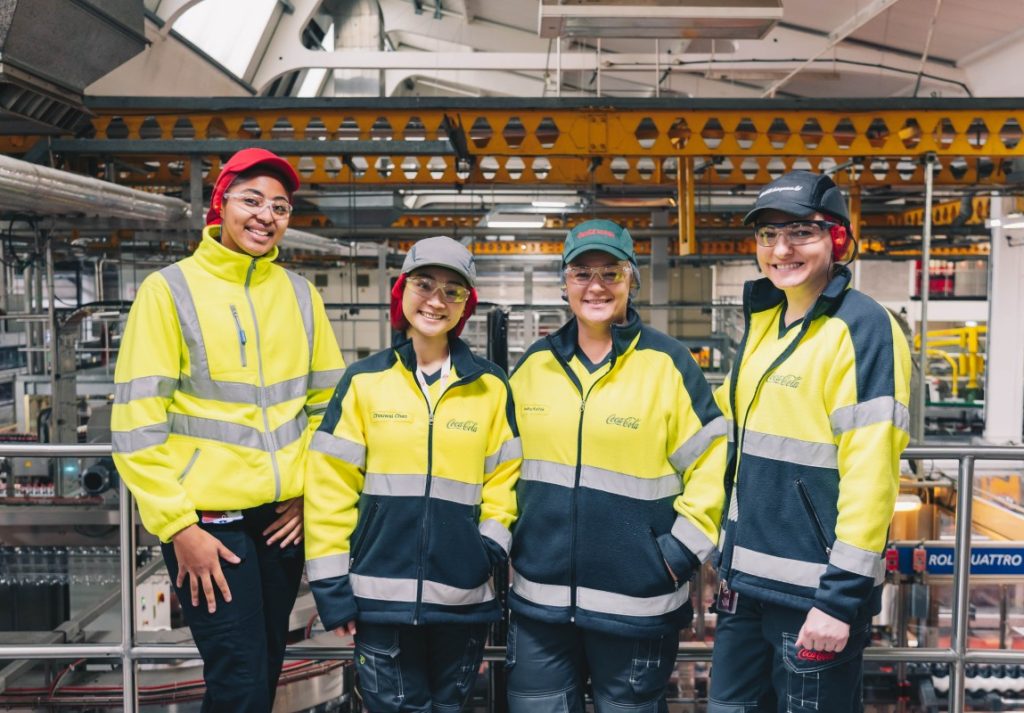
Case studies supplied by Skills England illustrate how employers are using apprenticeships not simply as an entry route for young people, but as a means of developing their own future workforce. At Coca-Cola Europacific Partners, for example, around 100 of the company’s 3,500 employees are currently apprentices, with a further 16 apprentices due to join this year.

Sharon Blyfield OBE, Head of Early Careers and Apprenticeships at Coca-Cola Europacific Partners, said the company’s approach was based on developing people with the specific capabilities it needs.
“We hire to retain. We know the skills and capabilities we’re trying to build – we can’t just go out and recruit those people. But with apprenticeships, we can grow and develop people in the way the business needs. Our apprentices fast-track within the organisation faster than a new hire because they’ve done all that groundwork. When engineering vacancies come up and apprentices are due to come off programme, it’s the apprentices who fill those roles – straightaway that’s a cost saving, and it’s supporting succession planning,” Blyfield said.
The company said apprentices can move rapidly into permanent roles once they complete their programmes, helping it address engineering vacancies while supporting succession planning.
T Levels offer another route into industry
Skills England is also encouraging businesses to offer placements to students taking T Levels. The qualifications combine classroom learning with at least 315 hours – approximately 45 days – of industry placement. Skills England said they are designed to give young people the knowledge and practical experience needed for skilled employment, further study or a higher apprenticeship.
One T Level is roughly equivalent in size to three A levels, with qualifications awarded UCAS points in line with A levels. Around a quarter of T Level students who progress into work secure jobs with their industry placement employer, according to Skills England. For employers, the agency said placements can provide a way to refresh their workforce and address skills shortages while bringing new ideas and perspectives into the organisation.
Lloyds Banking Group, a leading supporter of T levels since their introduction, has expanded its T Level programme from six placements in 2022 to more than 100 placements annually over the past three years. Around half of its T Level students have subsequently progressed into permanent roles with the organisation, demonstrating the programme’s value as a pathway into employment.
The bottom line is the next generation of skilled workers will need opportunities to enter industry, and businesses themselves stand to benefit from creating them, making apprenticeships and T Level industry placements a win-win for everyone.
For more articles like this, visit our Skills channel