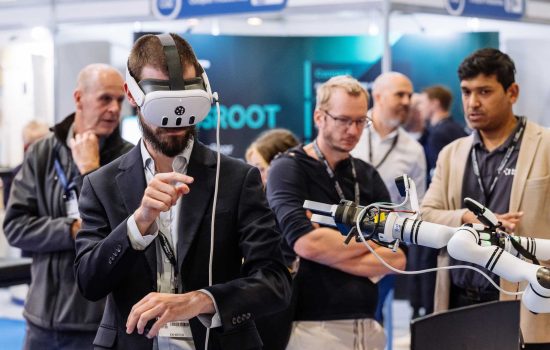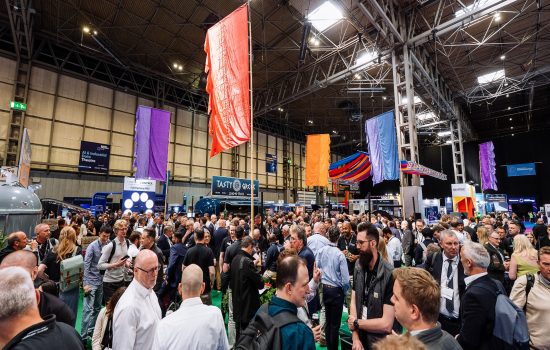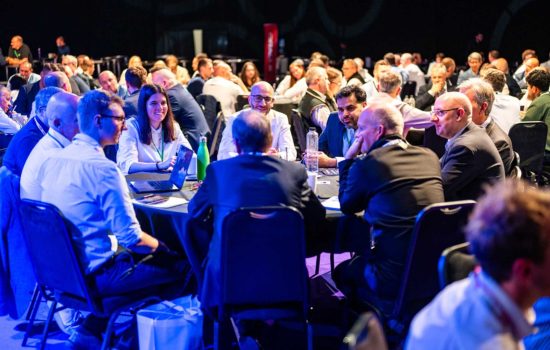
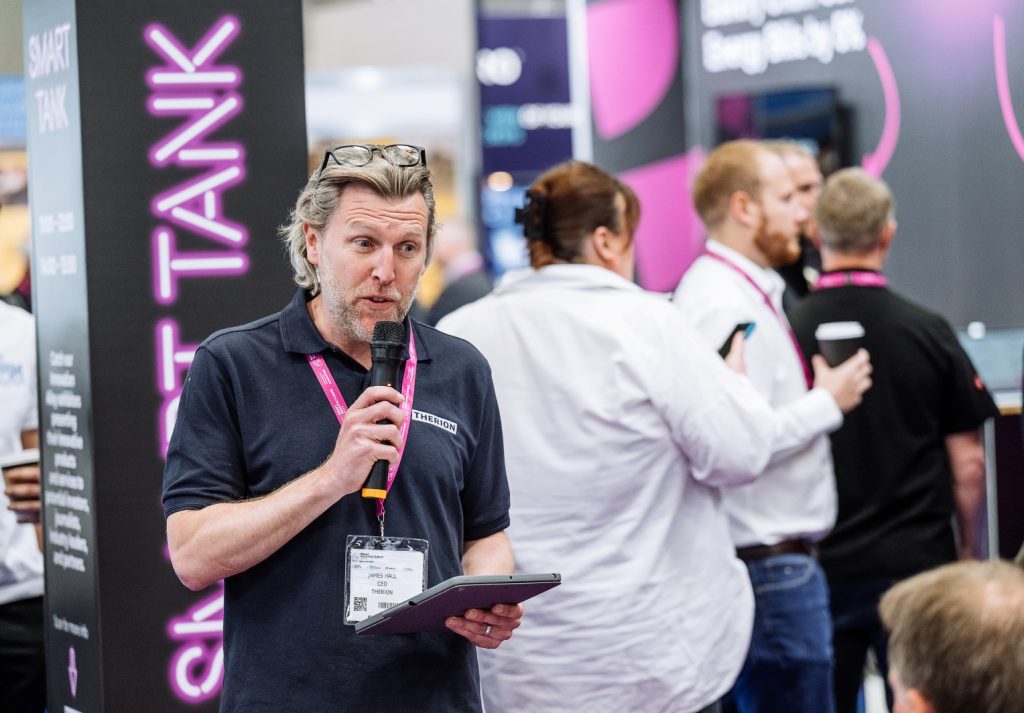
Smart Manufacturing Week 2026, taking place at the NEC in Birmingham on 3-4 June, will also see the return of the Smart Tank feature, an exciting platform for entrepreneurs to pitch business ideas and product concepts to a panel of industry experts, designed to nurture and accelerate innovation.
Smart Tank injects the excitement of the start-up environment onto the expo floor, where exhibitors in Innovation Alley will pitch their ideas to a live audience and a panel of expert judges.
Designed to be fast-paced, engaging, and filled with innovative ideas, Smart Tank offers emerging companies an opportunity to present their vision directly to investors, academics, industry influencers, the media and the show audience.
Smart Tank’s winners walk away with a prize package designed to supercharge their growth, alongside a complimentary exhibitor space at next year’s event. The winners will also gain access to a mentor, direct introductions to investors, coverage from the press and free online advertising with both Smart Manufacturing Week and The Manufacturer.
We caught up with two such winners from last year’s event to find out more about them.
Logidot
Dr. Niccolò Corsini, Founder and CEO, Logidot.
LOGIDOT creates a digital twin of a warehouse, factory or operations by digitally connecting and tracking its mobile assets.
Logidot’s solution consists of a cloud platform and sensors that can be placed on assets (or worn by an operator) to detect hazardous behaviour and noncompliance in industrial environments. Automated alerts, reports and analytics help feed this information into continuous improvement of operations and operator training. Founder and CEO, Dr. Niccolò Corsini, picks up the story.
Can you provide some background into Logidot?
My passion for manufacturing was born out of a childhood trip to see a biscuit and chocolate factory my father was running.
And my passion for technology and industry is what led me to start Logidot, which, in a nutshell, creates a digital twin of a warehouse, factory or operations by digitally connecting and tracking its mobile assets – forklifts, tools, stock, robots – everything that moves inside as well as outside of a site.
It then orchestrates all the material handling operations in real time. We do that by combining uniquely low cost plug-and-play and high-performance location tracking sensors with an AIbased intelligence platform.
This gives managers and operatives actionable data to continuously improve performance to make the factory smarter.
What problems does the Logidot solution solve?
The core issue that we address is the lack of real time visibility in industrial sites and the lack of intelligence that would bring them into an optimal flow.
While we’re used to using GPS in our daily lives, there’s no real equivalent in an industrial environment. And so this lack of visibility is what causes a lot of operational inefficiencies, quality and safety issues, and ultimately, operational waste. I’ve always wondered why we couldn’t use tech such as GPS or mobile apps to solve these problems.
While I was studying for my PhD, I dug a little deeper and realised that existing technologies were either inaccurate, expensive or difficult to use – hence why they were not widely adopted by industry.
At Logidot, we’ve developed a tracking solution that is truly plug-and-play, scalable and can be installed – fully wirelessly, without expert skills and with minimal disruption to operations – in a matter of days, without sacrificing the performance or breaking the bank.
It hits the sweet spot in terms of the ease of use, accuracy and costs, to really make it more accessible to operators, whether they are a small warehouse or a big factory. The cost of downtime in factory environments is extremely high, so new technology needs to be installed very quickly with minimal disruption, because manufacturers don’t have the luxury of halting operations for a week while new technology is deployed.
That’s effectively what our solution does. And, not only can it be installed very quickly without cabling, it can calibrate itself without the need for excessive intervention. So it can be rolled out at a much lower cost, without compromising the high accuracy and robustness that is required in these environments.
What are some of the main use cases for the Logidot solution?
One very common use case is tracking forklifts, both inside the warehouse as well as in production. We can track their location and movement, but also those of the pallets that are being picked up and dropped. We can map their movement which helps end users understand the utilisation of their fleet – are they being managed effectively? Are they being managed safely?
This means we can dynamically optimise their routes, in the same way we as consumers would use certain travel apps. Logidot can figure out where the congestion and traffic might be and find a better route. This helps reduce the distance travelled, as well as the travel on empty.
One of our FMCG clients for example, through better routing and scheduling, have experienced a 20% reduction in idle time, and a 10% increase in pallet throughput. There have also been benefits on the safety side via a reduction in incidents, such as collisions and speeding in pedestrian areas. This has resulted in a payback in less than eight months.
Our solution can work as a standalone system or it can seamlessly integrate into existing factory management systems, and can augment with real time location, process data and intelligence. So it doesn’t just collect location data, it can also use other sensory information, such as environmental conditions and other process signals that are then leveraged to make decisions and actions on the shopfloor. So, by combining real time tracking with AI-based intelligence, Logidot gives managers and operatives the data to continuously improve performance.
The plug-and-play nature of the solution means we can acquire data on existing operational bottlenecks very quickly, which gives managers the opportunity to continuously improve performance and take remedial actions.
On top of that, we also have a simulator which uses the collected data to understand different scenarios and how they would impact performance. So before any change or technology is implemented, its impact can be simulated so users can better understand whether it would make sense from a business standpoint. All of that then feeds into better planning, but also improved training of staff and allocation of resources.
What does the Logidot customer journey look like?
We usually conduct a phased deployment and typically start with the installation of wireless sensors and configuration of a standalone platform. This gives customers rapid visibility into the operations and actual data of their operations to improve efficiency, safety and sustainability across a variety of use cases.
For longer installations, we also have the option of wiring the sensors and connecting them to the main power supply so that they last for many years. But in order to derive the full benefit, many customers also want to integrate the Logidot solution into their existing systems, whether that’s ERPs, WMS or MES. And doing that helps augment their systems with location awareness and intelligence.
Customers can also leverage our AI assistant where we can build an operational knowledge repository that effectively allows the customer to upload the company-specific documentation – SOPs, training manuals, health and safety procedures, etc. The AI assistant then leverages that knowledge to give very specific responses and insights to the users, whether they are operatives or managers.
And we can fine tune this, depending on the needs of the customer, with the goal of making the system feel as native as possible to the operator.
We are conducting user testing on our AI-Assistant based learning tool are looking for operators (managers, frontline workers, planners/continuous improvement) who would be willing to give a brief interview. You can book a slot directly by contacting Logidot: info@ logidot.com.
What’s Logidot’s USP?
Our secret sauce comes from the plugand- play, high-performance hardware, which comes with mesh protocols that are robust, low power, very easy to install and deploy, and are combined with physical AI algorithms.
So we’ve designed a system that’s fully integrated, from collecting data right up to the recommendations to the end user. Many companies just focus on the hardware or software, but to get the best performance, you need a fully integrated stack.
This combination of proprietary technologies is what gives us a solution that’s leading-edge in terms of asset tracking and optimisation capabilities. If you consider the performance, ease of use and total cost of a system, it has to perform well on all these parameters, regardless of whether it’s a high value manufacturer or a logistics operator that operates on smaller margins.
Experiences of Smart Tank
Smart Tank was really enjoyable. It felt like mini Dragon’s Den and I really liked being bombarded with zero nonsense questions by industry veterans who have seen many businesses before and know what works and what doesn’t. So it was enjoyable having that fast paced interaction. And I enjoyed being challenged like that. – Dr. Niccolò Corsini, Company Founder, CEO.
Taking part and winning the Smart Tank competition was a positive experience for us. We built a good rapport with the panel and because they clearly understood the space in which we are operating, it made it easier to explain our pitch and have insightful conversations about the value of our solution. – Keith Galant, Director, Uie.
Uie
Keith Gallant, Director, Uie.
THE MONITURE solutions allows engineers to monitor the temperature of joints and contactors, minute-by-minute, recording far greater amounts of information from their machines. That’s why Moniture stands out. It offers batteryless, wireless monitoring of temperatures within electrical components.
Uie as a business aims to understand machinery problems and create innovative solutions on how industry can monitor the health of the machinery, while improving the engineering and maintenance practices for equipment reliability. Keith Galant, Director at Uie (understand, innovate, elevate) explains more.
At Smart Tank you showcased the Moniture sensor. What problem was the sensor designed to solve for critical electrical infrastructure?
The problem is that in settings that incorporate high voltages inside the electrical panels, workers are not able open the panels and use thermal imaging cameras to check the temperature or condition of the electrical components.
One solution is to install windows – either polymer or crystal – in the doors but this is prohibitive in some instances. This creates an issue around how to monitor the condition of electrical components.
We looked at the sensor technology that was currently available and put together the Moniture system, which is essentially an energy harvesting sensor. Moniture is fitted onto the electrical component and if it’s an AC component over six amps, it will induce power into the sensor wirelessly. This then creates enough power to record the temperature every minute and transmit that wirelessly through the electrical panel -through concrete buildings up to approximately 150–200m away.
This allows laboratories to monitor the temperature of joints and contactors, minute-by-minute, recording far greater amounts of information from their machines. Being able to compare the real time data allows them to also predict problems before they arise.
Real-time temperature monitoring is key to predictive maintenance. Can you share a specific use case that illustrates the return on investment (ROI)?
We installed a system for a customer that was experiencing repeat failures on an inverter drive which had problems with temperature and load balancing.
The system allowed them to monitor the temperature on the inverter, so if the load and the temperature increased, the company could make changes to the process environment to reduce the load on the inverter and the fan that was running.
In cost terms, the inverter wear is greatly reduced; these cost around £20,000 per module to replace and there’s around six modules. With our installation the customer was able to see which inverter was degrading and could plan a repair before any catastrophic event, making the repair cost lower and less frequent.
There is also a saving on process costs. If the system was to fail during a process, then there would be huge losses for every day the system was offline. Our system and installation came at a fraction of that cost.
Beyond the sensor itself, what kind of data does the Moniture system collect? What role does software play in translating the data into an action for the owner of critical components?
Our Moniture sensor speaks wirelessly to a gateway, sending simple data such as serial numbers, temperature and time stamps. The gateway is then able to output data streams from all channels in an industrial PC language such as SCADA. We can configure our gateway to align with the customer’s needs. Some customers want to take that data straight into their own systems and we can give them that option.
We can also provide a cloud software service where we can send data into our own cloud, or the customer’s IoT cloud.
We currently use traditional thresholdbased analytics, but as we can take more data from across a plant, we plan to store it in data lakes and apply more advanced machine learning analytics to identify new opportunities for our customers.
Can you explain the installation and deployment process for a customer integrating Moniture across its facility? What aspects make it scalable for widespread industrial use?
It can be daunting for a customer to try and install our sensors throughout the entirety of its sites, so we first look at the most critical components where failure would have the biggest impact on the plant. Then, we would only add sensors to the failure points on the machine. It is unlikely a business would place them on everything within the plant.
When we first interact with a customer, we would visit the site and carry out a survey. Some businesses are aware of the criticality of their assets, some are not, so we are able to help with raising awareness levels. Then we design the gateway around the needs of the customer, how many points there are and where they are on-site.
Once the installation is made, we help the customer with integration with existing systems, whether they are choosing to host on our platform or their own.
In a rapidly evolving IIoT space, how does Uie view its position relative to other monitoring solutions?
Our main USP is that our sensor is wireless and batteryless, making it completely unique in the marketplace. There currently aren’t any other fixed monitoring systems for electrical points that go to this level of scalability.
This is due to the fact that most others are battery powered or operate via a wired connection. Moniture sensors are selfpowered, have wireless communication, can cover large distances and through materials which we find on industrial sites such as thick concrete and steel piping.
What is your long-term vision for Uie?
Looking ahead, our focus is on building on recent major utility and government contracts, expanding into multi-site deployments and continuing to grow our connected condition monitoring offering as the business scales.
We are experiencing quick growth and as such, are adding analysts and software engineers to our workforce to expand our own technology IP and software.
We want to grow to be the premier condition monitoring company within the UK and Europe, in terms of batteryless technology. Right now, we are well-placed to help the energy industry to understand the condition of assets in real time and manage the systems.
For more stories like this visit our Innovation channel